
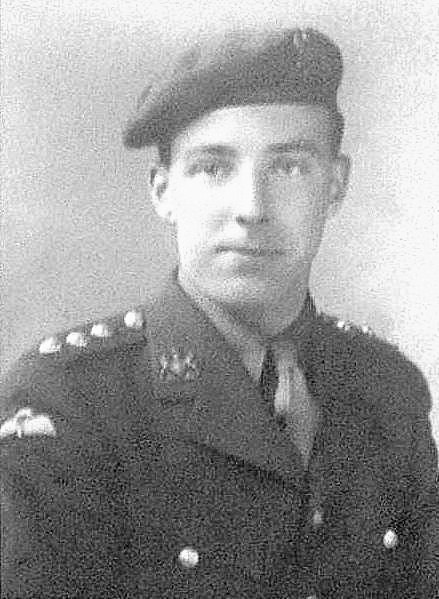
Albert Richards (19 December 1919 – 5 March 1945) was a British war artist. Born in 1919 to a World War I veteran, he enlisted as a sapper in 1940. He later served in the British Army during World War II, both as a paratrooper and as a war artist. He was the youngest of the three British official war artists killed during the conflict
Richards was born in Liverpool but grew up in a working-class household in nearby Wallasey. the son of Hannah Beatty and George Richards, a World War I veteran and wood machinist. The family moved in 1925 to 2a St Bride’s Road, Egremont., Wallasey, subsequently to 14 Queensway, Wallasey where he attended Manor Road School up until the age of eleven. Richards then attended Wallasey Central School up until the age of fifteen. Attending the Wallasey School of Art and Crafts Richards won a scholarship, awarded by the Borough of Wallasey to attend the Royal College of Art (started 9th January 1940) for three months before being conscripted into the Army on 3rd April 1940.
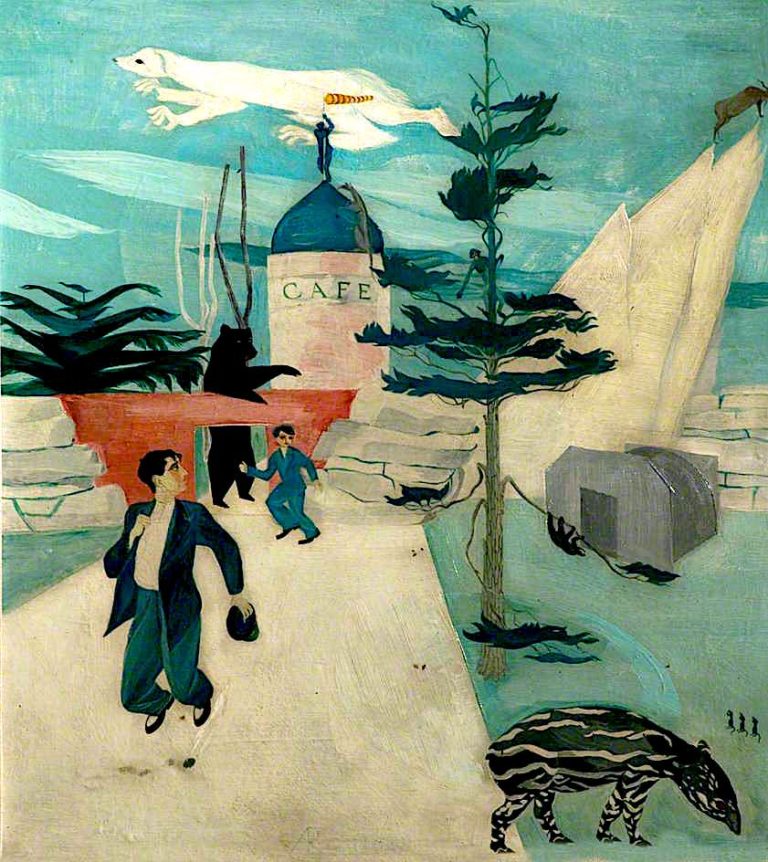


Early works: Escape From the Circus, 1938. The Seven Legends, Self Portrait, 1939. The Process of Time, 1939.
Richards enlisted as a sapper in 286 Field Company, Royal Engineers and was promoted to the rank of Lance Corporal. He served as a sapper from April 1940, assigned to duties such as building barrack huts and defence works throughout England and he frequently painted scenes showing these tasks. He submitted several of these paintings to the War Artists’ Advisory Committee, which, impressed with their freshness and quality, began in May 1941, to purchase his artwork. Richards received 15 guineas for a painting in September 1941.
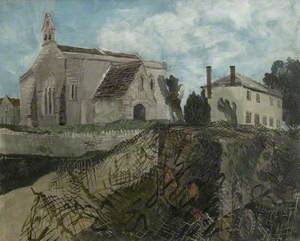

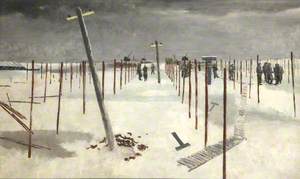
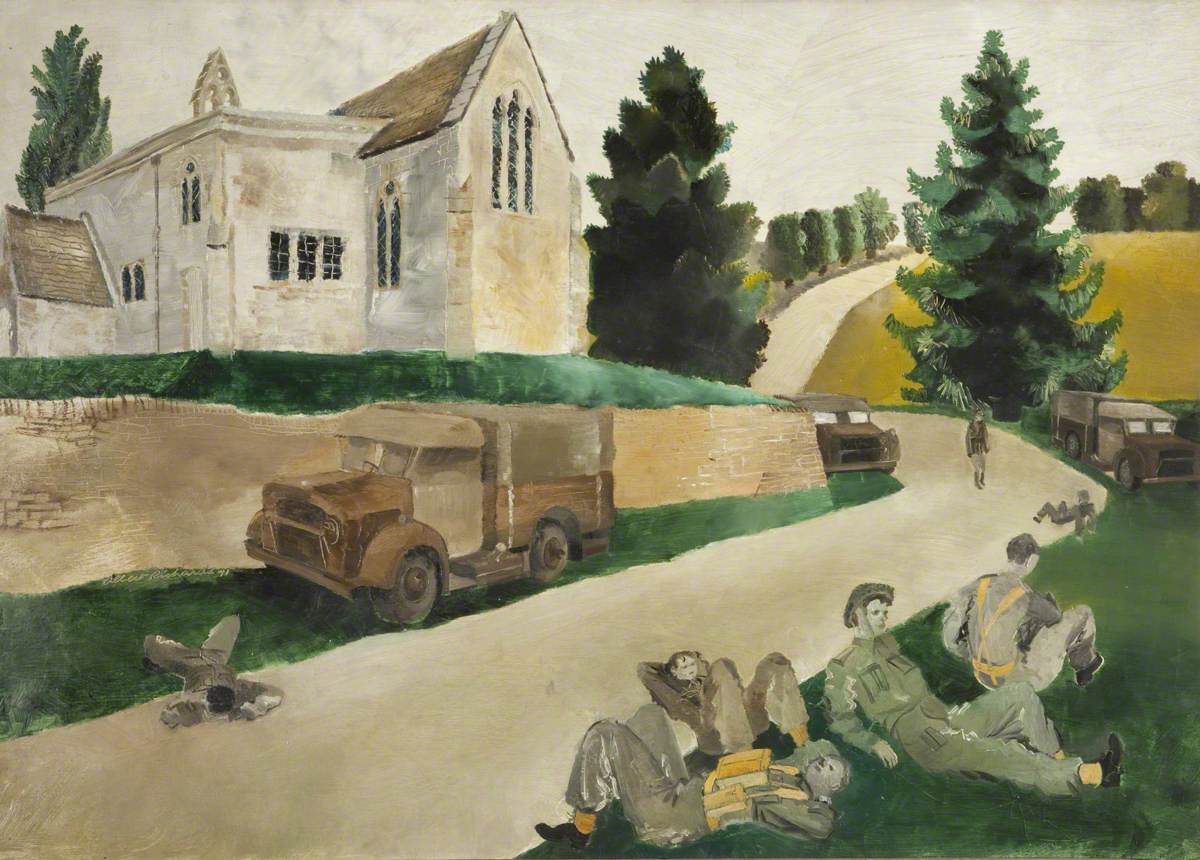
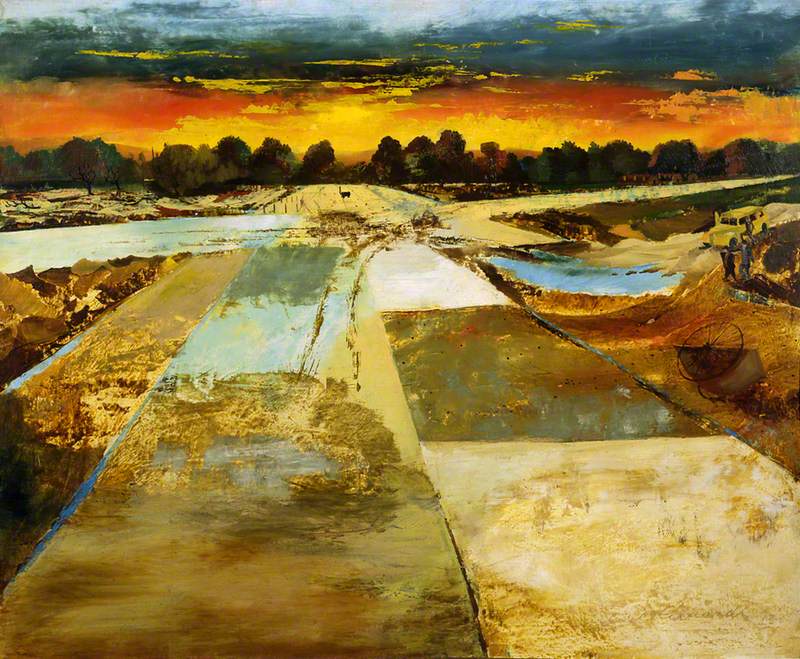
Inglesham Church and Rectory, 1939. Building a Hutted Camp in Essex. Sappers Erecting Pickets in the Snow, 1941. The Minute Halt. Take Off and Landing Field – This work was the last Richards painted as a sapper (a military engineer) submitted to the War Artists Advisory Committee in September 1943.
In 1942 he escaped the tedium of sapper work by becoming a parachutist with 391 (Antrim) Parachute squadron. He underwent training at the No.1 Parachute Training School at RAF Ringway, near Manchester, He depicted this training in several paintings such as Kilkenny’s Circus and Parachute Training over Tatton Park. In September 1943 Richards was offered a three-month contract by WAAC, he reluctantly declined, not wishing to risk his present work in the Parachute Regiment, which he found both enjoyable and artistically inspiring.

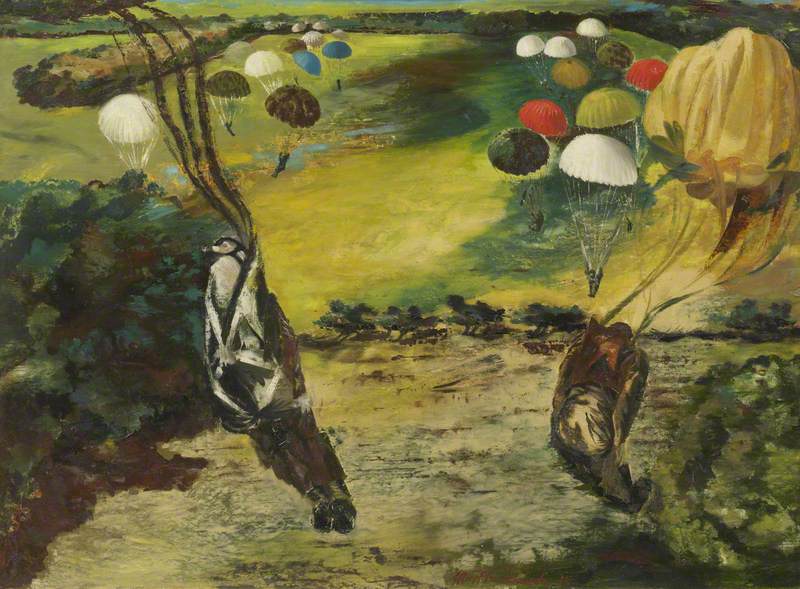
Kilkenny’s Circus, Parachute Training School Paratroops Undergoing Synthetic Training. Parachute Jump Near Tatton Park.
In December 1943 he accepted his first six-month WAAC commission.
The WAAC bought several more of his pieces and invited him to a meeting. On March 1, 1944, Richards was made Britain’s youngest official war artist and given the honorary rank of captain — the only artist selected from a fighting unit.
Later in the month Richards took part in a large-scale parachute drop over Brize Norton in Oxfordshire, an event he recalled in the painting The Drop. This was in fact a practice exercise for D-Day. Richards took part in a second such event, Operation Mush, over five days in April across Gloucestershire.

The Drop, 1944.
On the night of June 5, at RAF Broadwell in Oxfordshire, he prepared for the biggest day of his life by writing to EC Gregory at the WAAC: “In a few hours’ time I start upon my job as official war artist… and I feel that I will really be fulfilling the task set out to do, to produce paintings of the war and not preparations for it… Tomorrow I shall be in France. The beginning.”
Just after midnight on 6 June he was dropped near Merville to the east of Sword Beach with a unit of the 6th Airborne Division. This was a top-secret mission to take out the powerful German battery guarding Sword Beach, before the armada arrived.
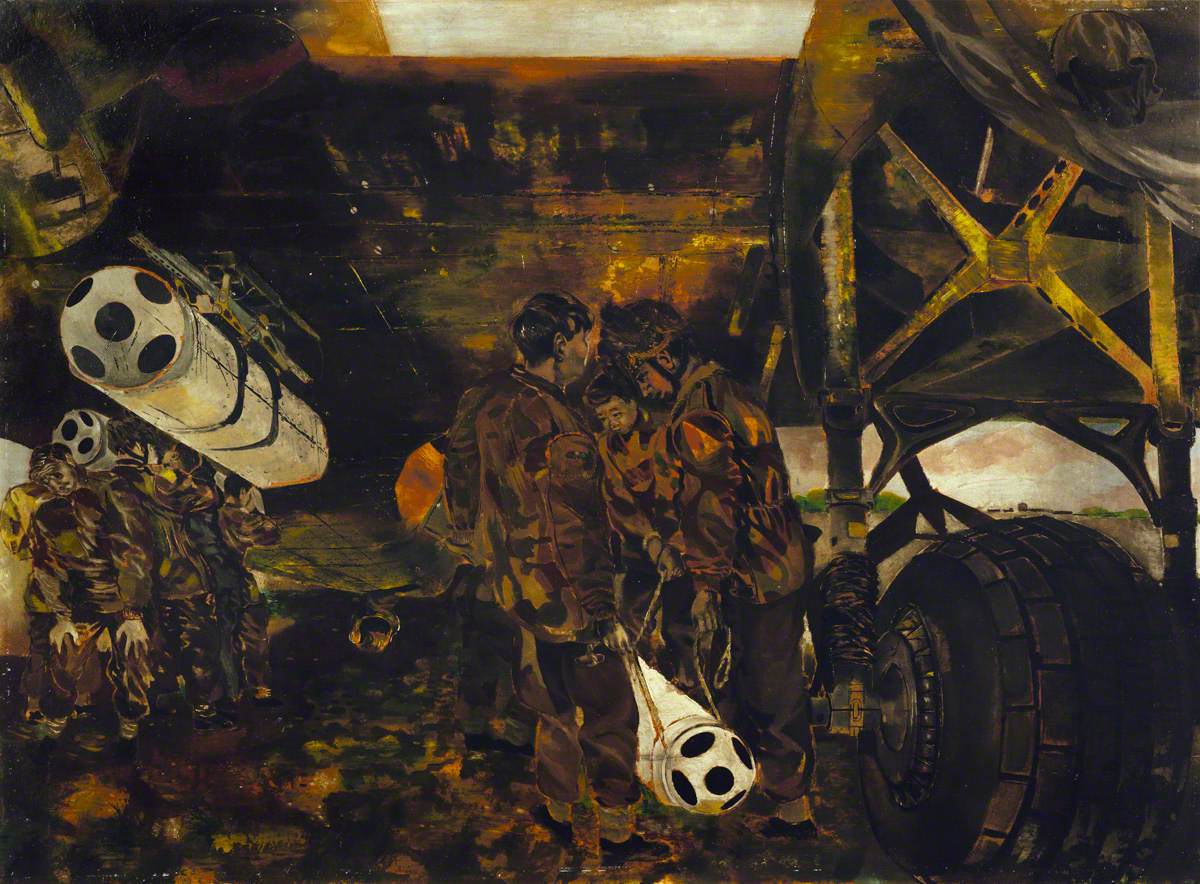
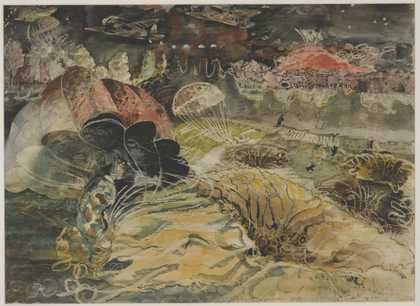


Loading Containers on a Dakota Aircraft. The Landing H Hour minus 6. In the Distance Glow of the Lancasters Bombing Battery to be Attacked. A View of Le Havre. Withdrawing from the Battery after the Battery’s Guns Had Been Destroyed – Jefferson recalled: “He produced a picture that was called Withdrawing from the Battery… and I am there in it, in a bomb crater being attended to by a doctor. As Albert promised, he’d put me in his picture.”
He took part in the attack on the Merville Battery and the capture of Le Plein village. Richards depicted the attack on the gun battery in several paintings composed within a few weeks of D-Day. The mission to take out the Merville Battery on the Normandy coast was almost a complete disaster. Commanding Officer Lt Colonel Terence Otway had 750 men under his command but only 150 made it to the rendezvous. He had no other option but to go for it. Put in charge of a small platoon, Richards played a key role in helping to overpower the German position which, incredibly, was taken in just 15 minutes. Immediately, he set to work with pad and pencils. He spotted Alan Jefferson, an officer he’d roomed with, lying injured. “Don’t move!” he joked and frantically began sketching him.
Richards used watercolours for speed and painted “quite bleak colours and quite angular shapes to convey the horror of war and the destruction of the natural world”.

The Beginning of the Advance, German Bridge Demolition.
Richards continued with the advancing Allied forces through France and, after a brief period of leave in England went on into the Low Countries. In France he painted scenes such as the remains of the gliders used in the attack on Pegasus Bridge at Ranville, destroyed bridges and roadside camouflage screens.
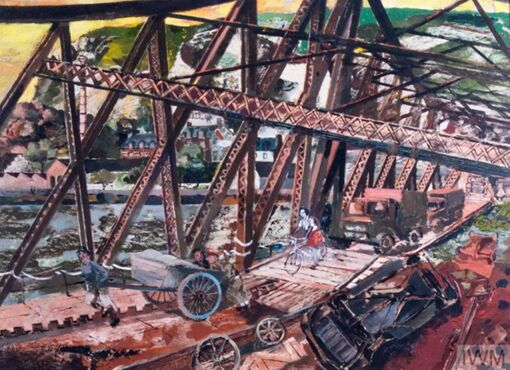
The Break through, ‘Marmalade Bridge’, A Railway Bridge Crossing the River Seine at Rouen
In October 1944, Richard’s work featured prominently in an exhibition at the National Gallery called Wartime Paintings of the Army Air Forces.
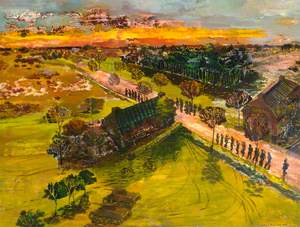


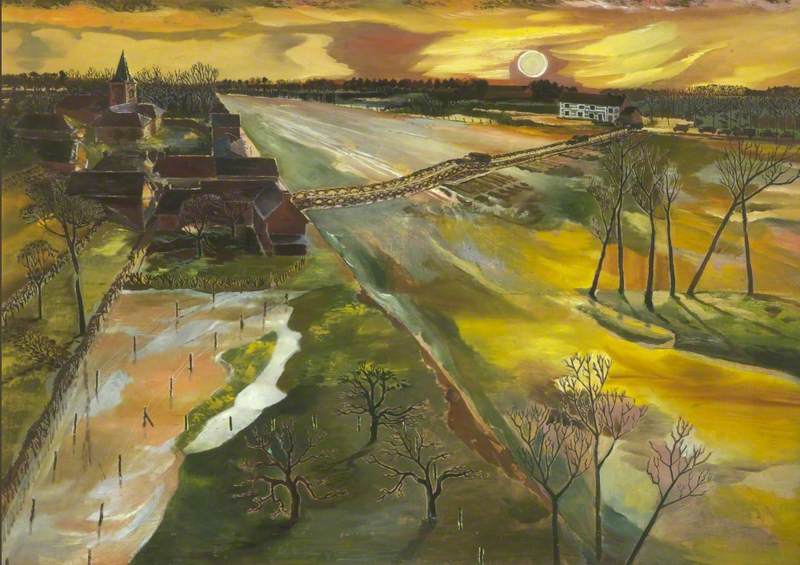
In Holland, Infantry of the 15th (Scottish) Division Taking Over from Hard-Pressed American Troops during a German Counterattack on the Village of Meijel. The Siegfried Line Between Heerlen and Aachen. Cold Holland 1944. Breaking up the Attack, Holland, 25 Pounders of the 15th (Scottish) Division Firing towards Meijel. The Flooded Maas, February 1945.
In January 1945, he recorded the funerals held for the victims of the massacre at Bande in Belgium. One of Richards last pictures, painted in February 1945, shows the bridge at Gennep built by Allied sappers across the flooded River Maas. It was in this area while still in Belgium that Richards was killed on 5 March 1945. Richards set off to paint a night attack by the Allies, but his jeep hit a landmine and he was killed. Another war artist, Anthony Gross, heard from eyewitnesses that Richards had taken a shortcut: “He misunderstood the directions, and they couldn’t do anything about it because it was night-time. Very sad.” He is buried at Milsbeek War Cemetery, near Gennep. At only 25 years old he was the youngest of the War Artists to be killed.
Maurice Collis, the art critic, later said that, through his watercolours, Richards had “achieved a synthesis of modern styles” and had “surpassed his masters… his battle pictures… being dreams of beauty that none of his comrades at the place could in any manner have seen”. Had he lived, Richards might have become one of the great artists of the 20th century.
Ivor Lambe, the War Artist’s Advisory Committee’s Publicity Adviser, drew up a letter which was distributed to press editors, about Richards’s life and death, and promoted an exhibition of his work which was held at the National Gallery in April 1945.
As far as I know there is no biography re Albert Richards and little information in other publications. I cannot lay claim to originality for this article which I have cobbled together from a number of sources. https://en.wikipedia.org/wiki/Albert_Richards_(artist) was a starting point and the Imperial War Museum website also helped. A welcome chunk of the information here came from ‘The Sketchbook War’ by Richard Knott ISBN-13 : 978-0750956154. Whatever, I do hope that this talented artist so tragically lost to us will find an appreciative audience of new admirers.
Graham Bennison July 2024. https://www.facebook.com/BennisonArtist
 Artistic Horizons
Beautifully told story of an amazingly talented artist. Thank you Graham.
LikeLiked by 1 person
Thanks Jenny. X
LikeLike
Hi Graham
Great to see that Albert has another champion! I have been researching his life and work ever since I made the documentary “Hidden Paintings of the North West” for the BBC in 2011.
https://www.youtube.com/watch?v=pJ7NOkUVAys
It featured our only Richards ‘expert’, Allen Freer, who sadly passed away last year. He very kindly sent me lots of information while he was still well enough.
I’d be very happy to talk further if you’d like to.
Best wishes,
Ged Clarke
LikeLike