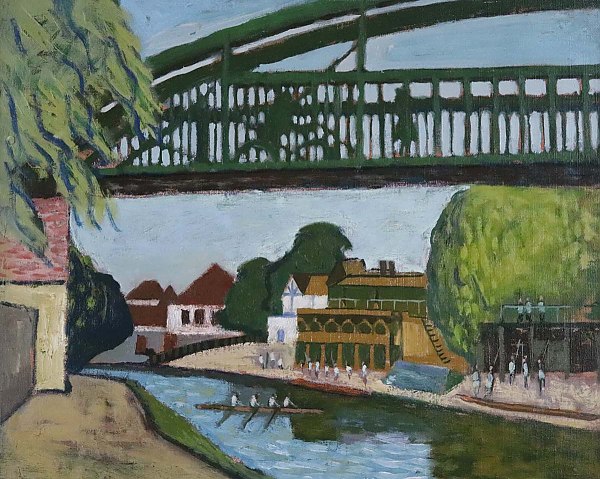
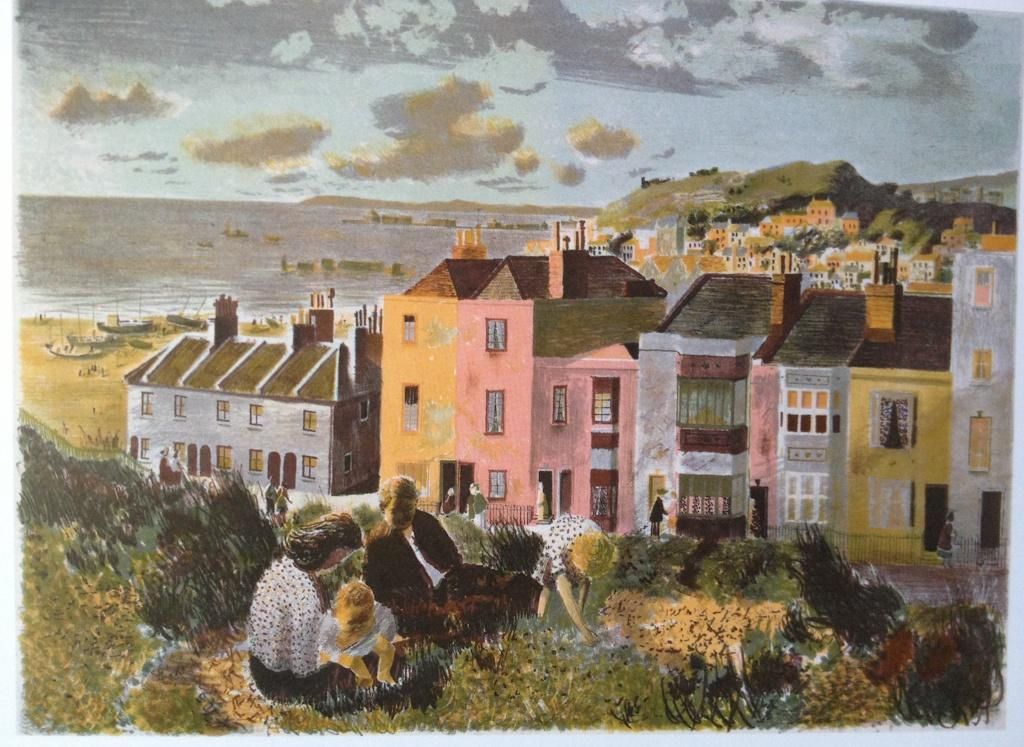
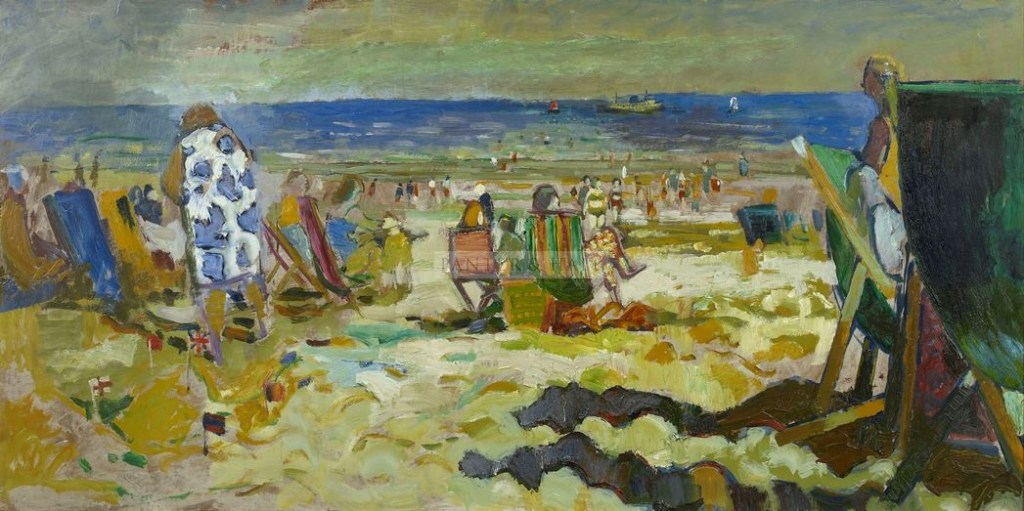
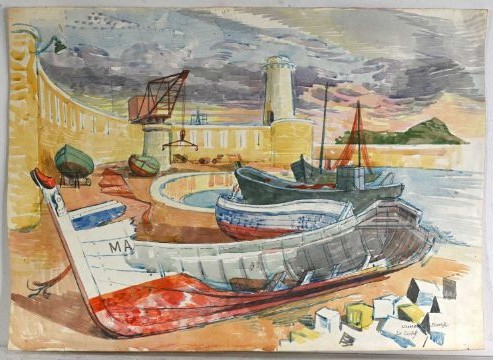
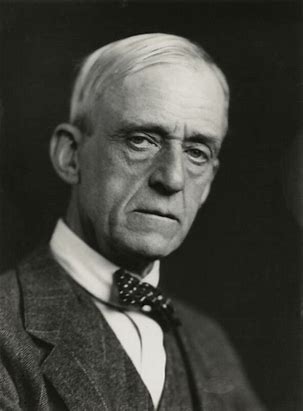
Duffy Ayers

Betty ‘Duffy’ Ayers, artist, born 19 September 1915; died 10 November 2017.

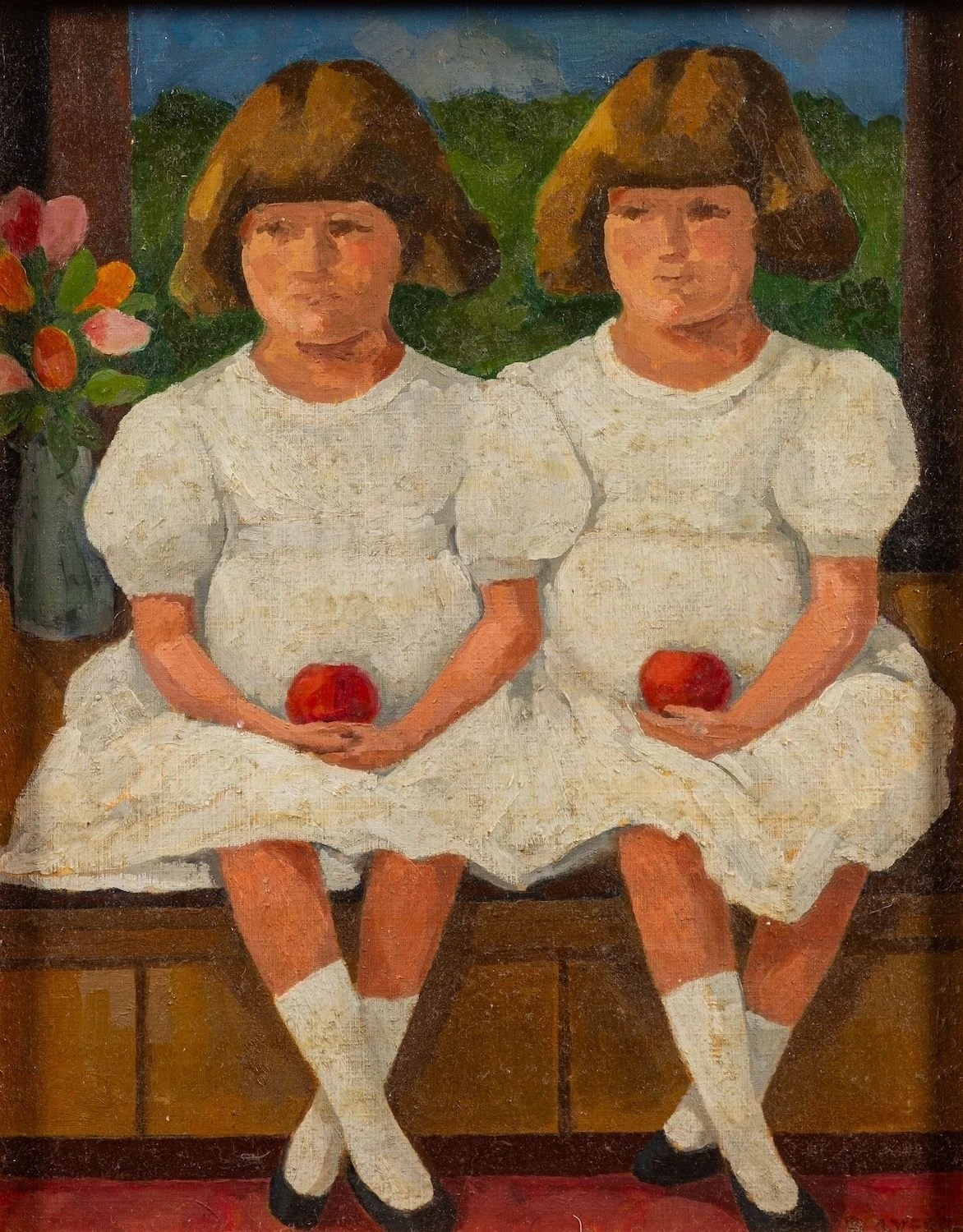
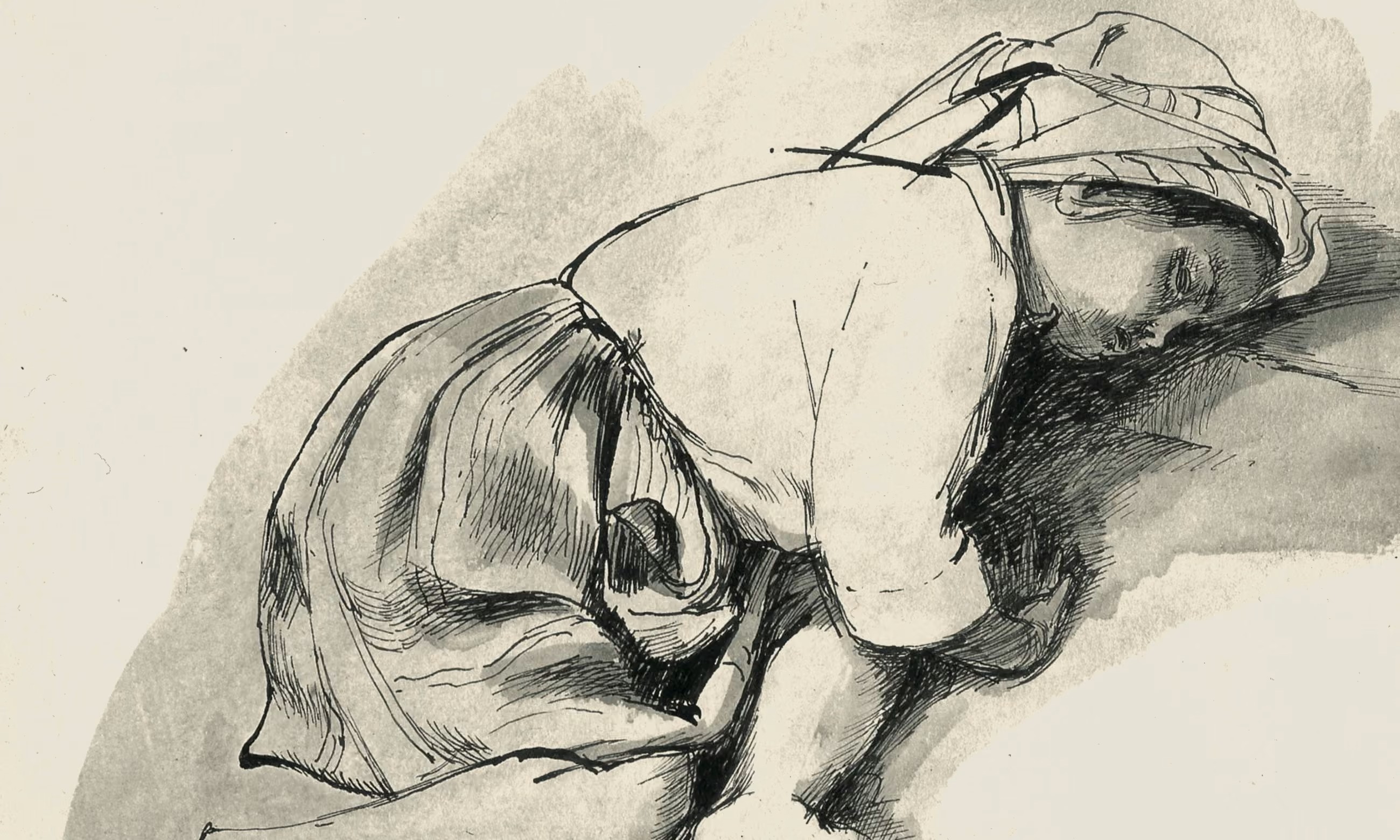
Duffy was born Betty FitzGerald, with an identical twin, Peggy, in Great Missenden, Buckinghamshire. Their father, William FitzGerald, the feckless brother of the Irish nationalist politician and poet Desmond FitzGerald, abandoned the family when the twins were very young. Their American mother, Laura (nee Farlow), felt she had no alternative but to leave her daughters in a convent school on the Kent coast while she went to teach English in Turkey.

While the other pupils went home for their holidays, the FitzGerald girls stayed with the nuns, who treated them, they recalled, with great cruelty and starved them of affection. The girls did not recognise their mother on her return after seven years’ absence. Emotionally, Duffy was deeply scarred by this long childhood experience but it consolidated in her a remarkable stoicism and strength of character, and she was herself the gentlest of women.

Peggy and Duffy.

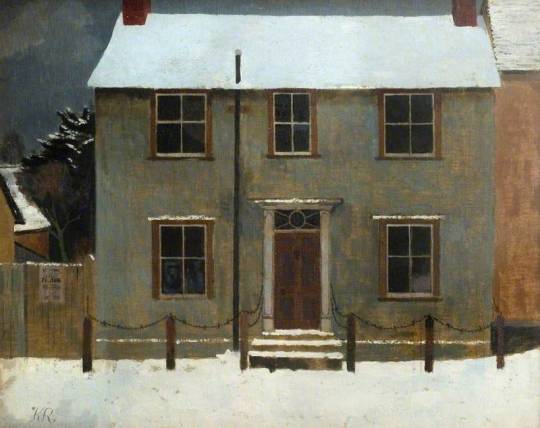
In the early 30s Duffy attended the Central School of Art in London where she met Michael Rothenstein, later to become one of the leading printmaker-artists of his generation. They married in 1936, she 21, and moved to Great Bardfield in 1941. They lived initially in Chapel House (in the grounds of John Aldridge’s Place House) before moving to Ethel House in the High Street.. The north Essex village was home to a distinguished community of artists from the 1930s to the 60s, including Eric Ravilious, Edward Bawden, Tirzah Garwood and John Aldridge.

Duffy’s emergence from the extreme unhappiness of her schooldays no doubt deepened her empathy, during their first years together, with Michael’s slow recovery from the melancholia of myxoedema (arising from a thyroid condition) that had afflicted him throughout his 20s.
Duffy did little of her own work during these years, but she collaborated with Michael on large-scale paintings and later assisted his printmaking. During the second world war she made few paintings of her own but worked at times with the designer Peggy Angus on wallpaper designs.

Later she taught art to the local women of the Women’s Institute proving to be a gifted teacher who encouraged original work of remarkable quality.  During the war she maintained a lively correspondence with Robert Graves, a pre-war friend who was a regular visitor to Great Bardfield now living back at home in Deya, Majorca following an exile during the Spanish Civil War and WW2.

During the war Duffy was almost killed when a bomb fell near a bus she was on. “I escaped because I was on the top floor,” she said.

Duffy and Michael’s son Julian, later founder of Redstone Press, was born in 1948, and daughter, Anne, who became an artist, was born in 1949.

By the mid-50s, Great Bardfield had become famous for its popular Open House exhibitions, initiated in 1951, when several of its artists were employed on murals and design work for the Festival of Britain. For several years, for a summer fortnight, thousands of art lovers descended on the village to traipse through the artists’ houses, delighted by a figurative English modernism that was accessible and stylish, often depicting the life of the village and the landscape around it. During the 40s and early 50s Duffy was a lively presence at the heart of this social and artistic activity. Michael had by this time set up printmaking facilities at Ethel House on the High Street (later enlarged with a studio extension by Frederick Gibberd).

In 1955 Duffy and Michael separated, and they divorced in 1956. Duffy married the graphic artist, Eric Ayers (1921-2001). “He was always waiting in the wings,” she said. Duffy left Great Bardfield, and stopped painting for many years. Following her second marriage, to Eric Ayers, she moved to a Georgian house in Bloomsbury, central London, where she lived for the rest of her life. She showed regularly at the Royal Academy Summer Exhibitions, and in commercial galleries.

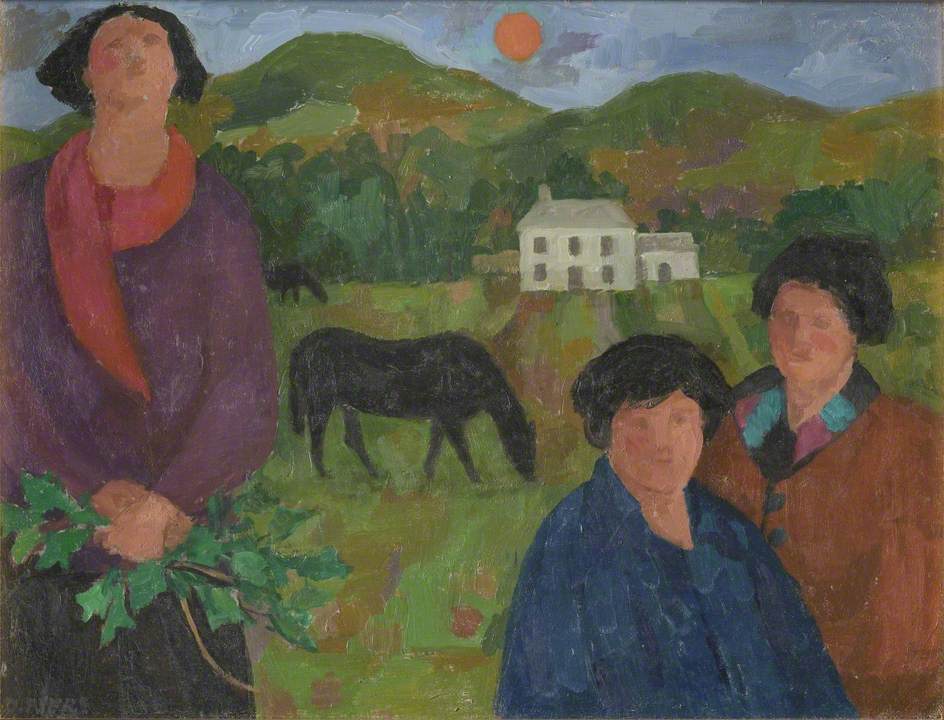
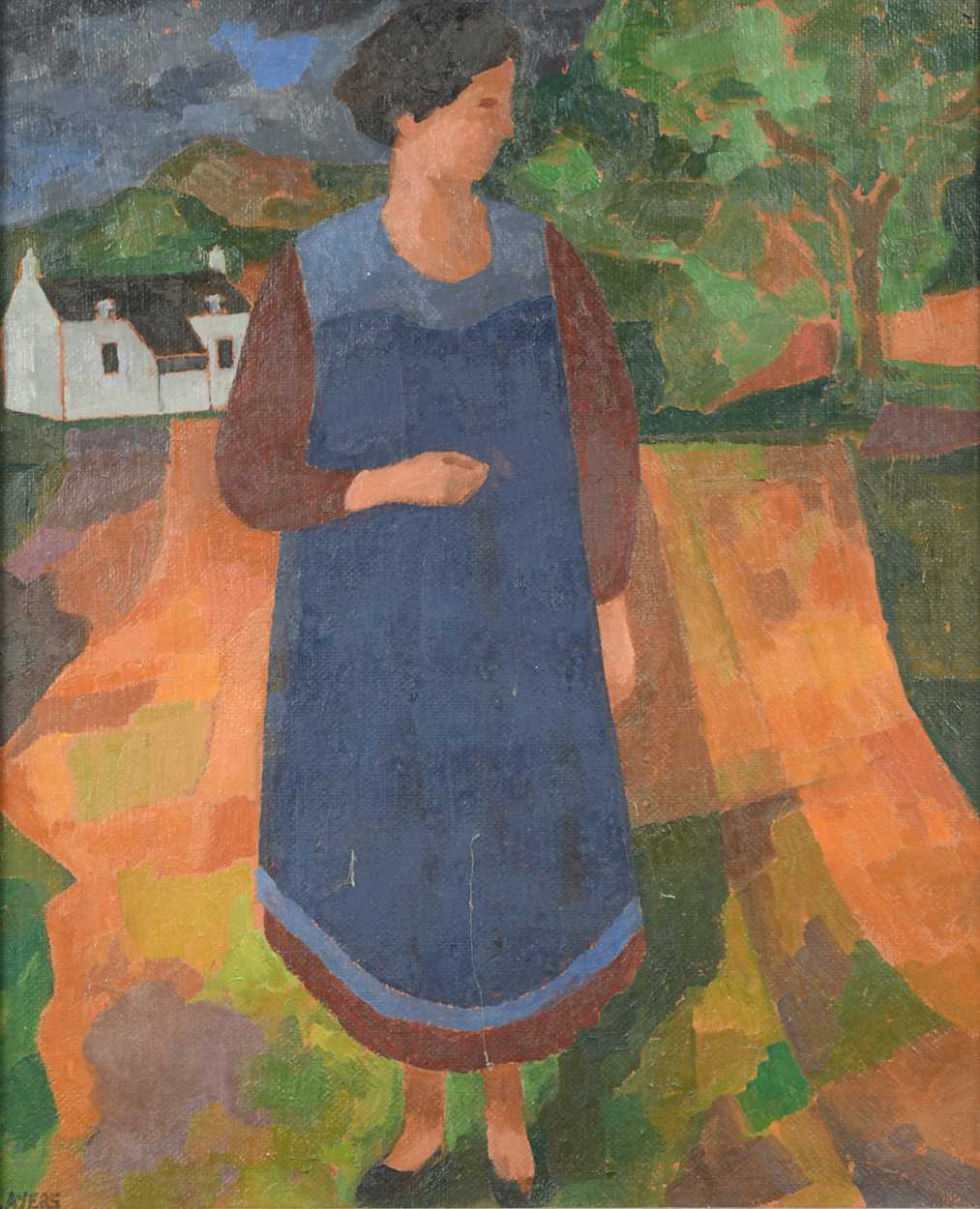
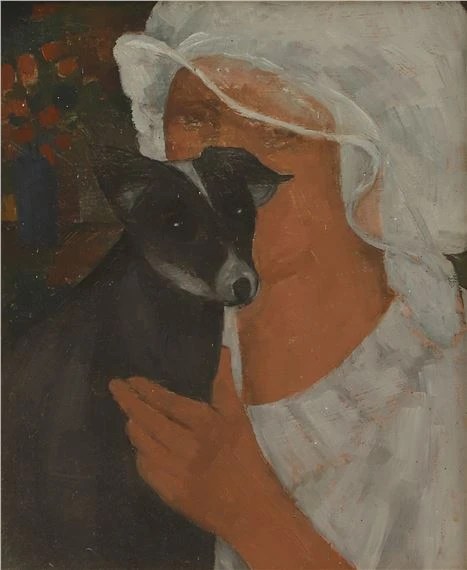
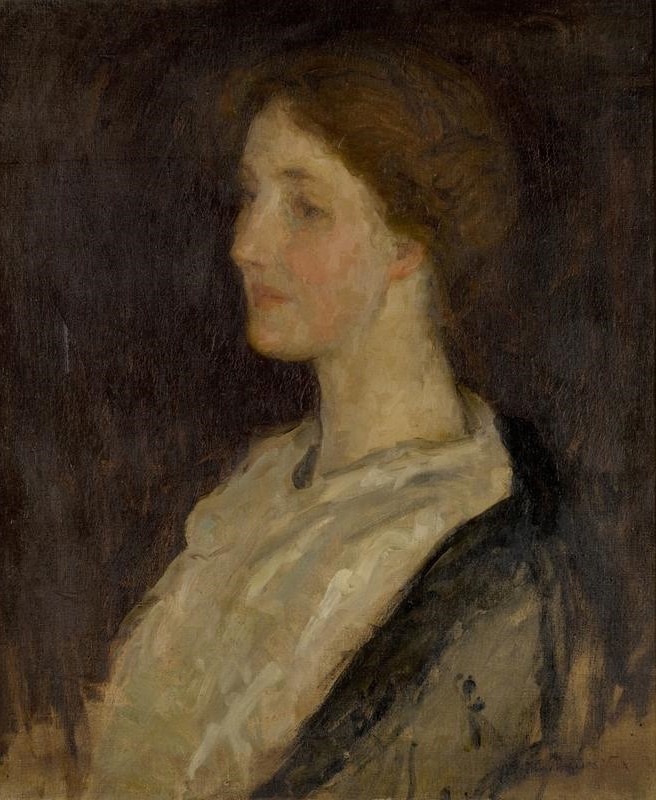
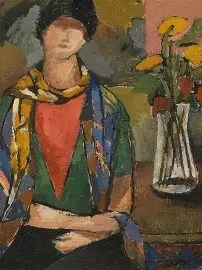
Duffy’s work included a few still life paintings but mainly women, full face in ageless garments. She avoided landscapes, “leaves are horrid repetitious shapes !”
After Eric died in 2001, Duffy carried on painting until a fall left her frail. In 2006 an Australian couple, Sven Klinge and Belinda Murphy, moved in as temporary carers; they stayed for 11 years. They kept Duffy alive and alert, steered her through many interviews about her years in Great Bardfield and monitored her increasing dementia. Despite the late onset of blindness, her final decade may well have been one of her happiest. Duffy died in November 2017 at the age of 102

Eric Ravilious at Newhaven

Ravilious visited Newhaven in late July, staying at the Hope Inn during August and September 1935 with friend and fellow artist Edward Bawden, Ravilious had a brief visit to Newhaven in 1934 while staying at Furlongs the cottage of artist friend Peggy Angus. Newhaven was within walking distance of Furlongs, approximately 7 miles. Ravilious first visited Furlong’s at Peggy’s invitation in February 1934 spending four days there before returning home to Brick House, Great Bardfield, Essex, he returned with wife Tirzah in the Spring of 1934. https://httpartistichorizons.org/2020/06/12/eric-ravilious-and-furlongs/

The Hope Inn, Newhaven

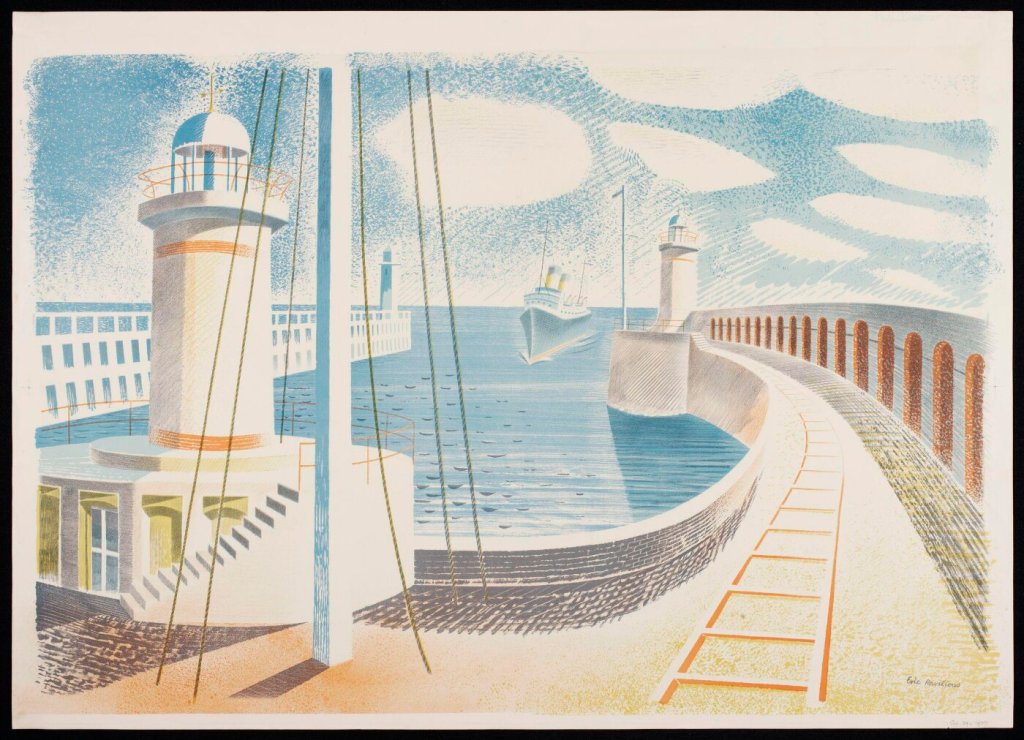
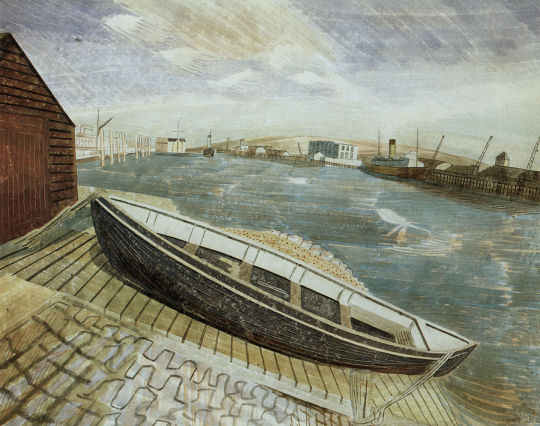
Arriving in Newhaven late July Eric was spurred on by a commission to produce a lithograph for schools, he found his inspiration among the ‘attractive jetties and dredgers’ of the harbour. He picked out the small lighthouses at the harbour mouth, including one with a signalling mast seen in the foreground of Newhaven Harbour, pictured against a cloudless blue sky.

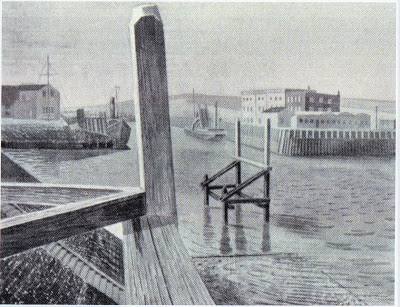
The painted sketch dates from 1935 when ER and Edward Bawden were enjoying their painting holiday together. In August 1935 Tirzah’s diary records: ‘Drove with Daddy (F.S. Garwood) to Newhaven afternoon and saw Eric and Edward. Eric has 7 starts of watercolours.’

We know Ravilious was working down at the harbour on 1st August as Peggy Angus reported: ‘I looked out for you when we embarked and waved to a lanky figure near the angler’s pub.’ Ravilious replied: ‘The lanky figure was me alright.’

The watercolour painting is dated 19th September, 1935. This provided the basis for the lithograph

When Ravilious arrived back at Newhaven in September, 1935, a terrific storm blew up, the worst for years. He walked to the end of the jetty to look at the lighthouse: ‘The spray from the breakers crashing on the weather-side of the breakwater was a quite extraordinary sight – I got very wet and think now it was almost a dangerous walk out there, but worth it.’

The watercolour Newhaven Harbour was bought from the Zwemmer Gallery by Beryl Sinclair, nee Bowker. She studied with Edward and Eric at the Royal College of Art. Nicknamed Bowk. Ravilious painted her twice, once in the Colwyn Bay Pier Murals in the kitchen with a plant and then again in a lost oil painting – ‘Bowk at the sink’, 1929-30.

The lithograph was part of the brave pre-WW2 experiment Lithographs for Schools, a series issued by Contemporary Lithographs Ltd. The lithographs didn’t sell at the time but are now highly sought after. John Piper was drawn into the project as a general assistant, but it was Barnett Freedman that was the foremost exponent of lithography working with Harold Curwen from the early 1930’s. Freedman was key in persuading friend Ravilious to try his hand at lithography.

‘The James’ and ‘The Foremost Prince’ worked from Brighton Pier in the summer and were laid up at Newhaven out of season.

This watercolour depicts the steamer SS Rouen as it left for Dieppe, and was completed by Ravilious at the Hope Inn in Newhaven, within a day of the initial sketch. Ravilious wrote to his mistress Helen Binyon: ‘Sweetie the holiday crowd downstairs is making a great noise with concertinas and pianos and drunken song, I rather like it.’

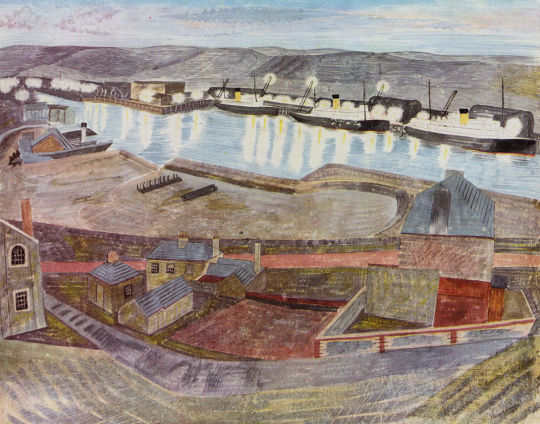
Brighton Queen at Night 1935.

The Brighton Queen, was dive-bombed and destroyed in 1940 during the evacuation of troops from Dunkirk. This watercolour was a product of the second stay in September. Back at Castle Hedingham writing to Helen Binyon, Ravilious told how he had sold this work for 12 guineas to W H (Pink) Crittal, a member of the window manufacturing company. See….. https://httpartistichorizons.org/2023/07/25/ariel-crittall/

No photo description available.

In the autumn of 1933 Peggy visited Zwemmer’s Gallery in London to view works by Eric Ravilious and Edward Bawden. Visiting on the last day of the exhibition Peggy longed to buy a painting but by then they had all been sold. So, Peggy wrote to former RCA fellow student Bawden offering to buy a watercolour painting if he would accept an arrangement of paying by instalments of £1 at a time.  Bawden replied inviting Peggy to visit Brick House for a weekend so she could choose a watercolour. Peggy duly visited Brick House in January 1934 and arranged to buy a painting. Ferryboat Entering Newhaven Harbour was completed later,

I understand she didn’t receive the watercolour until February 1936 when it was framed. At Brick House Peggy was bowled over by the decorations on the walls, the ceiling and floor. Peggy was pleased to see Eric again having only bumped into him once on Westminster Bridge since leaving the Royal College of Art.  She was also able to meet Tirzah, Charlotte Bawden had been a fellow student at RCA.

image
image

The friendship between Bawden and Ravilious was not always harmonious, Edward strongly disapproving of Eric’s affair with Helen. Ravilious stated on one occasion that he was fed up of Edward’s malicious digs. In February 1936 Ravilious wrote to Helen: ‘I won’t go away with him this summer if I can tactfully avoid it. Newhaven was a strain and I feel twinges of it still.’

image

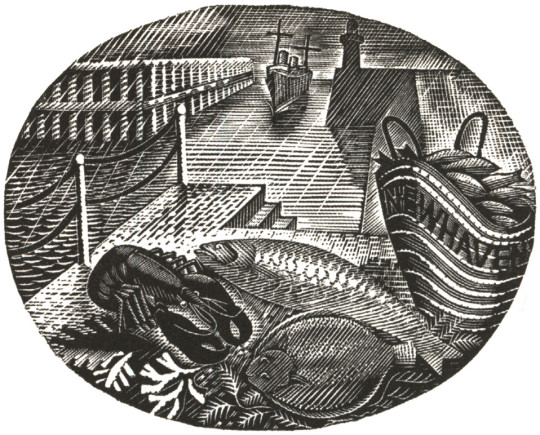
February, Wood-engraving for the Country Life Cookery Book, 1937

Charles Ginner

Charles Isaac Ginner CBE, ARA was born 4th March 1878 in Cannes, south of France, the second son of Isaac Benjamin Ginner, a British medical doctor. His mother Lydia Adeline Wightman was born in Scotland. He was educated in France at the Institut Stanislas (Cannes) and spoke and looked like a Frenchman.

At an early age, Ginner formed the intention of becoming a painter, but his parents disapproved. When he was sixteen, he suffered from typhoid and double pneumonia and travelled in a tramp steamer around the south Atlantic and the Mediterranean to convalesce; on returning to Cannes, he worked in an engineer’s office, and in 1899, at the age of 21, moved to Paris to study architecture. He worked in an architect’s office in Paris from 1899 to 1904. He then entered the Academic Vitti and trained as a painter with Spaniard Anglada y Camarasa who also taught at the Ecole des Beaux-Arts. Camarasa disapproved of Ginner’s admiration for Vincent van Gogh.

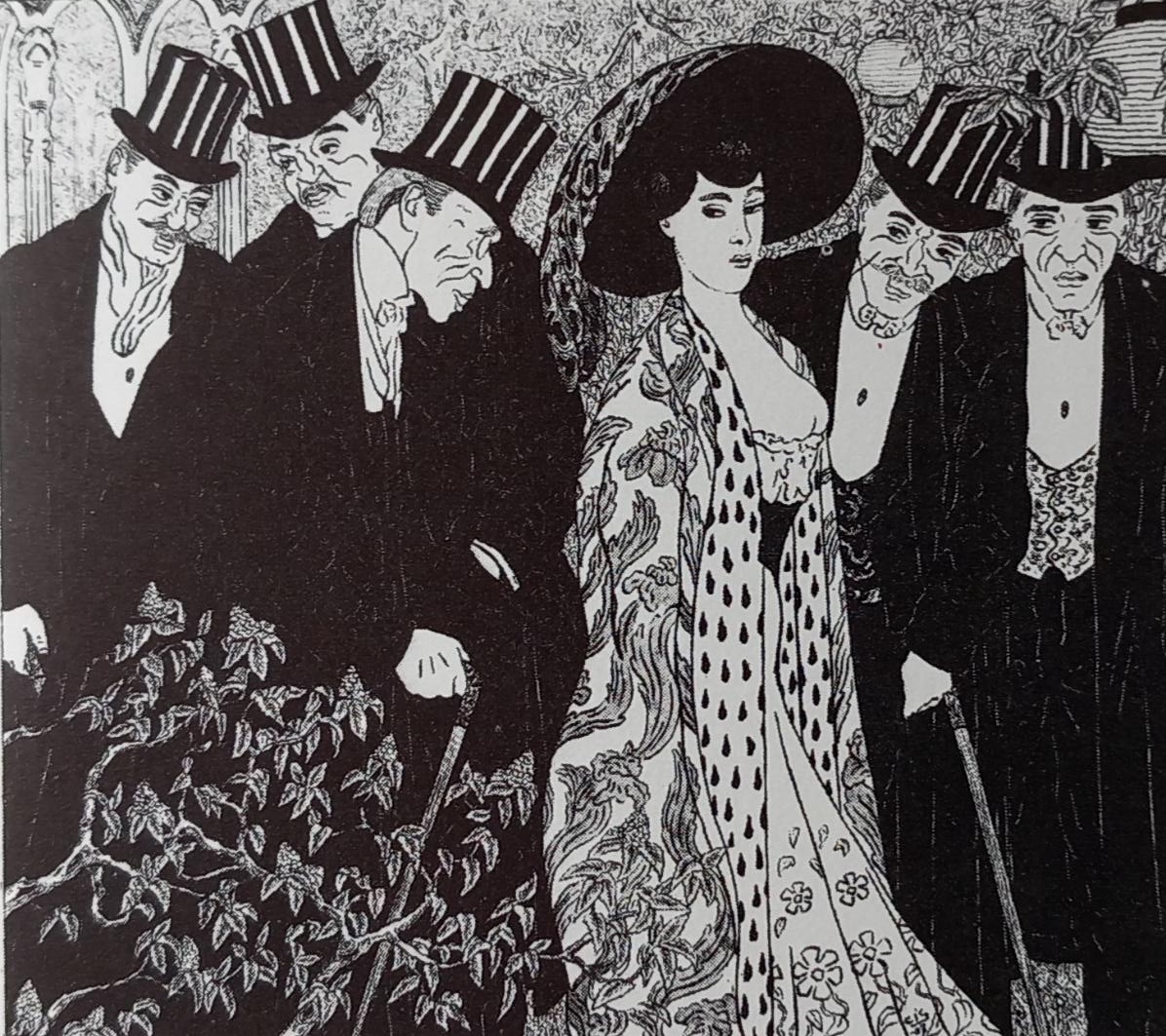
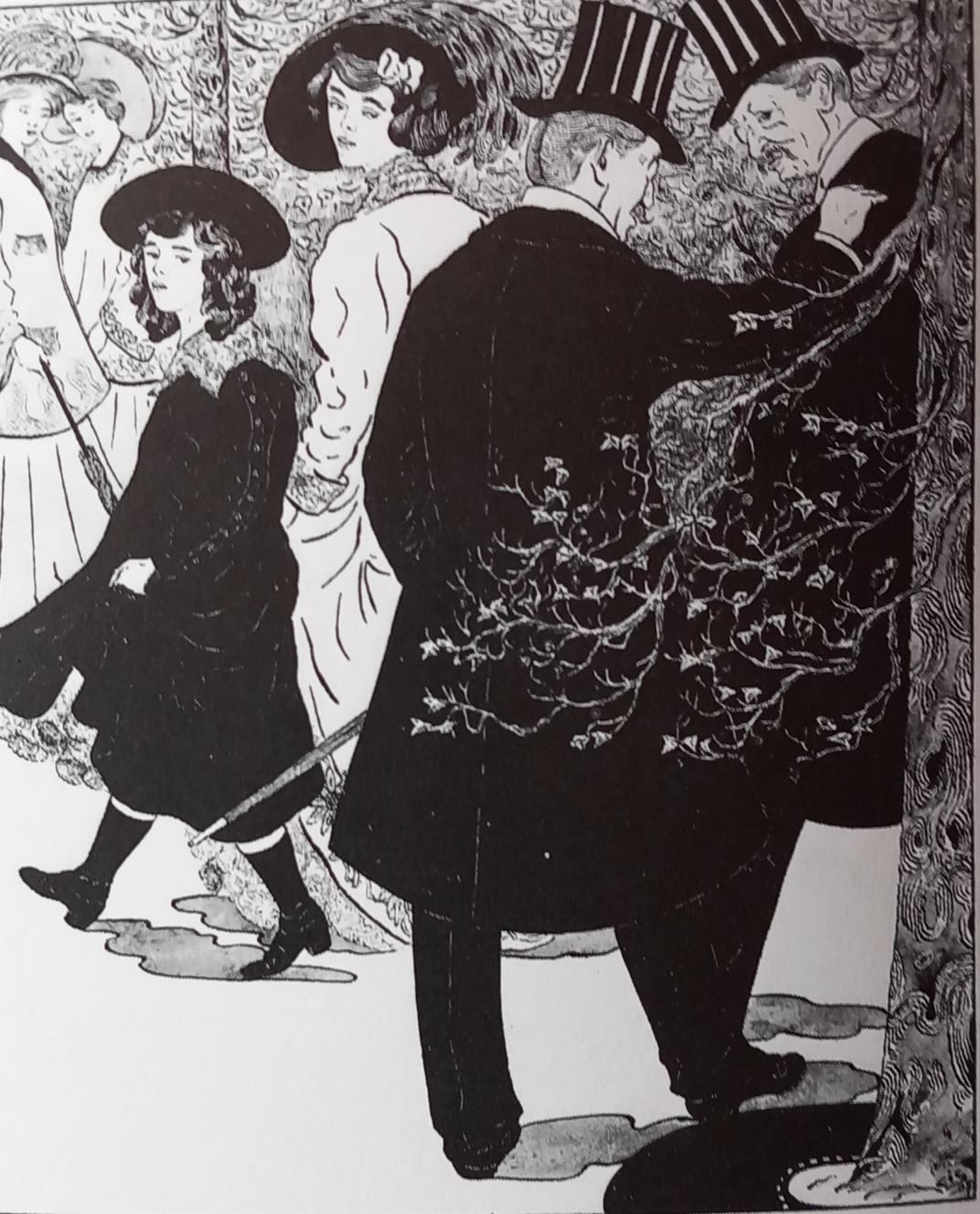
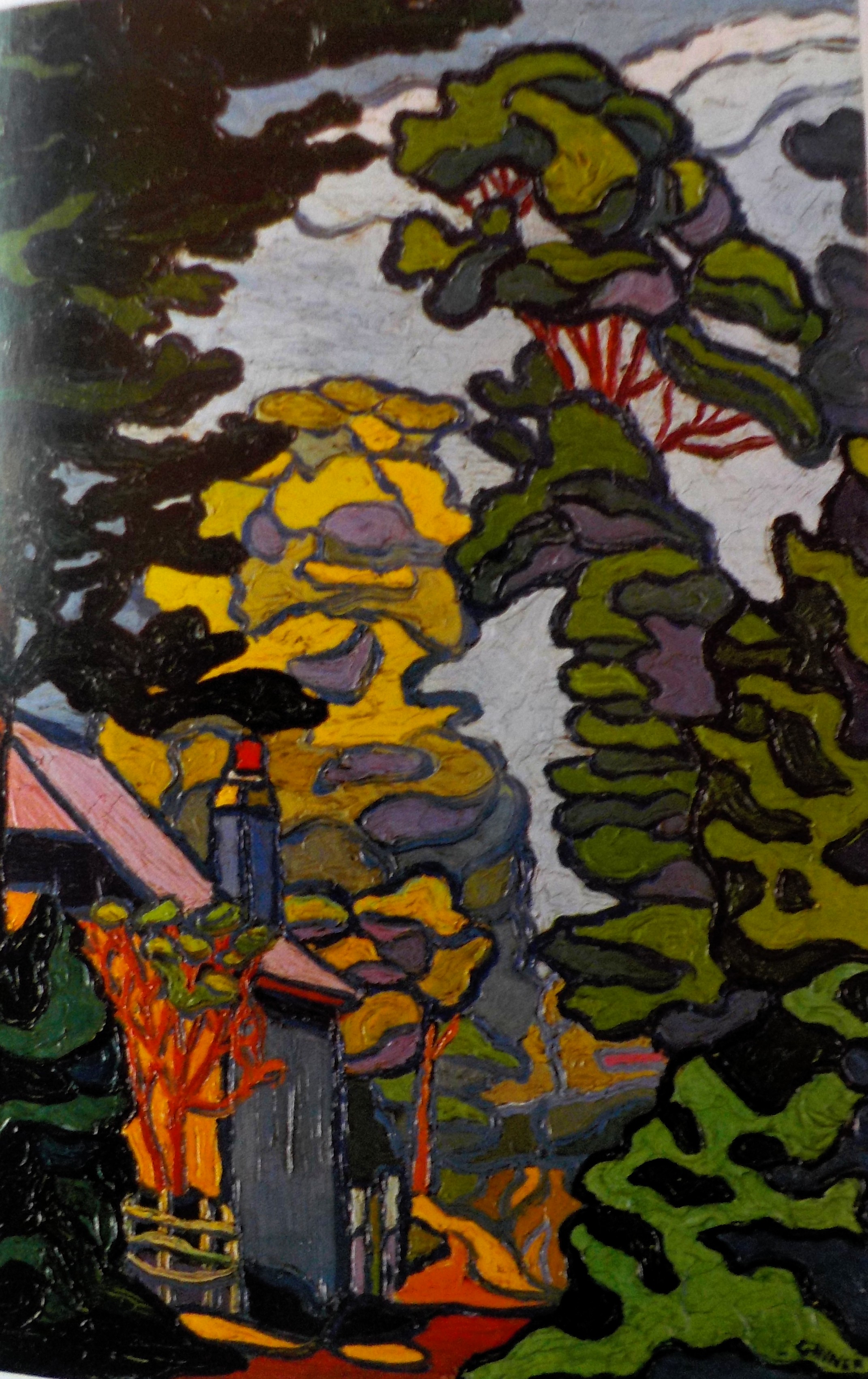
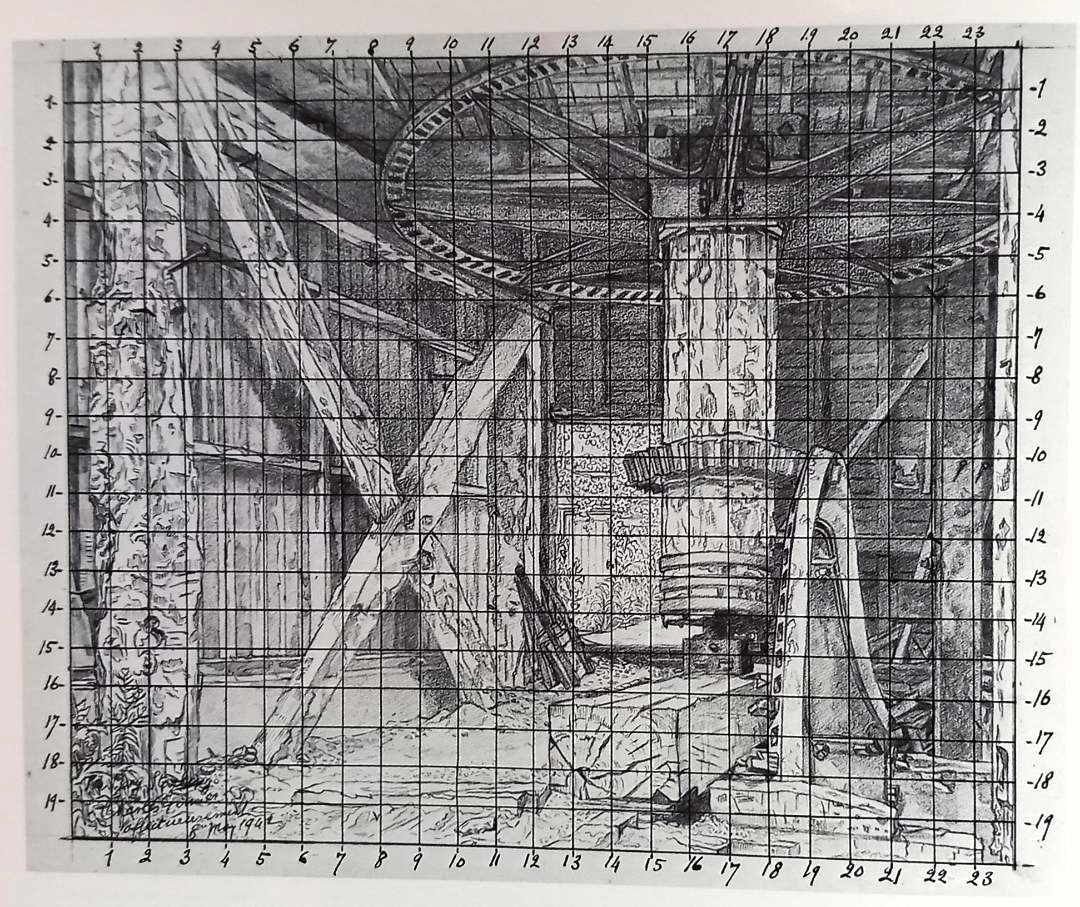
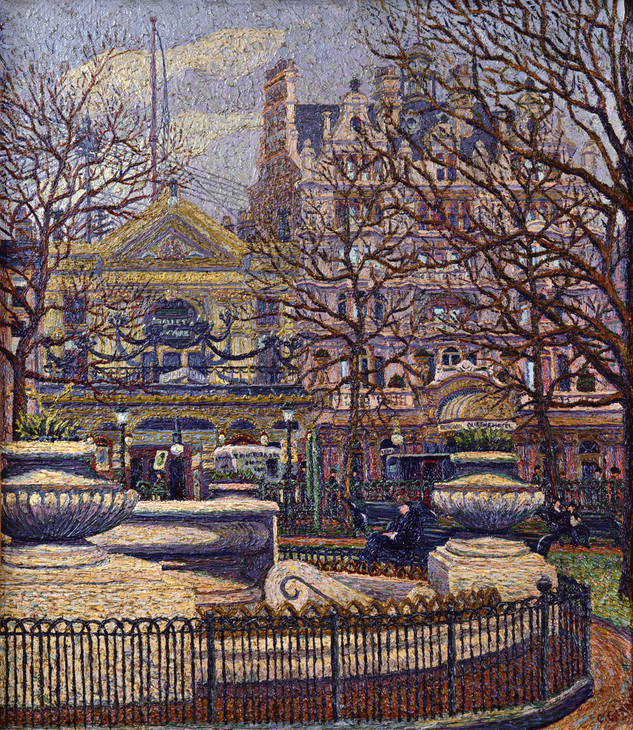
Question d’ Actualite 1904. Du Tic Au Tac 1907. Les Suiveurs 1907. Ginner’s early French work – illustrations for magazines. In one of these illustrations, Les Suiveurs 1907, depicts people in a public park, he drew a tree trunk densely covered with art nouveau patterns, showing his liking from the beginning for a saturated decoration of busy, concentric linear shapes.

In 1908, Ginner left Vitti’s and worked on his own in Paris, inspired by van Gogh, Paul Gauguin and Paul Cezanne. His earliest surviving oil painting dates from 1908 now aged thirty. I

While still resident in Paris, Ginner contributed to his first London exhibition: the open-submission Allied Artists’ Association at the Royal Albert Hall in 1908. The organiser, Frank Rutter, later recalled:

Few people took much notice of his work when it was first shown here in 1908, but several artists were literally attracted by his lavish use of pigment, and the canvas being still wet, took away samples of his paint in their finger-nails. Some few, however, approached his work with more respect, and I well remember Spencer Gore coming up to me before the Ginners and saying with conviction, ‘This man is a painter.’

In 1909, Ginner visited Buenos Aires, Argentina, where he held his first one-man show, which helped to introduce post-Impressionism to South America. His oil paintings showed the influence of Van Gogh, with their heavy impasto paint.

Ginner held a joint exhibition in September at the Salón Costa in Buenos Aires with a fellow student from the Académie Vitti, the Danish painter Dora Erichsen (died 1943), where he sold at least five paintings. The art historian Wendy Baron reasons that the two probably travelled to and from Argentina together, and that Dora was most likely the married woman described in Benjamin Fairfax Hall’s first-hand account of Ginner: ‘He never married and adopted a slightly cynical attitude towards sex, affecting to regard his mistress as a constitutional necessity like the T.C.P. with which he gargled every morning. He was much in love as a young man with a woman who preferred to marry someone else. The marriage was not a success and would have been disastrous for the two daughters born of it, had not Ginner, who had a great fondness for children, made himself responsible for their education and welfare.

In 1910, perhaps at the suggestion of Walter Sickert, whom he knew in Dieppe, he came to live and work in London. Ginner lived in England for the rest of his life but retained a French accent for many years.  Around 1910 Ginner began recording his paintings and drawings in a series of four notebooks in which is listed the titles, dates and sizes of works, as well as where they were exhibited and to whom they were sold, exchanged or given away. He backdated his records to 1908, where the first oil painting is listed. 

He served on the Hanging Committee of the Allied Artists Association’s third exhibition. He was immediately absorbed into the circle of Harold Gilman, Spencer Gore, Robert Bevan and the influential art critic Frank Rutter. Initially living in Battersea, he later moved to Camden Town where he was a neighbour of Gilman and Gore. He regularly attended the Saturday afternoons at 19 Fitzroy Street, meeting John Nash, Albert Rothenstein CRW Nevinson, Jacob Epstein, Walter Bayes and Lucien Pissarro.

In 1911, he became a member of the newly formed Camden Town Group, a male only group.

Ginner, Nash, Bevan and Gilman.

Sickert wrote to artists Ethel Sands and Nan Hudson: ‘As you probably know, the Camden Town Group is a male club.  There are lots of 2 sex clubs, and several one sex clubs, and this is one of them and women are not eligible.’

In 1913 the London Group was formed from the merger of the Camden Town Group an all-male group, and the Fitzroy Street Group. In 1914 in the New Age Ginner spelt out the artistic creed known as New Realism. In the same year he showed jointly with Gilman at the Goupil Gallery. The two artists shared their combined philosophy: – All great painters by direct intercourse with Nature have extracted from her facts which others have not observed before and interpreted them by methods which are personal and expressive of themselves – this is the great tradition of Realism.

Sickert responded ironically to Ginner’s article: Have Mr. Ginner and Mr. Gilman reflected that, when they put their heads between the sandwich-boards of this or any classification, they will have to carry the blasted boards about for another thirty or forty years?

Ginner and Gilman also saw Sickert’s comments re thick impasto as a veiled attack on their manner of painting. Ginner deftly responded, ‘Sir, – Paint is thicker than turpentine. In answer to Mr. Sickert I have but one statement to make: I shall paint as thick as I damn well please.

Ginner also commented in his ‘Neo-Realism’ article for New Age, 1st January 1914. ‘Each age has its landscape, its atmosphere, its cities, its people. Realism, loving Life, loving its Age, interprets its Epoch by extracting from it the very essence of all it contains of great or weak, of beautiful or sordid, according to the individual temperament.’

In 1914 Ginner also joined the Cumberland Market Group, a short-lived artistic grouping meeting in the studio of Robert Bevan in Cumberland Market. The group consisted of Ginner, Bevan, Gilman and a young John Nash.  Later members of the group were McKnight Kauffer and Nevinson. The group held only one exhibition. The group lapsed after Gilman’s death in 1919.

During World War 1 Ginner was called up, serving firstly in the Royal Army Ordnance Corps, secondly in the Intelligence Corps, being bi-lingual he was promoted sergeant and stationed at Marseilles, and lastly for the Canadian War Records.

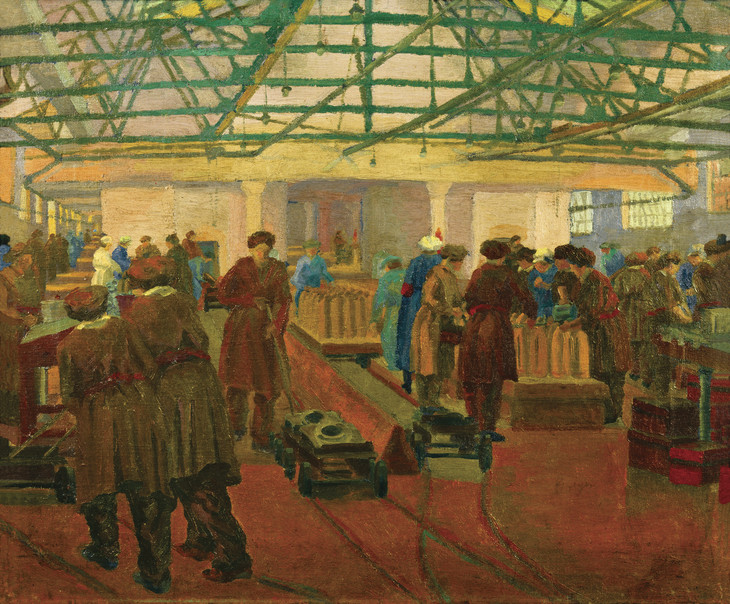
Ginner’s earnings from painting were pitifully low until a breakthrough came in 1918 when he was commissioned by the Canadian War Record to paint the vast ten foot by eleven-foot No.14 Filling Station, Hereford.  He was paid £350 plus living expenses received in 1919. He received only £2 for the blouse factory painted in 1917. 

Back in London 1919 Ginner contracted Spanish Flu and Gilman came to nurse him, caught it himself, and died. Ginner published an appreciation of Gilman in Art and Letters.  The group lapsed after Gilman’s death.  In 1920 Ginner joined the New English Art Club.

Following Gilman’s death, Ginner moved to 61 Hampstead High Street where he lived until 1938. During this period, he became friends with Edward Le Bas, who was to be a great patron, he painted the artist in 1930.

In 1938 he moved to 66 Claverton Street in Pimlico, close to the Tate Gallery.

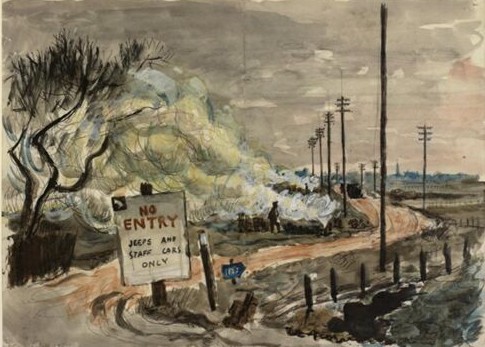
During World War II he was again an Official War Artist and specialised in painting harbour scenes and bombed buildings in London. In 1942 he became an Associate of the Royal Academy, where he advocated the admission of younger artists. Even now Ginner never made much money from his art, a Northern dealer called T W Spurr bought his work, paying five or six guineas for them.  They were then sold at Christie’s, usually for a loss.

In 1942 at the age of sixty-for Ginner was elected an ARA. He wrote to his friend and fellow artist, Stanislawa de Karlowska, Bevan’s widow, ‘Last April I was elected an A.R.A.! Just imagine it, me in the Royal Academy – wonders will never cease! In 1950 Ginner was awarded a CBE.   

Ginner has been described as a private man, a bachelor, well-mannered and genial.

Ginner died in London on 6th January 1952 of pneumonia, aged seventy-three. Stanislawa de Kalowska died in December 1952 aged 76.  The Arts Council of Great Britain held a touring memorial of forty-three of his works in 1953-4.

Bibliography: Wikipedia. Charles Ginner, Fine Art Society. The Camden Town Group, edited Robert Upstone, Tate Publishing, 2008.

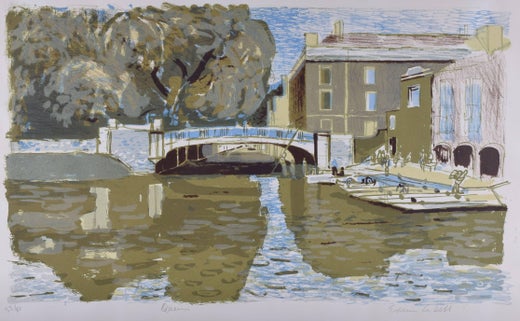
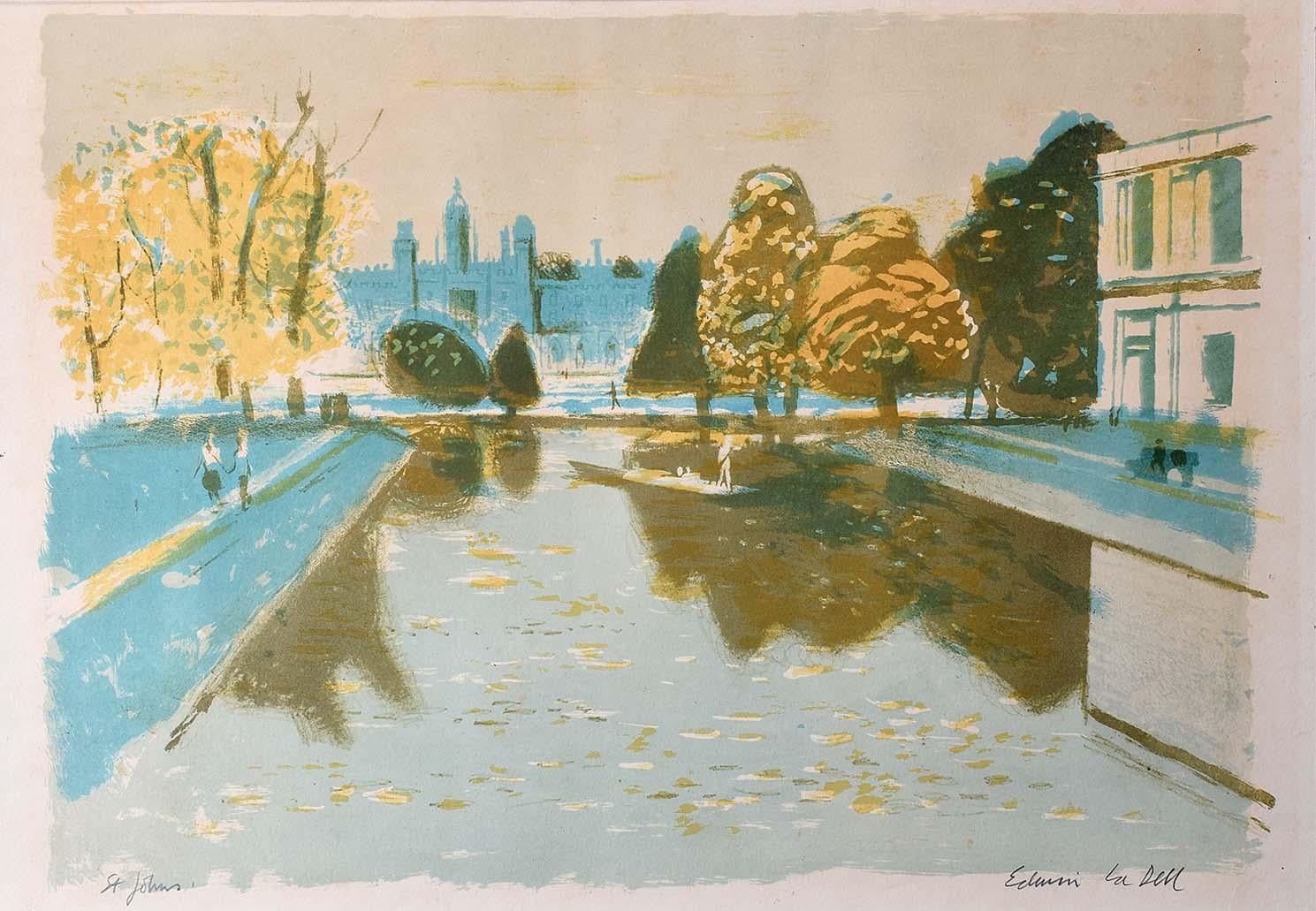
Edwin La Dell

Edwin La Dell was born 7th January 1914 in Rotherham, Yorkshire.  La Dell was the son of Thomas La Dell, a Sheffield-born bookbinder, and Ellen (née Boardman)  He was christened Thomas (after his father and grandfather) Edwin (following a family tradition on his mother’s side) but appears always to have been known as Edwin.

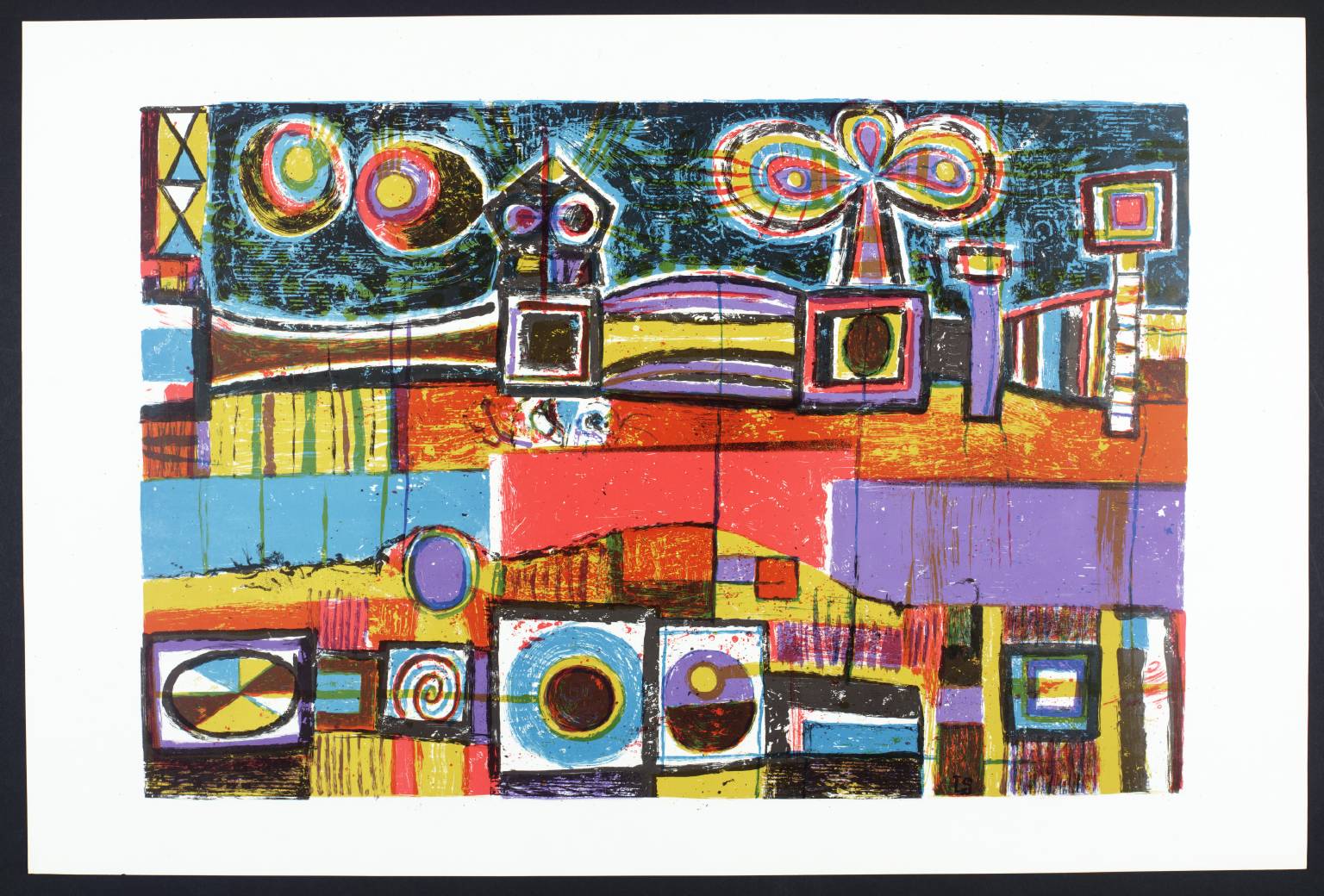
One of La Dell’s earliest lithographs is ‘The Rush,’ 1937,a typical London street scene from the 1930’s.

After attending Sheffield School of Art in 1935 he won a scholarship to study at the Royal College of Art where his tutors included John Nash, Percy Horton, Charles Mahoney, Gilbert Spencer, Barnett Freedman and Robert Austin.  On finishing, he was, in 1938, included in the 28th annual exhibition at Zwemmers of the Senefelder Club of which Frank Brangwyn was President and Matisse and Sir Muirhead Bone were Honorary members.   He sold well; his career began successfully, and it wasn’t long before he began teaching – at Camberwell School of Art. 

La Dell had begun to establish himself as a lithographer before the war. In 1939 he joined the Civil Defence Camouflage Establishment in Leamington Spa and worked as a camouflage designer. He became involved with the Artists International Association and also submitted work to the War Artists Advisory Committee.

In 1943 he was sent on active service, stopping first in Belgium (billeted with Mme Berger, the sister-in-law of Magritte) and then moving to the German Front.

From 1946 to 1949, he produced paintings, lithographs and murals for the Central Office of Information.  One of the artists La Dell worked with during the war was  Charles Mozley whose wife’s sister, Joan Kohn, married La Dell in 1940. In 1948, his work was included in a survey of 150 years of lithography that began with its invention in 1798.  Exhibited alongside Piper, Aldridge, Scott and Bawden, it cemented his reputation. 

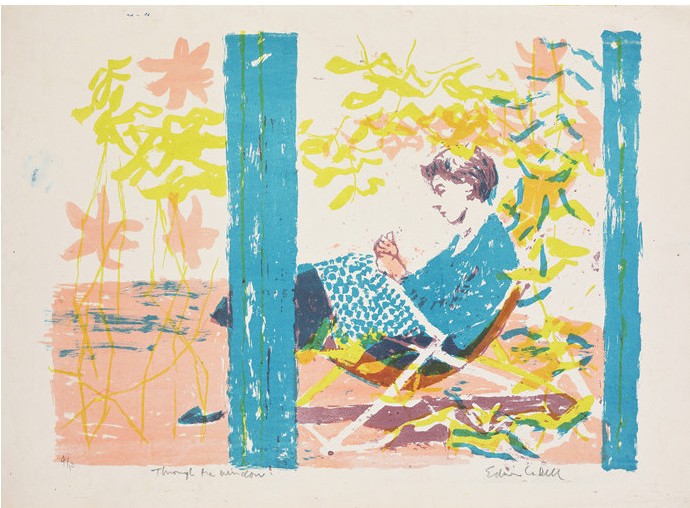
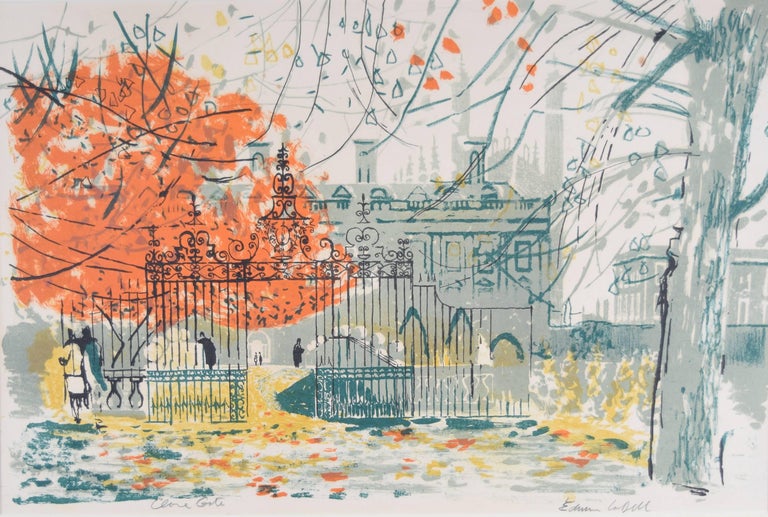
After the War, he continued making art and was employed as a teacher, initially working as a tutor at the RCA in 1948 before becoming Head of the Printmaking. In this role, his impact on post-war printmaking and future generations of printmakers was enormously influential.  He was instrumental in raising the appeal of printmaking and was involved in many of the commissions such as the Lyons Lithographs and the School Prints together with his own series of Oxford, Cambridge, Kent and New York. His vibrantly coloured lithographs drew inspiration from French artists such as Vuillard, Denis and Bonnard.

La Dell’s  best known works are those from the post-war era, in particular the lithographs he created for the coronation of  Queen Elizabeth II in 1953.  For the Coronation a group of artists were invited to create lithographs for the Royal College of Art. Following the success of the Schools Prints series and Contemporary Lithographs, these prints were sold in limited editions and helped boost the RCA’s skills at reviving lithographic techniques. They were exhibited at the Redfern Gallery from April – May, 1953.

Another contribution was ‘Newmarket,’ one of six lithographs by various artists commissioned for Guinness in 1956. Originally the title was ‘Newmarket Races’ but it was shortened to just ‘Newmarket.’ La Dell chose a subject relevant to the pub audience. In the Guinness Book of Records Newmarket is listed as the world’s largest racecourse.

He wrote and illustrated Your Book of Landscape Drawing and illustrated Wilkie Collins’ novel The Moonstone.

He was elected to the Royal Academy of Arts on 24th April 1969.  His work was exhibited throughout the world under the auspices of the British Council.

La Dell continued as head of the Department of Lithography at the RCA  until his death on 27th June 1970, aged 56.

La Dell’s work is currently held in many collections, including those of the Royal Academy,  Government Art Collection, the Tate and the Victoria & Albert Museum.

There is no definitive text re Edwin la Dell therefore this blog is cobbled together from many small sources, Wikipedia did give me a start though. HOWEVER 4th Nov. 2025. Today I received ‘Edwin La Dell,’ Lithographs and Etchings, edited by Tom and Maria La Dell, cheap at £10.to buy at Emma Mason Gallery, https://www.emmamason.co.uk/p/edwin-la-dell—lithographs-and-etchings

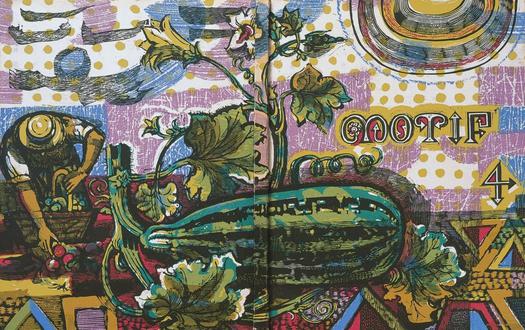
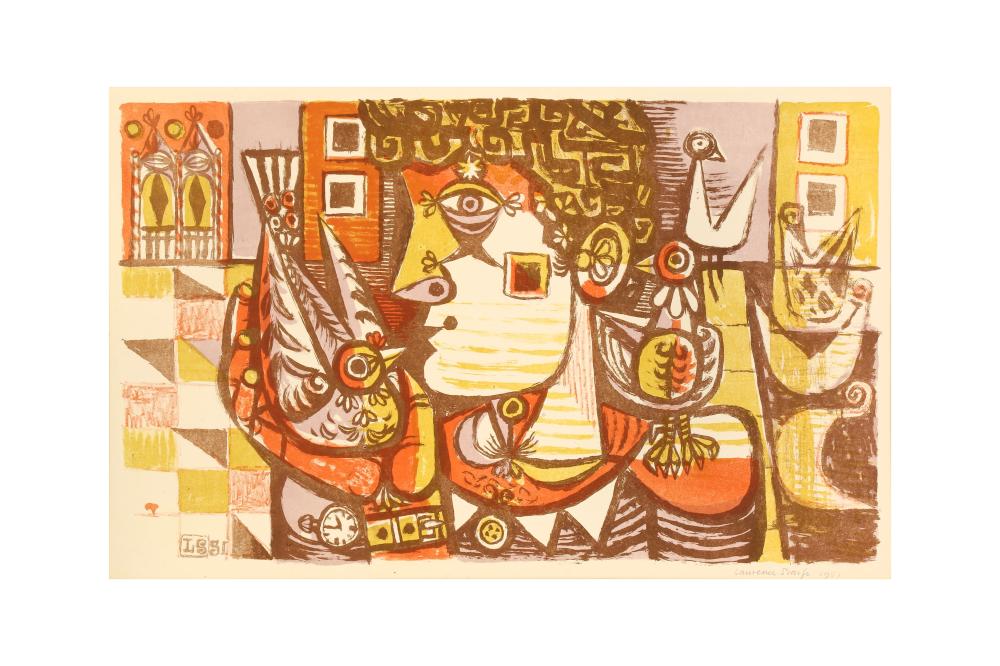
Laurence Scarfe 1914-1993

Publicity photograph for the 1958 Great Bardfield Open House Art Summer Exhibition. From left: Edward Bawden, Walter Hoyle, George Chapman, Laurence Scarfe, Stanley Clifford-Smith, Michael Rothenstein and Sheila Robinson with daughter Chloe.

Scarfe was born in Idle, Yorkshire, and studied art at the Shipley School of Art before moving to London to study painting at the Royal College of Art (1933-37).  After graduating, Scarfe taught at Bromley School of Art, 1937-39, and later at the Central School of Arts & Crafts, 1945-70. His final teaching post until his retirement in the early 1980s was at Brighton Polytechnic.

He carried out mural work for the British Pavilion at the 1937 Exposition Internationale des Arts et Techniques dans la Vie Moderne in Paris, the Books & Printing section at Britain Can Make It (1946) and the British Industries Fair (1948). Of major importance were his murals for the Dome of Discovery and the Regatta Restaurant at the Festival of Britain’s South Bank site (1951). Other murals included those for the P&O liners Orcades and Oriana in the ’50s. 

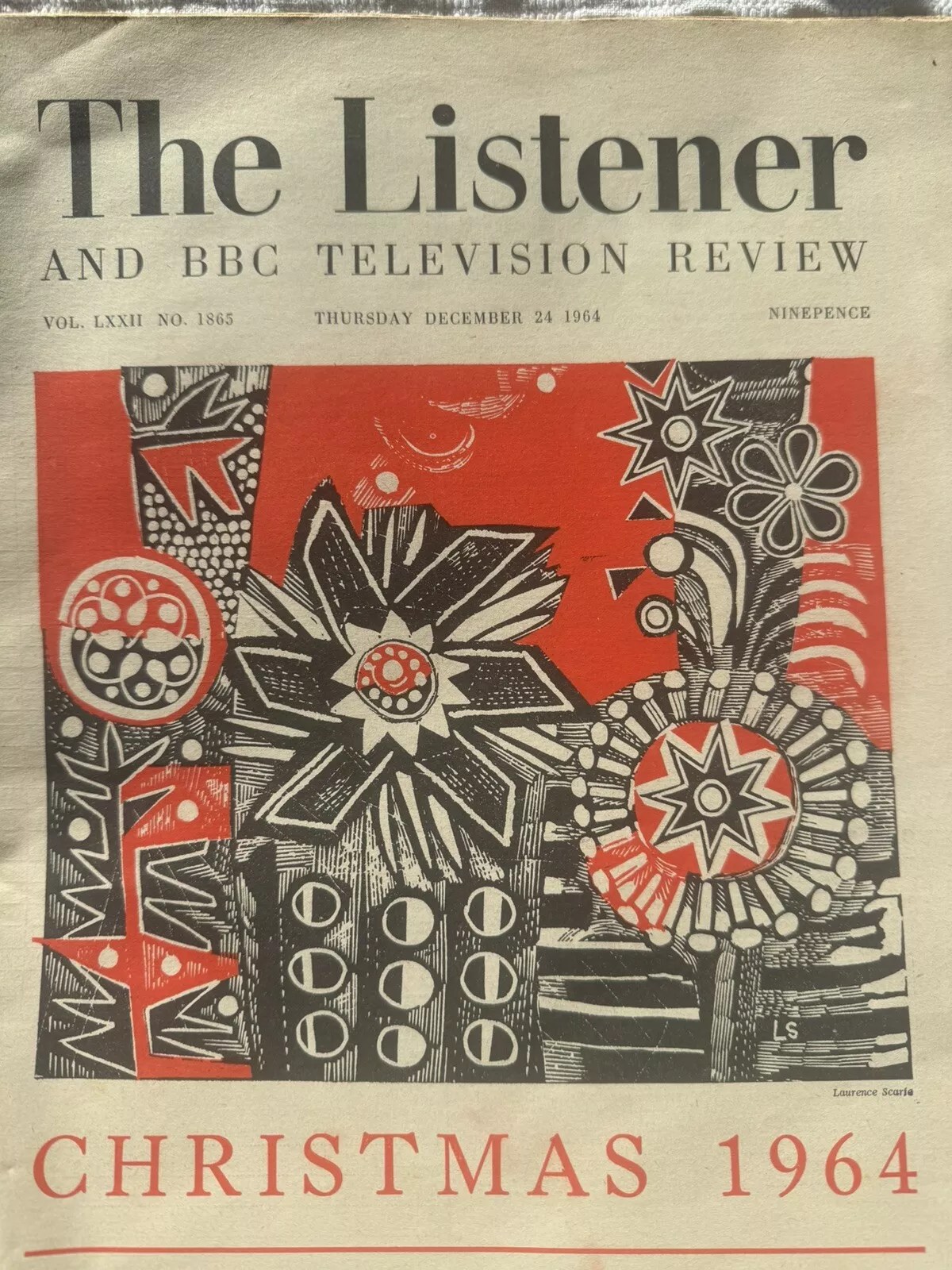
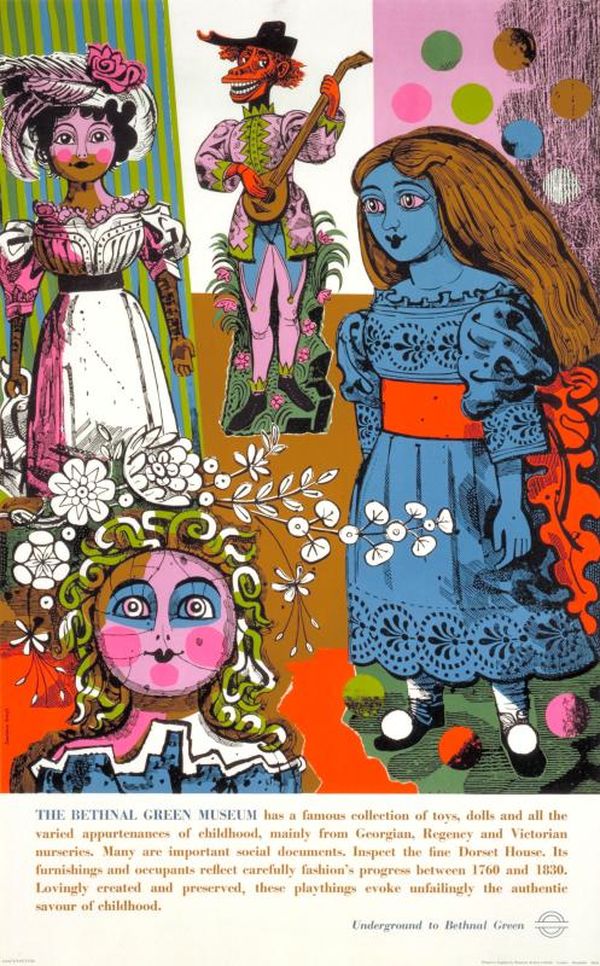
He authored and illustrated several books, and his poster and advertising designs were widely recognised, with commissions from the BBC, the Arts Council, and London Transport .

Though he found success as a commercial artist, Scarfe enjoyed teaching and lectured part-time for many years, including at the Bromley School of Art (1937-39), Central School of Art (1945-70) and Brighton Polytechnic, where he taught the History of Illustration and Graphic Design before retiring from teaching in 1980.

As a graphic designer, he was the art editor and contributor to ‘The Saturday Book’ and illustrated for the Radio Times. He also designed the Royal Coat of Arms for the Central Office of Information (COI). His poster and advertising designs were widely recognised including posters and advertising material for London Transport, the GPO, Arts Council, and BBC. He also illustrated a wide range of books, including Alec Waugh’s These I Would Choose: A Personal Anthology with Drawings (1948), A Record of Shell’s Contribution to Aviation in the Second World War (1949), and The International Wine and Food Society’s Guide to the Wines of Burgundy (1968). 

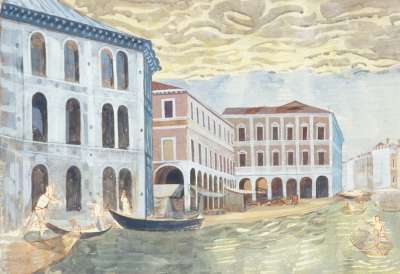
Scarfe travelled extensively throughout Europe from 1947 to ’69, most enjoying Italy, Sicily and Malta, and European thinking heavily influenced his ideas on painting theory. He was a member of the Society of Mural Painters and a Fellow of the Society of Industrial Artist and Designers. Most of the artist’s papers from the focal years of his career, 1935 to ’83, are held in the V&A Archive of Art & Design.

In 1958 the newly formed Great Bardfield Artists’ Association decided to repeat the open house format which had been so successful in 1954 and 1955. Clifford-Smith was appointed secretary, and the souvenir booklet was revised for the occasion.  Guest artists Peter Whyte and Laurence Scarfe joined the resident artists for the show. In early July a young TV presenter Alan Whicker interviewed Joan Glass and Edward Bawden for a BBC programme on the Great Bardfield art community. Thousands of visitors flocked to the village and the exhibition received national coverage. The surge of visitors resulted in traffic management problems for the local police. It was estimated that a staggering 19,000 visitors had viewed the art works and the artists sold a collective £5,000 worth of work.

In the 1960s Scarfe created a collection of wallpapers. A number of his wallpapers was exhibited to the public at the Museum of Domestic Design and Architecture, Middlesex University in London. 

Scarfe’s work represents a range of personal influences, through periods of design and theoretically focused work before the Second World War, through the optimism and growth of the Festival of Britain period and the abstract movements of the seventies.

Laurence Scarfe’s work found wide renown in his life and has been exhibited at the Leicester Galleries, Redfern Gallery, Zwemmer Galleries, New Burlington Gallery, Victoria and Albert Museum, Royal Academy, Society of Watercolour Painters, Orleans House Chiswick, as well as various galleries in the USA. He is represented in public collections throughout the UK, including the Imperial War Museum, (DCMS) Government Art Collection, Victoria and Albert Museum, Royal Institute of British Architects, Ministry of Works, University of Warwick Collection, Graves Art Gallery, Bradford Art Gallery, Brighton Museum, and the Tate.

Scarfe died in 1993 aged 79.

Unfortunately information re the life and work of Laurence Scarfe is few and far between. Wikipedia gave me a start and the rest is cobbled together from a variety of brief sources.

The Great Bardfield Open House blog is here :- https://httpartistichorizons.org/2021/09/03/great-bardfield-open-house-art-exhibitions/

Ravilious at Sawbridgeworth

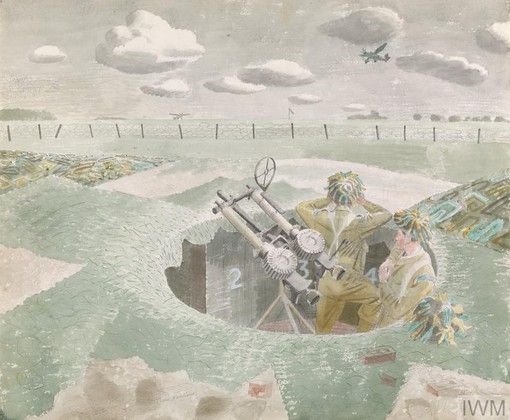
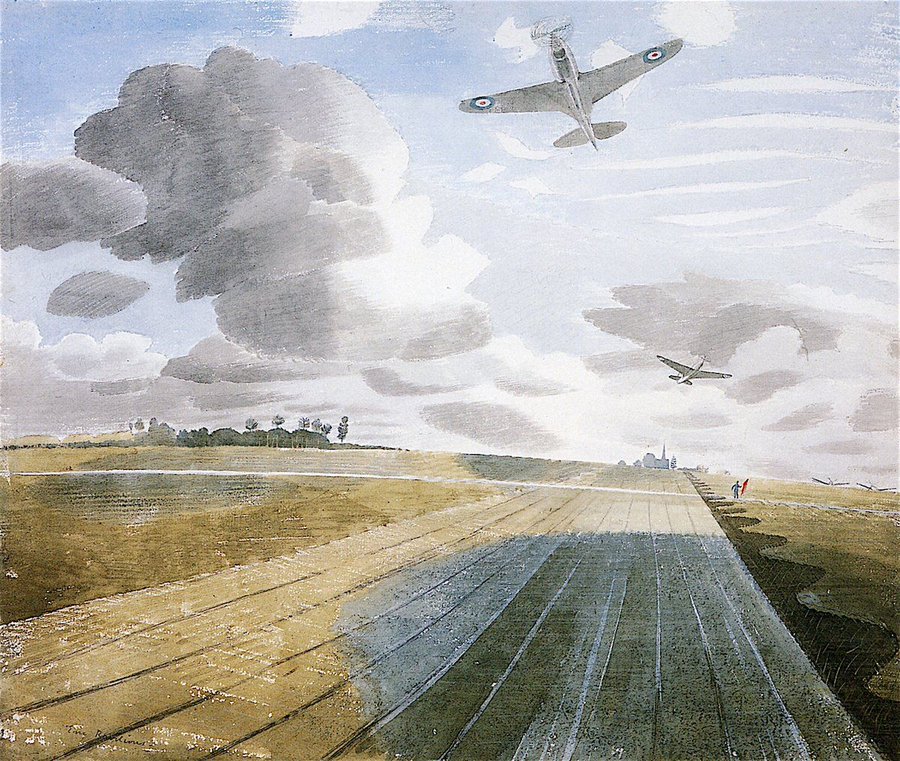
In 1942 Eric Ravilious was first at RAF Clifton near York. With Tirzah struggling with illness, he returned home in March. Tirzah had a mastectomy on the 11th March aged 33. Eric was next stationed at Debden near Saffron Walden so as to be near home. When Tirzah convalesced in Eastbourne in May 1942, he was posted to RAF Sawbridgeworth, an airfield in Hertfordshire, he lodged in a hut. “The brown tea at 7 is the most powerful ‘gunfire’ I’ve come across since war began. The batman boils it on his stove. This place is more primitive than most and my hut is I think made of cardboard and the bed, iron hard with no pillow, looking glass for shaving, chair, or towel.  I shave by touch alone and dry my face on a shirt.”

Over May and June, he produced a series of watercolours that provided a flavour of everyday life at RAF Sawbridgeworth, from the types of aircraft stationed there to the recreational activities which took place.

During his time at RAF Sawbridgeworth, Ravilious wrote of his experiences to Tirzah. On 9th May 1942, he stated, “the weather gets finer all the time but I feel bored of pictures of planes on the ground and want to go flying. At the moment I am having a shot at these very nice interiors but it is too early to say too much about them. A friendly major has lent me a large mirror so I can shave with a new blade.”

This watercolour of the operations room was acquired by the Fitzwilliam Museum in Cambridge while a second work was acquired by the Imperial War Museum in 2020.

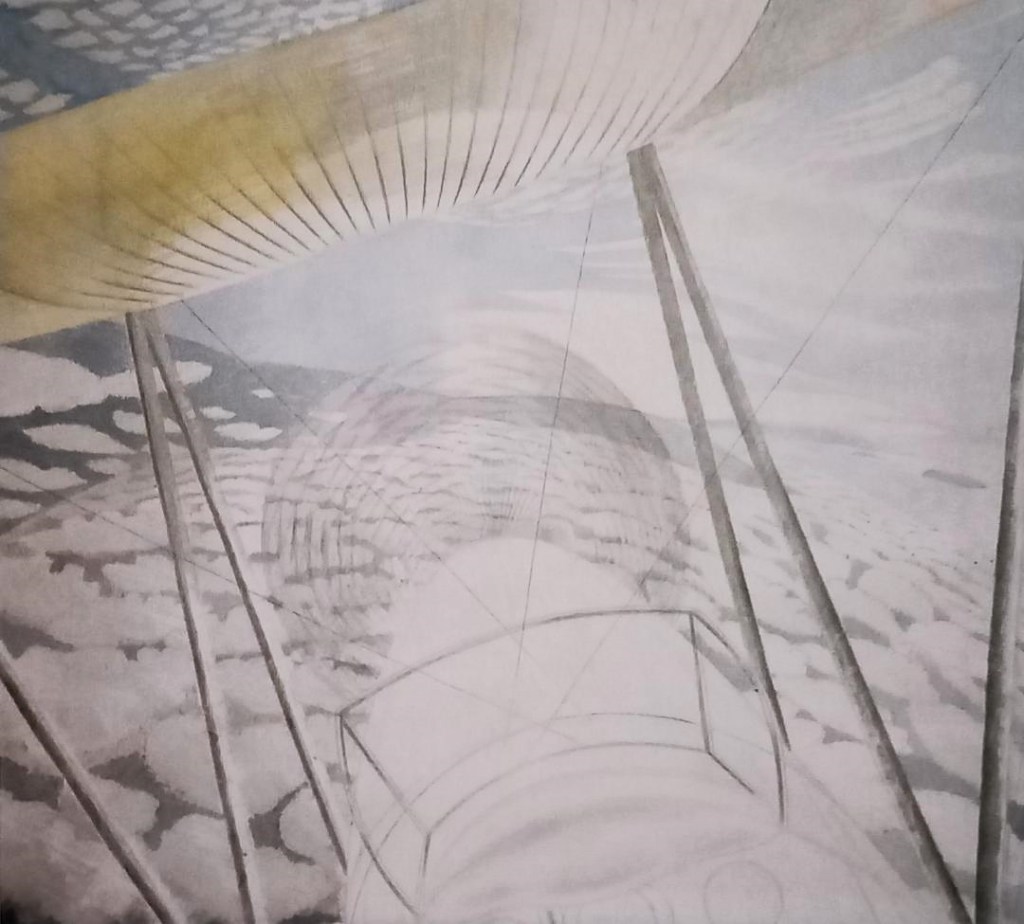
The operations room was a small hut used for controlling aircraft on the ground, as well as for studying maps and reconnaissance photographs. The picture shows the yellow and blue-green colour scheme used for such rooms, chosen because it was considered easy on the eyes. On the wall is a sector clock used for tracking aircraft, and through the windows can be seen a stationary Westland Lysander plane. Ravilious’ handwritten annotations are visible in the unfinished areas of the picture. This historic painting is amongst the Imperial War Museums’ strong holdings of work by the artist, providing an important record of his methods, as well as insight into working life on a wartime RAF base.

The windows in the second watercolour reveal that the scene is unfinished; these areas are sketched in pencil, yet to be painted with watercolour. A large arrow can be seen through the window and airfield markings and the vague shape of an aircraft are shown through the right, both accompanied by handwritten annotations by Ravilious – handy notes to assist him in completing the work at a later date. On 9th May 1942, he stated, “the weather gets finer all the time but I feel bored of pictures of planes on the ground and want to go flying. At the moment I am having a shot at these very nice interiors (eg Operations Room) but it is too early to say too much about them.”

The Fairey Battle was one of the most promising aircraft chosen for the rapidly expanding RAF in the 1930s. When introduced into service in 1937 it could carry twice as many bombs over twice the distance as the Hawker Hart and Hind bombers it replaced. By 1939 it was obsolescent but due to the lack of more modern types it remained in front line service. Battles of No.226 Squadron were the first RAF aircraft to be sent to France on the outbreak of war.

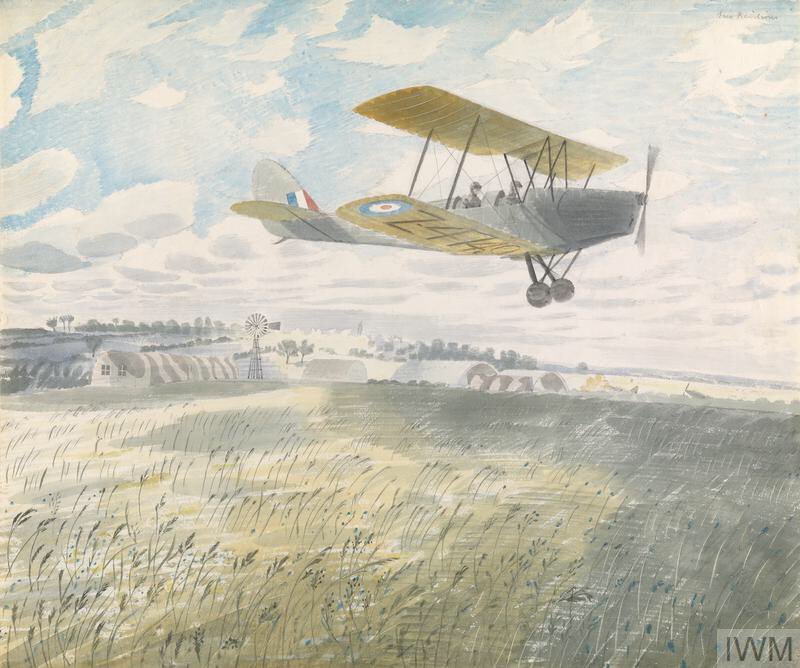
Despite his primitive hut living conditions, Ravilious enjoyed documenting everyday life on the airfield including aircraft in flight and recreational activities. In this watercolour, Ravilious has depicted five Supermarine Spitfires at the base, shown in the colours of a unit that never flew Spitfires from the airfield, however, this scene is wholly fabricated. Spitfires were not present at the site until August 1942. Perhaps Ravilious had heard of their impending arrival, or he was eager to illustrate the famous fighter plane in detail – the answer remains a mystery.

June 1942. Eric’s drawing of a Tomahawk Taking Off was given to Wing Commander P J A Riddell as a thank you for providing Eric with the facilities he needed while at Sawbridgeworth.  The drawing has not been traced. The site is now defunct as a military base and few of the original buildings exist, many subsumed by modern industrial buildings and farmland. the Sick Quarters Site has become a small industrial estate.

At the end of July 1942 Eric moved on, a brief stay at Weston Zoyland near Bridgewater. For some months Eric had been discussing possible placements in Russia, Ireland and Iceland. By the 12th July Eric was at home in Shalford working on unfinished paintings from Sawbridgeworth.

” I’m busy on about six painting’s, mostly made from notes made in Tigers from the air. It is a tricky but amusing job and I hope to produce something in a week or two if they don’t all take a wrong turning.”

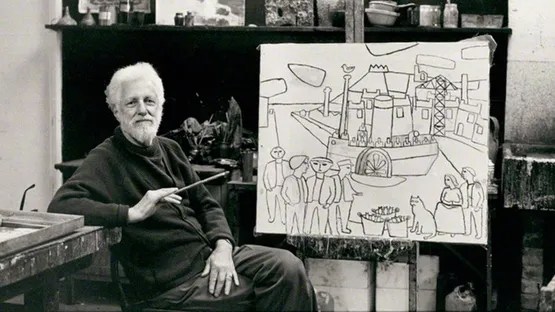
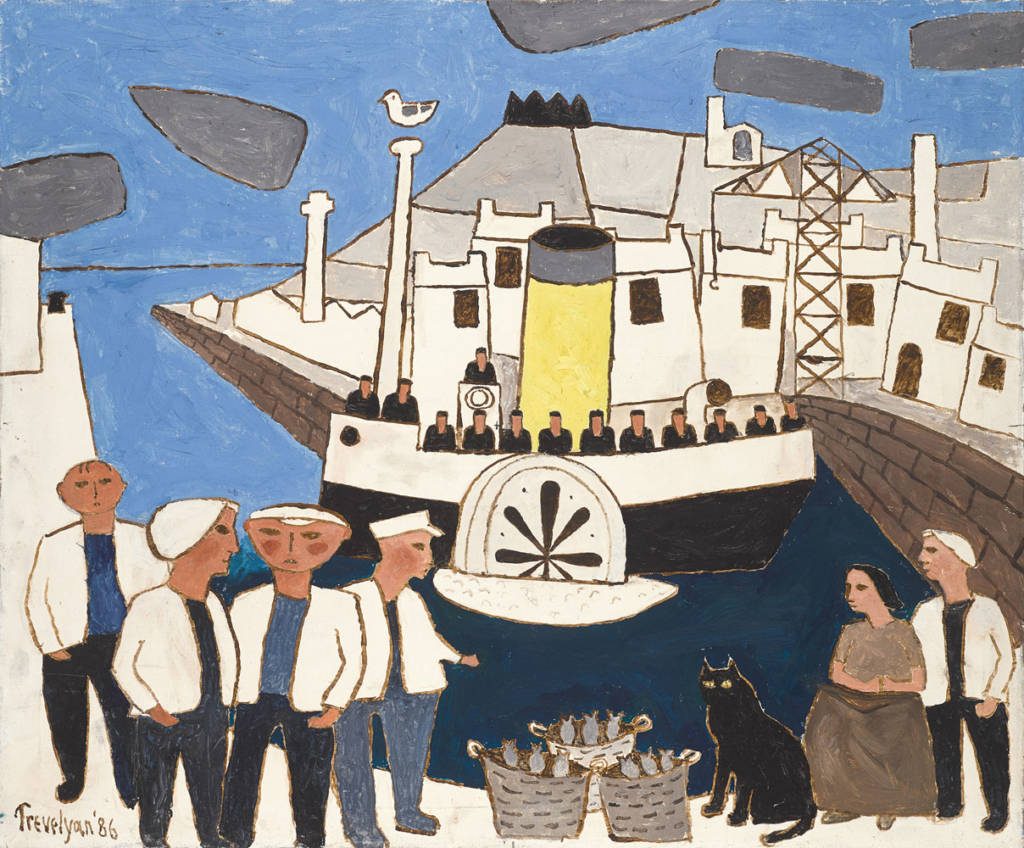
Julian Trevelyan RA (20 February 1910 – 12 July 1988).

Ursula………https://www.facebook.com/groups/488249232182567/permalink/1111077453233072/

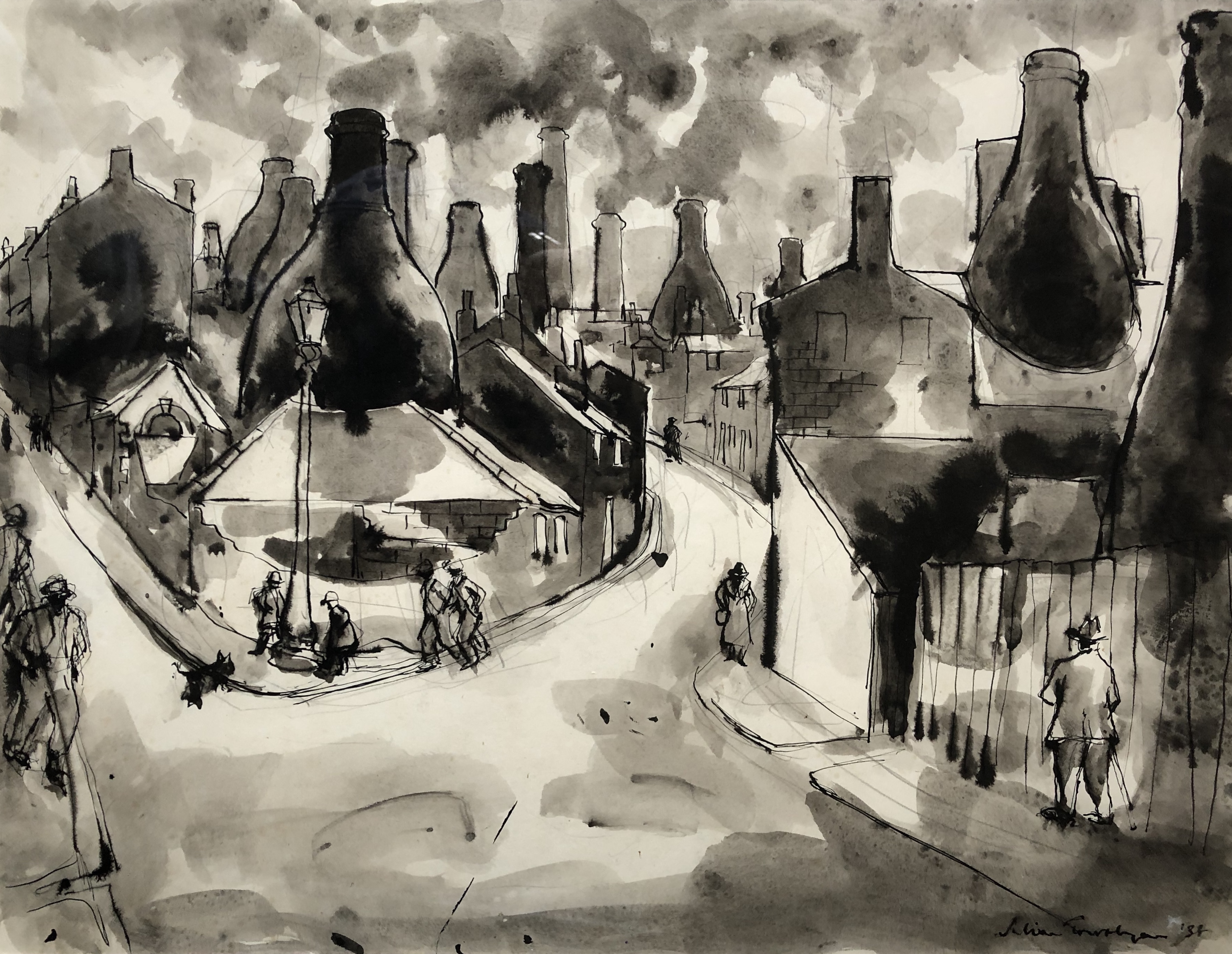
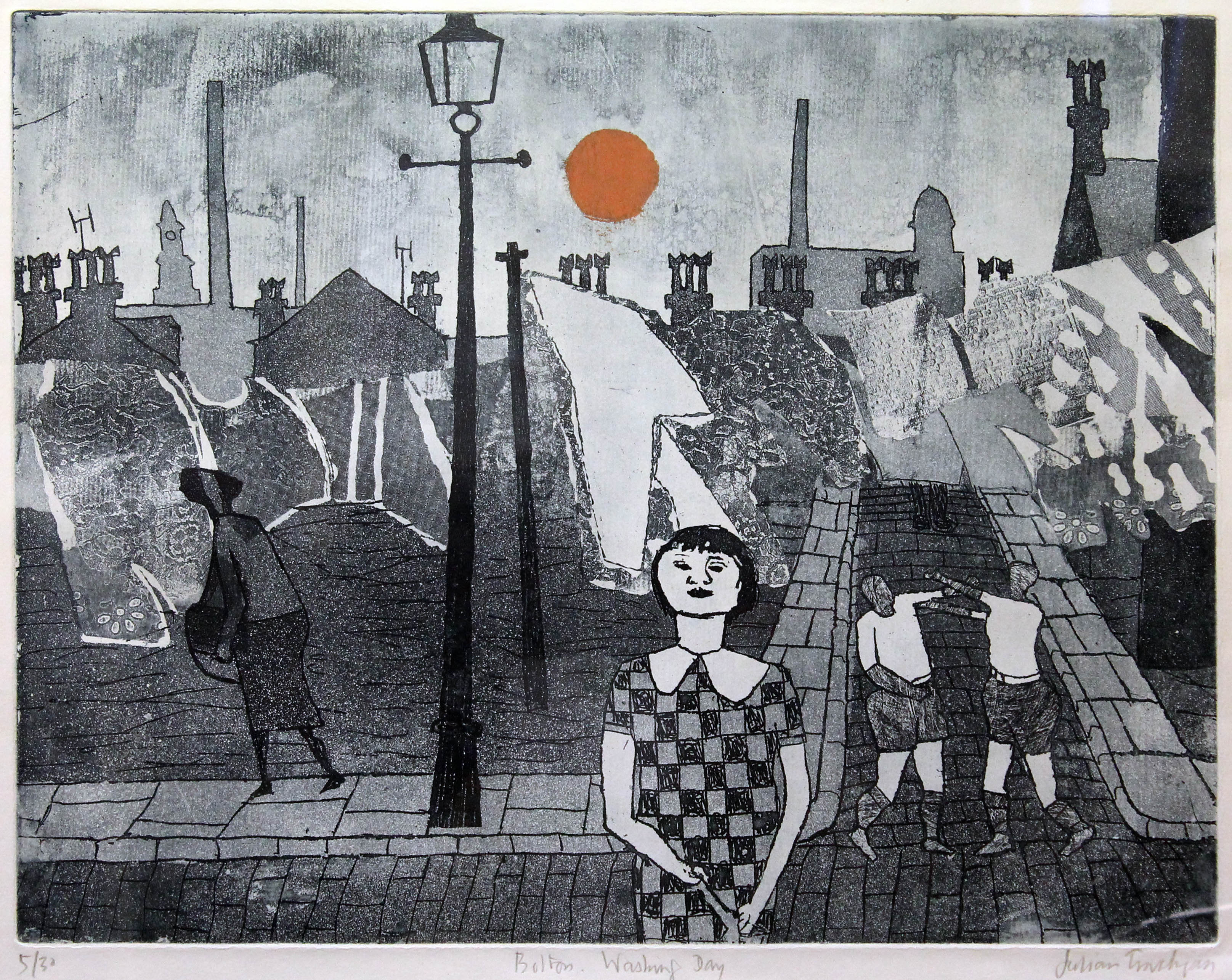
As one of the first participants of Mass Observation, which aimed to record the routines and rituals of everyday life in Britain using volunteer observers, diarists and participants. Trevelyan spent a month in Bolton’s industrial streets, painting and creating collages from his suitcase full of materials. Trevelyan’s collages from his involvement with Mass Observation are regarded as a critical part of his development bringing together so many strands of his artistic development during the late 1930s.

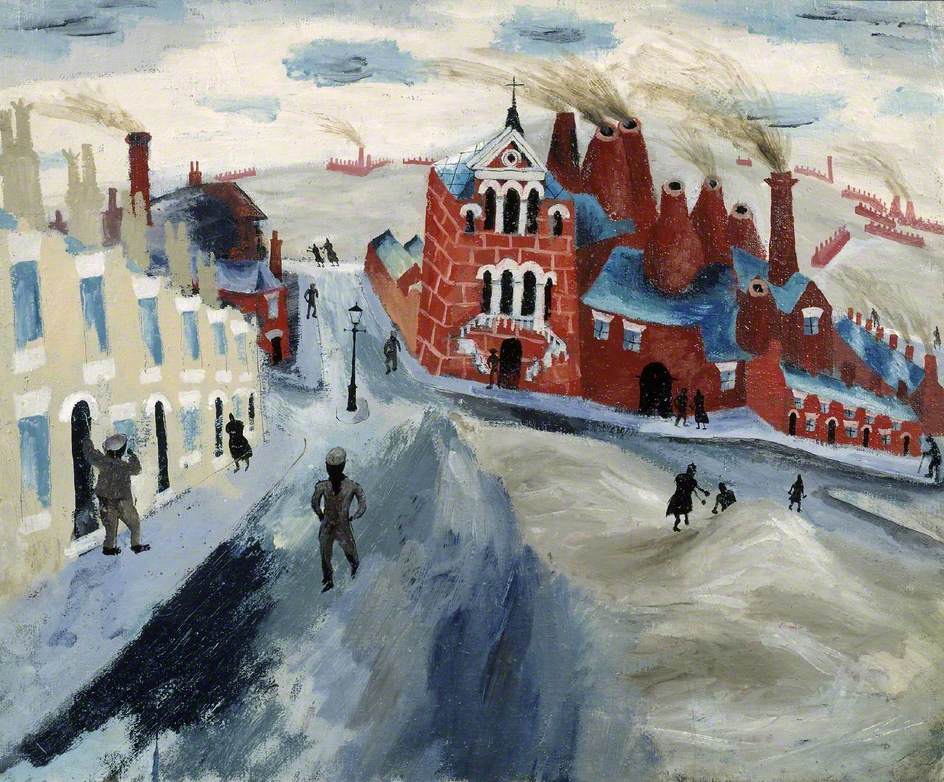
Trevelyan created a powerful series of collages and paintings of the industrial north. The collages, including Rubbish May be Shot Here (1937), incorporated allusions to contemporary politics and popular culture by way of magazine and newspaper cuttings, old catalogues and bills, and the paintings, including The Potteries (1938), were darkly expressive yet deeply personal in their evocation of poverty and deprivation.

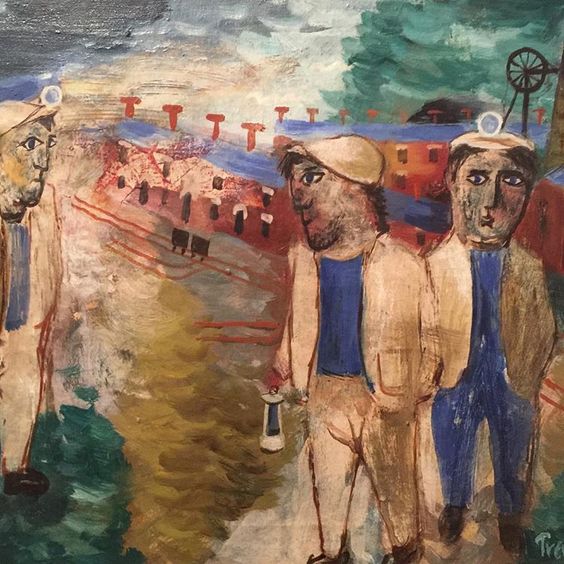
During this time he became interested in ‘Sunday painters’ and championed the self-taught group of Ashington Miners, known today as the ‘Pitmen Painters’. Having had little formal training himself, Trevelyan was fascinated by these self-taught painters, believing strongly that anyone could be an artist. In 1939, shortly after resigning from the London Surrealist Group, he organised an exhibition of their work at the Peckham Health Centre.

You cannot hide anything in the desert.

Trevelyan died on 12 July 1988 in Hammersmith, London.

To celebrate the centenary of his birth, an exhibition of his prints was held at Pallant House Gallery in Chichester from 10 May to 13 June 2010.

https://httpartistichorizons.org/2020/09/09/bolton-work-town-survey-1937-38/

https://httpartistichorizons.org/2020/09/27/the-pitmen-artists-of-ashington/

Thanks go to Wikipedia, Pallant Gallery and Art UK for help with the text here.

Albert Richards

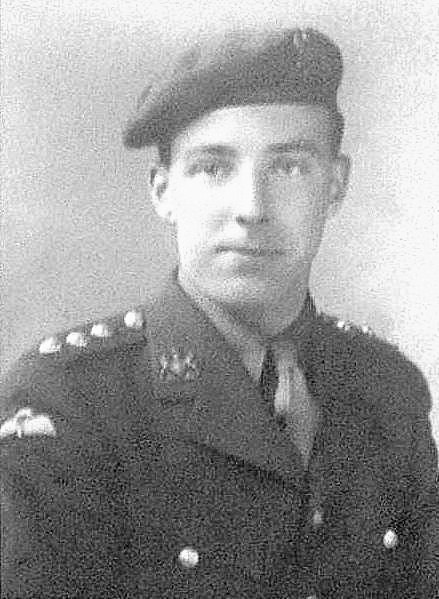
Albert Richards (19 December 1919 – 5 March 1945) was a British war artist. Born in 1919 to a World War I veteran, he enlisted as a sapper in 1940. He later served in the British Army during World War II, both as a paratrooper and as a war artist. He was the youngest of the three British official war artists killed during the conflict

Richards was born in Liverpool but grew up in a working-class household in nearby Wallasey. the son of Hannah Beatty and George Richards, a World War I veteran and wood machinist. The family moved in 1925 to 2a St Bride’s Road, Egremont., Wallasey, subsequently to 14 Queensway, Wallasey where he attended Manor Road School up until the age of eleven. Richards then attended Wallasey Central School up until the age of fifteen. Attending the Wallasey School of Art and Crafts Richards won a scholarship, awarded by the Borough of Wallasey to attend the Royal College of Art (started 9th January 1940) for three months before being conscripted into the Army on 3rd April 1940.

Richards enlisted as a sapper in 286 Field Company, Royal Engineers and was promoted to the rank of Lance Corporal. He served as a sapper from April 1940, assigned to duties such as building barrack huts and defence works throughout England and he frequently painted scenes showing these tasks. He submitted several of these paintings to the War Artists’ Advisory Committee, which, impressed with their freshness and quality, began in May 1941, to purchase his artwork. Richards received 15 guineas for a  painting in September 1941.

In 1942 he escaped the tedium of sapper work by becoming a parachutist with 391 (Antrim) Parachute squadron. He underwent training at the No.1 Parachute Training School at RAF Ringway, near Manchester, He depicted this training in several paintings such as Kilkenny’s Circus and Parachute Training over Tatton Park. In September 1943 Richards was offered a three-month contract by WAAC, he reluctantly declined, not wishing to risk his present work in the Parachute Regiment, which he found both enjoyable and artistically inspiring.

In December 1943 he accepted his first six-month WAAC commission.

The WAAC bought several more of his pieces and invited him to a meeting. On March 1, 1944, Richards was made Britain’s youngest official war artist and given the honorary rank of captain — the only artist selected from a fighting unit.

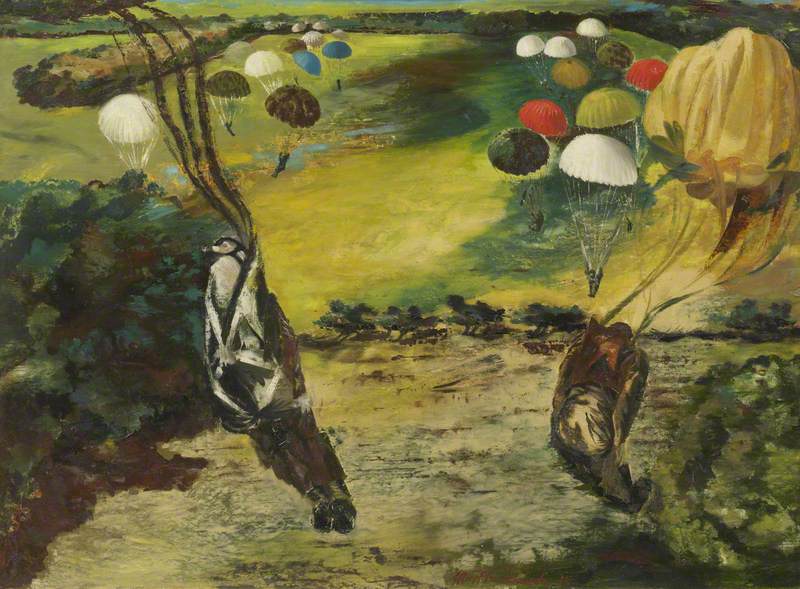
Later in the month Richards took part in a large-scale parachute drop over Brize Norton in Oxfordshire, an event he recalled in the painting The Drop. This was in fact a practice exercise for D-Day. Richards took part in a second such event, Operation Mush, over five days in April across Gloucestershire.

Just after midnight on 6 June he was dropped near Merville to the east of Sword Beach with a unit of the 6th Airborne Division.  This was a top-secret mission to take out the powerful German battery guarding Sword Beach, before the armada arrived.

He took part in the attack on the Merville Battery and the capture of Le Plein village. Richards depicted the attack on the gun battery in several paintings composed within a few weeks of D-Day. The mission to take out the Merville Battery on the Normandy coast was almost a complete disaster. Commanding Officer Lt Colonel Terence Otway had 750 men under his command but only 150 made it to the rendezvous. He had no other option but to go for it. Put in charge of a small platoon, Richards played a key role in helping to overpower the German position which, incredibly, was taken in just 15 minutes. Immediately, he set to work with pad and pencils. He spotted Alan Jefferson, an officer he’d roomed with, lying injured. “Don’t move!” he joked and frantically began sketching him.

Richards used watercolours for speed and painted “quite bleak colours and quite angular shapes to convey the horror of war and the destruction of the natural world”.

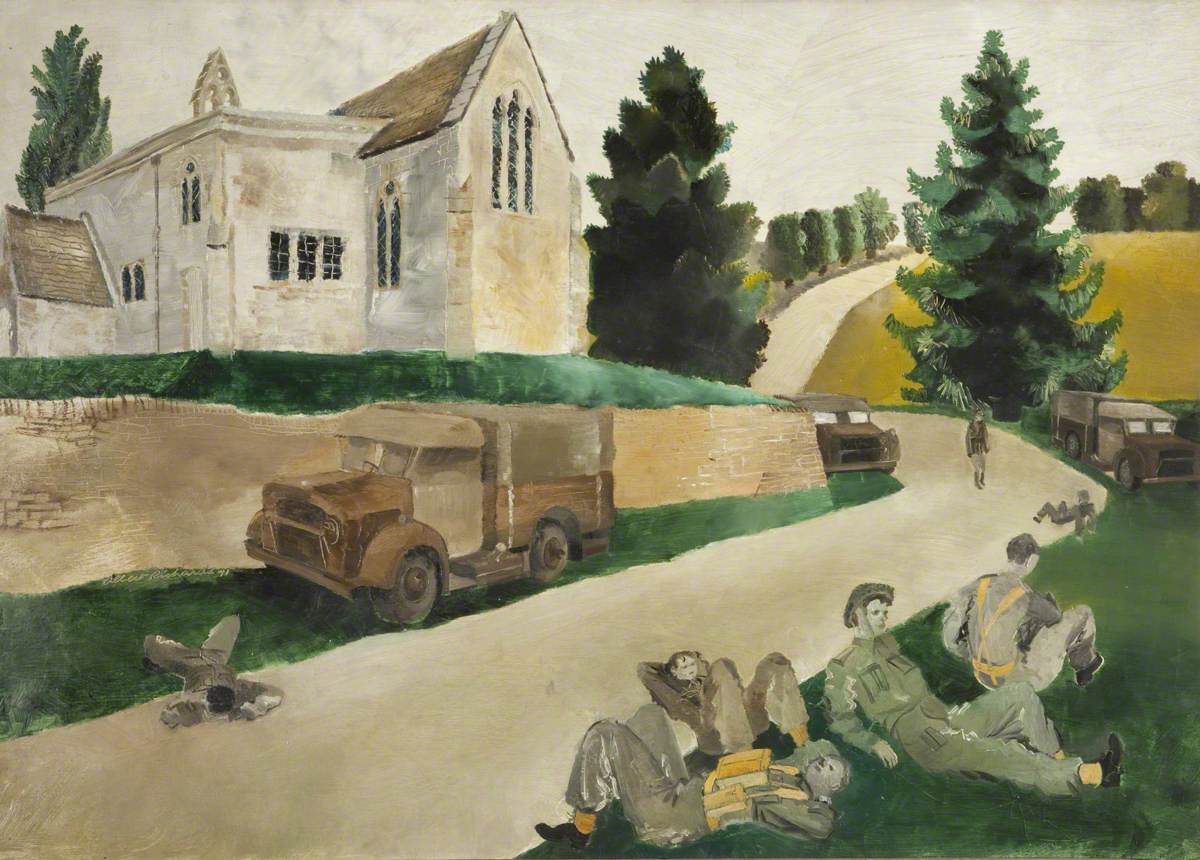
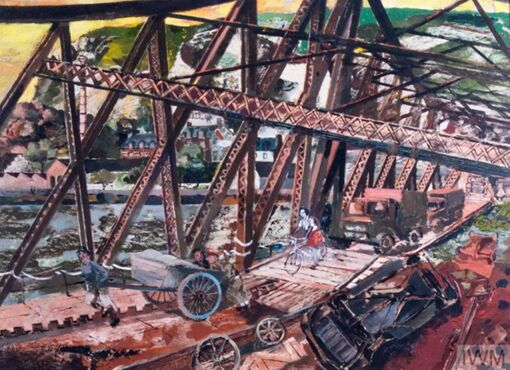
Richards continued with the advancing Allied forces through France and, after a brief period of leave in England went on into the Low Countries. In France he painted scenes such as the remains of the gliders used in the attack on Pegasus Bridge at Ranville, destroyed bridges and roadside camouflage screens.

In October 1944, Richard’s work featured prominently in an exhibition at the National Gallery called Wartime Paintings of the Army Air Forces.

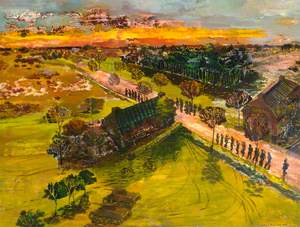
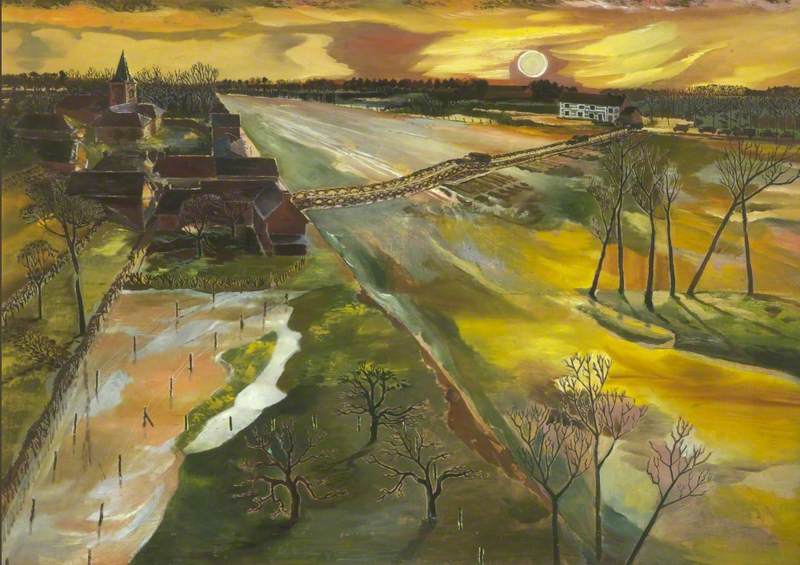
In January 1945, he recorded the funerals held for the victims of the massacre at Bande in Belgium. One of Richards last pictures, painted in February 1945, shows the bridge at Gennep built by Allied sappers across the flooded River Maas. It was in this area while still in Belgium that Richards was killed on 5 March 1945. Richards set off to paint a night attack by the Allies, but his jeep hit a landmine and he was killed. Another war artist, Anthony Gross, heard from eyewitnesses that Richards had taken a shortcut: “He misunderstood the directions, and they couldn’t do anything about it because it was night-time. Very sad.”  He is buried at Milsbeek War Cemetery, near Gennep. At only 25 years old he was the youngest of the War Artists to be killed.

Maurice Collis, the art critic, later said that, through his watercolours, Richards had “achieved a synthesis of modern styles” and had “surpassed his masters… his battle pictures… being dreams of beauty that none of his comrades at the place could in any manner have seen”. Had he lived, Richards might have become one of the great artists of the 20th century.

Ivor Lambe, the War Artist’s Advisory Committee’s Publicity Adviser, drew up a letter which was distributed to press editors, about Richards’s life and death, and promoted an exhibition of his work which was held at the National Gallery in April 1945.

As far as I know there is no biography re Albert Richards and little information in other publications. I cannot lay claim to originality for this article which I have cobbled together from a number of sources. https://en.wikipedia.org/wiki/Albert_Richards_(artist) was a starting point and the Imperial War Museum website also helped. A welcome chunk of the information here came from ‘The Sketchbook War’ by Richard Knott ISBN-13 ‏ : ‎ 978-0750956154. Whatever, I do hope that this talented artist so tragically lost to us will find an appreciative audience of new admirers.
Ethel Carrick Fox

7 February 1872 – 17 June 1952.

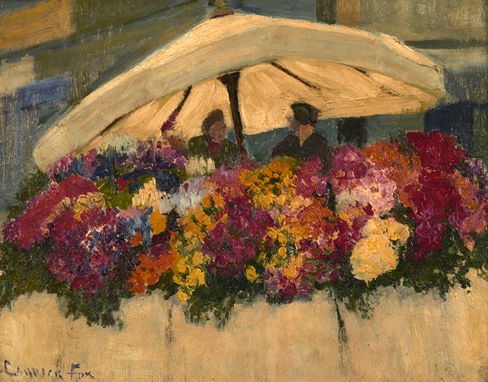
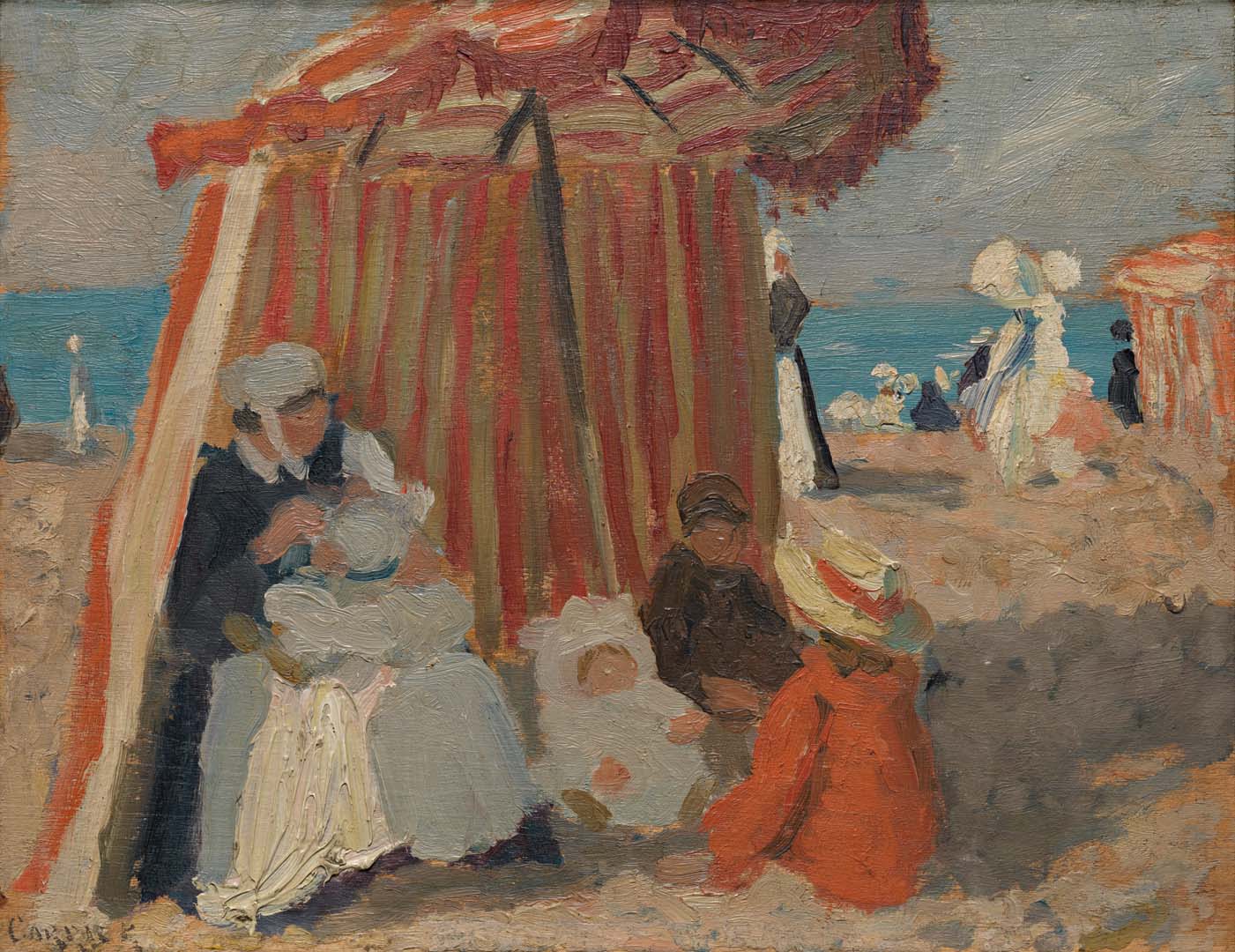
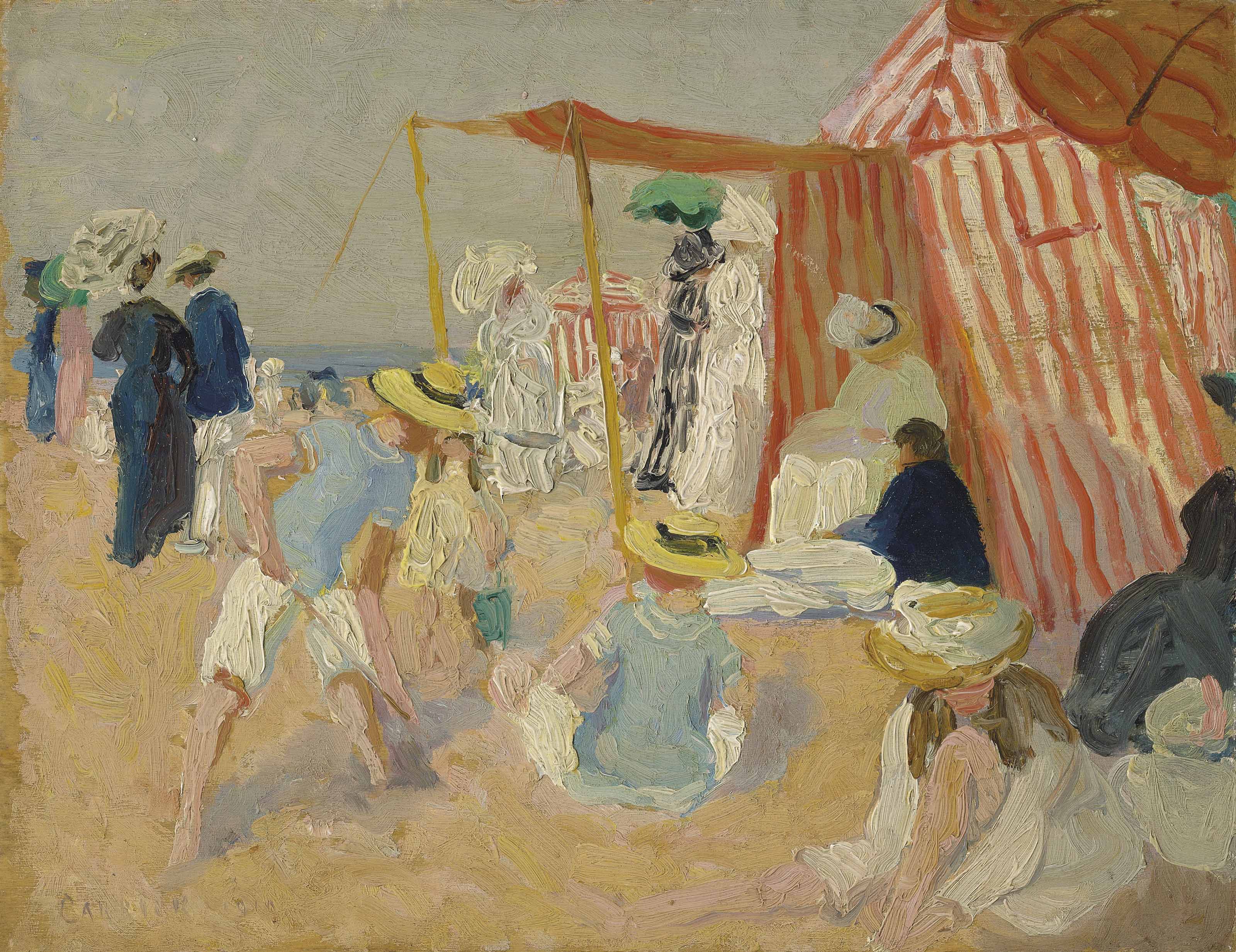
Ethel Carrick Fox was an English Impressionist and Post-Impressionist painter. Much of her career was spent in France and in Australia, where she was associated with the movement known as the Heidelberg School.

Ethel Carrick was born in Uxbridge, Middlesex, to Emma (Filmer) Carrick and Albert William Carrick, a wealthy draper. Ethel was the second eldest of ten children living at Brookfield House, Uxbridge. Ethel’s father was affluent enough to employ maids and send his sons to university, but not daughters ! Ethel stayed at home minding her younger siblings educated by a governess at home, emerging at age eighteen to ‘come out’ into the social world in search of a husband.

She trained in London at the Guildhall School of Music and leaning towards art took private lessons with artist Francis Bate, she discovered that she loved painting.

Henry Tonks

As a relatively older mature student in her mid-twenties Ethel enrolled at the Slade School of Fine Art under Henry Tonks (1898-1903). Tonks was a haughty, gruff, confirmed batchelor, tall and gaunt. He could, on a bad day, reduce a student to despair with his biting criticism in front of the entire class. One unfortunate average girl pupil suffered his severe disapproval, glaring at her work he commented: “I only hope you can sew.”

To Ethel, however, the Slade was vibrant and exciting, a chance to fend off the constant pressure to marry.

Carrick began as an Impressionist plein air painter, the Newlyn and St Ives artists were painting out of doors. Ethel attended the Newlyn summer school in Cornwall tutored by Stanhope Forbes. Ethel started to exhibit her work first at the Royal academy in London in 1903, a Pissarro-influenced work. It was at St Ives that Ethel met a shy Australian artist called Emmanuel Phillips Fox who came from a Jewish background.  He was nearly 40 and excelled in twilight, romantic landscapes. A romance flourished during those summer days.
Emmanuel returned to London and Carrick also moved in order to be close to him. Exhibiting together at the Felix Art club in 1904.

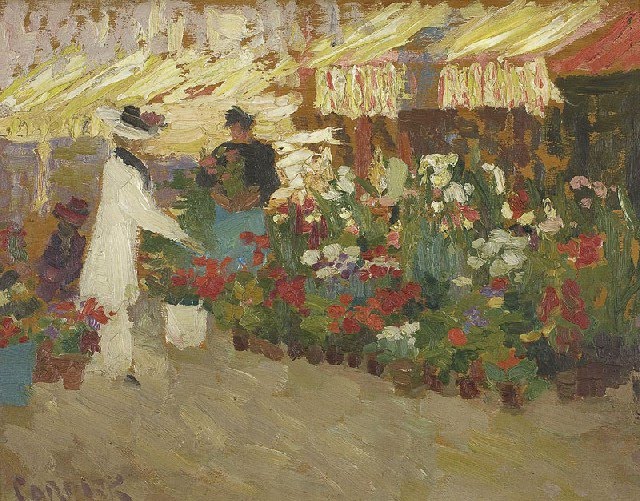
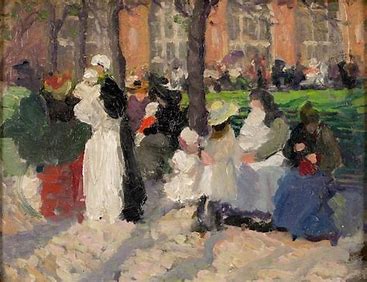
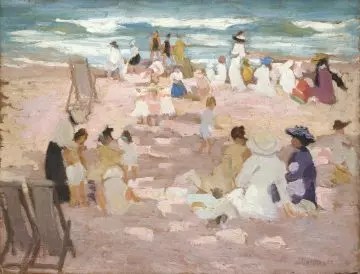
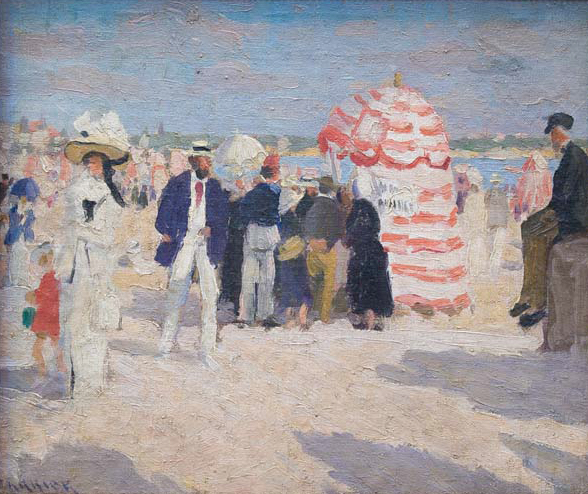
Their wedding took place at St Peter’s Church, Ealing in May, 1905 attended by 150 guests. Soon they departed to live in Paris, a city where art was greatly valued. Ethel quickly moved to a more Post-Impressionist style featuring blockier compositions and sharper colour contrasts. Some of the works produced around 1911-12 are distinctly Fauvist in their strong colours, high abstraction, and loose handling of the paint. With their lodgings only a fifteen-minute walk from the Luxembourg Gardens for Ethel these gardens became an outdoor studio with an endless supply of free models!

Most afternoons Ida John, wife of Augustus, pushed their youngest of four children around the gardens. In 1907 Ida died following complications of childbirth and this could be one of the reasons why Ethel never started a family.

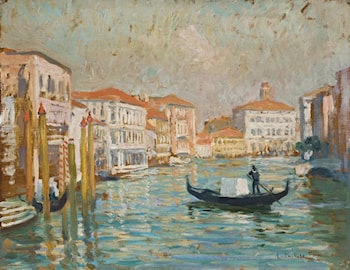
The couple enjoyed a delayed honeymoon visiting Venice in 1907.

Ethel travelled widely in Europe, North Africa, and the South Pacific (Tahiti) during this period and made a trip to Australia in 1908. They spent seven months living with Emmanuel’s widowed mother in Malvern a suburb of Melbourne. Ethel’s first one-women show took place in August 1908 at Melbourne’s Bernard Academy. After what was a stressful stay with Emmanuel’s family the couple departed from Sydney on the SS Mongolia on the 29th August 1908.

Back in Paris Ethel concentrated on her career also playing the role of loyal wife, in Melbourne Emmanuel’s family had constantly pressured her to start a family. In the Paris salon of 2008 Ethel exhibited four bold, colourful works, two of women and children in the Luxembourg Gardens alongside two Australian scenes.
In February 2011 to escape the bitter cold in Paris the couple took a ship from Marseille to Algiers, then travelled around North Africa.

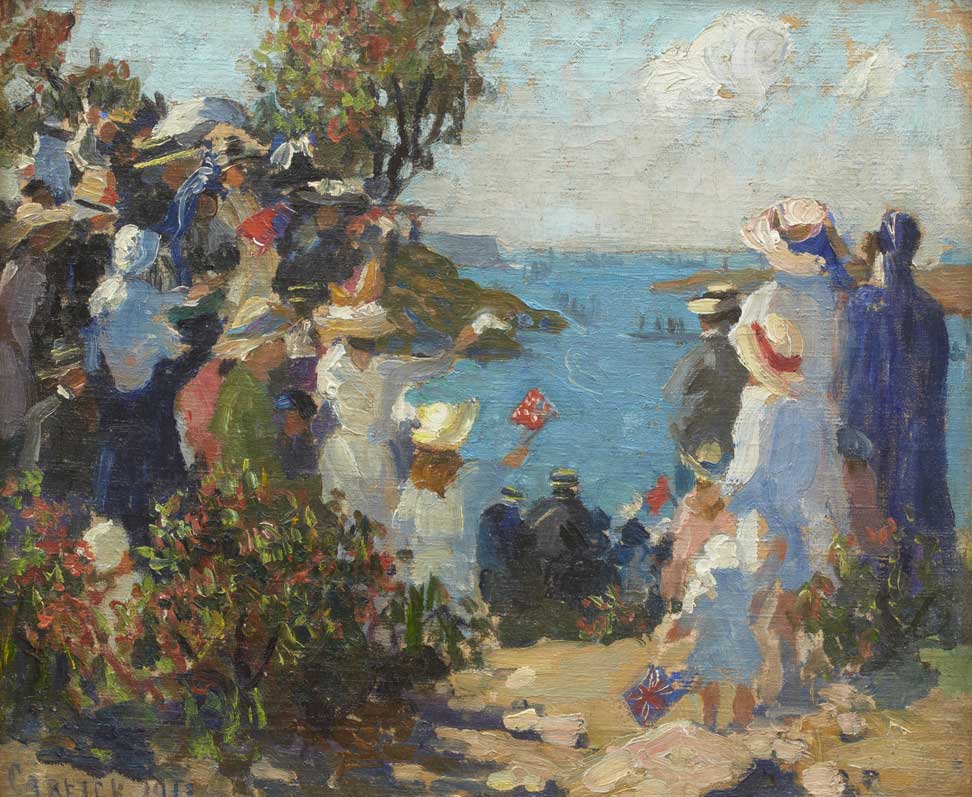
In May 1913 the couple returned to Australia for a second visit which was supposed to last for one year. Emmanuel had a solo exhibition in Melbourne in June. Ethel was one of the few women honoured by another solo exhibition which took place in July in Melbourne.

The outbreak of World War I saw the couple in Melbourne, where they organised a charity art exhibition to raise war funds and to support the French Red Cross with a field lorry.

Emmanuel Phillips Fox.

Emmanuel, a heavy smoker, now had health problems and his condition plus the stress of war alongside living with ‘Mannie’s’ family saw Ethel depart for Sydney on her own, no doubt hoping things would improve when the war was over and they could return to Paris. When Emmanuel was diagnosed with lung cancer Ethel returned to Melbourne. He died on the 8th of October 1915.
Following Emmanuel’s death Ethel began two decades of travels that took her through the Middle East, South Asia including India, and Europe. She returned intermittently to Australia to exhibit her work and go out on painting expeditions around the country. In the 1920s, she was recommended by the Académie de la Grande Chaumière in Paris as a private teacher of still life painting, and she counted a number of Australians and Americans in Paris among her students.

Early in 1925 Ethel sailed back to Australia staying in Sydney at The Manor a mansion purchased by the Theosophical Society, which she embraced. A compulsive traveller many travels followed before a seven year stay in Paris, returning to Australia in 1932. In 1934 she organised a joint exhibition of her and Emmanuel’s work in Melbourne at the Atheneum Gallery. Back in Paris in 1938 Ethel with failing eyesight, having been married to a Jew feared for her safety. She managed to board an ocean liner bound for Australia packed with Jewish refugees. Back in Sydney Ethel was welcomed at The Manor where she survived by teaching private pupils.

At the end of the war Ethel returned to Paris in 1946. In 1952 at the age of eighty a frail Ethel made her final trip to Australia, did she wish to end her days in Melbourne? Not long after her arrival Ethel suffered a cerebral haemorrhage, lingering in a coma for two days. Ethel died on the night of 17th June. Two days later she was cremated in a private ceremony attended by few people.      

In her lifetime, Carrick’s reputation was eclipsed by her husband’s, in part because she worked tirelessly a good deal of her time promoting his career rather than her own, lobbying Australian collectors and curators to buy his work and arranging exhibitions both while he was alive and posthumously.

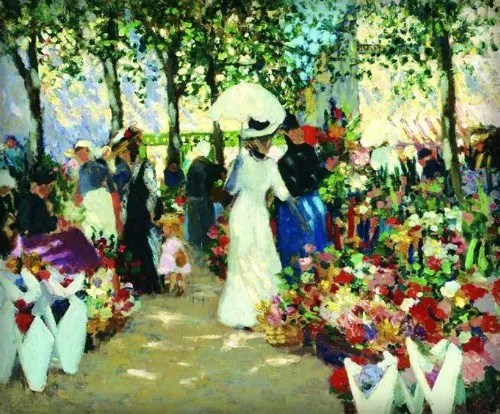
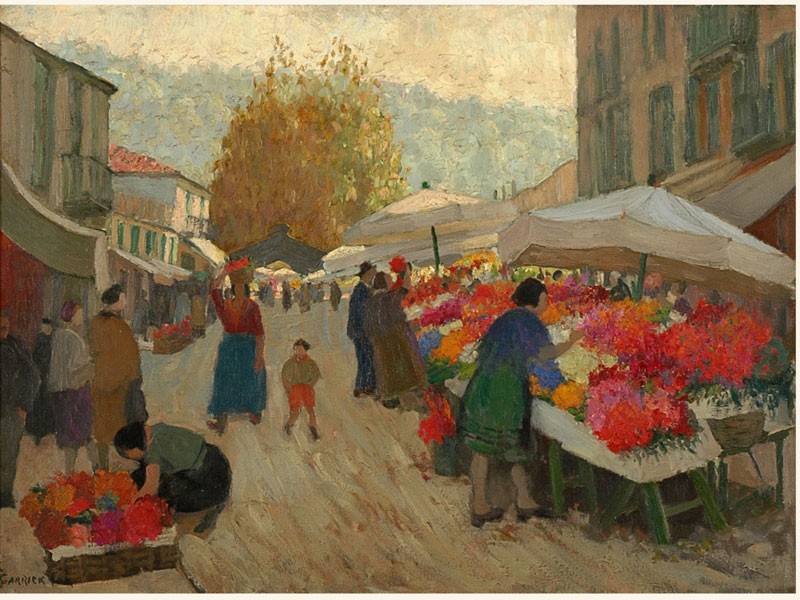
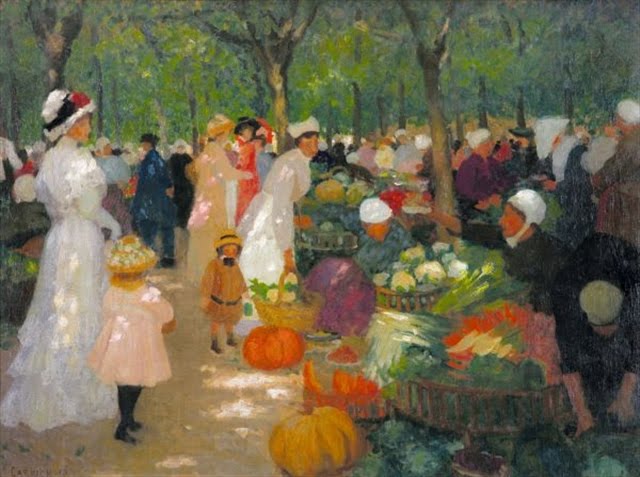
In recent years, her reputation has been rising, and critics today consider her work more adventurous than that of her husband. In 1996, one of her paintings, Market Under Trees, set an auction record of A$105,500 for works by an Australian woman artist. The work was later resold at  $1.464 million.

Most of the information for this blog is taken from ‘Ethel Carrick Fox – Travels and Triumphs of a Post Impressionist.’ Pandanus Press. 1997.

Timothy the Tortoise

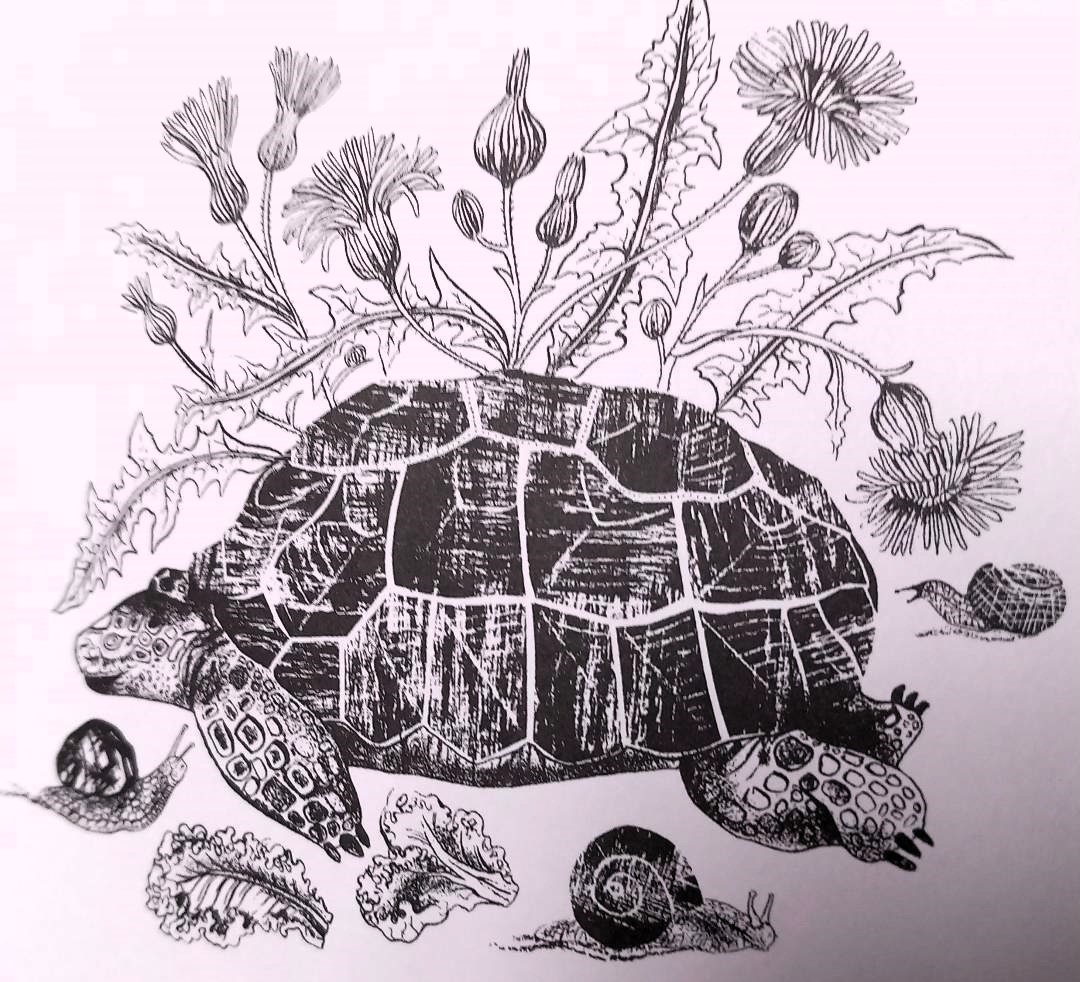
‘It hobbles towards its benefactress.’ Linocut by Christopher Brown 2020.

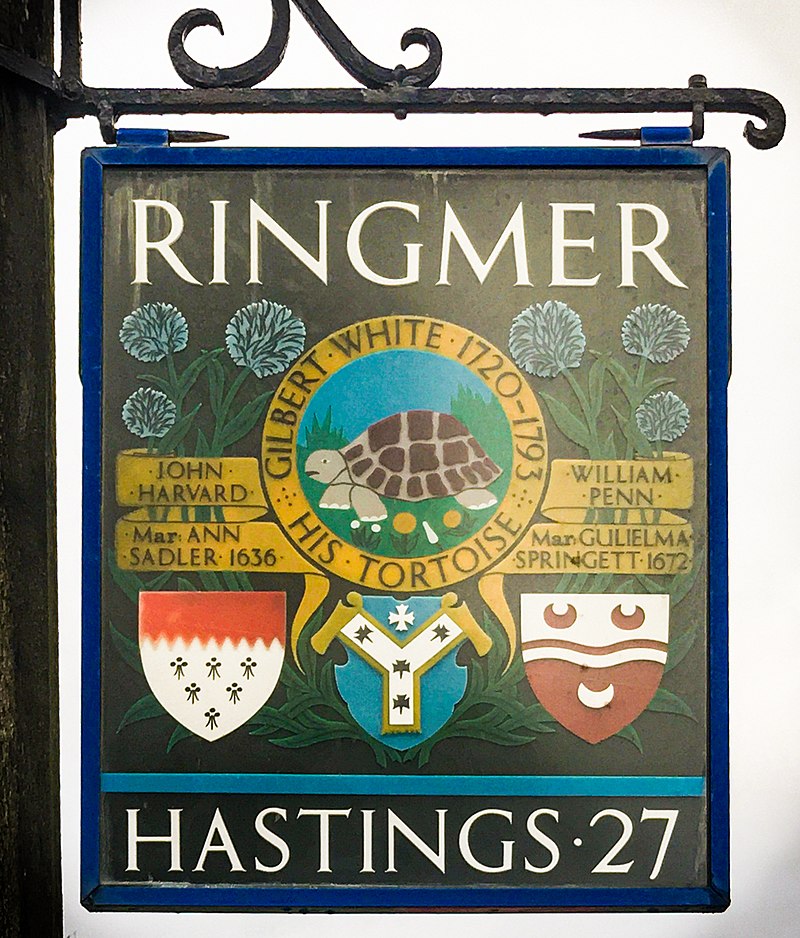
Ringmer, north of Glynebourne had a most distinguished resident He was Timothy the Tortoise, who takes pride of place on the village sign beside the green. He belonged to Mrs Rebecca Snooke, who lived at Delves House and was the aunt of the naturalist Gilbert White who took a great interest in the pet’s habits when he paid visits. Mrs Snooke had originally purchased Timothy from a sailor in Chichester harbour.

White recorded: ‘I was much taken with its sagacity in discerning those that do it kind offices; for as soon as the good old lady comes in sight who has waited on it for more than 30 years it hobbles towards its benefactress with awkward alacrity, but remains inattentive to strangers.

‘Thus not only the ox knoweth its owner, and the ass his master’s crib, but the most abject reptile and torpid of beings distinguishes the hand that feeds it, and is touched with the feelings of gratitude.’

In April 1780 the aged Timothy went to live with White at Selborne in Hampshire, being carried the 80 miles in post chaises which apparently perked him up enough to do two laps of the garden when he arrived.

Letter to Daines Barrington. Selborne, Aril 21st, 1780.

‘The old Sussex tortoise, that I have mentioned to you so often, is become my property. I dug it out of its winter dormitory in March last, when it was enough awakened to express its resentments by hissing; and, packing it in a box with earth, carried it eighty miles in post-chaises. The rattle and hurry of the journey so perfectly roused it that, when I turned it out on a border, it walked twice down to the bottom of my garden; however, in the evening the weather being cold, it buried itself in the loose mould, and continues still concealed.’

Eric Fitch-Daglish: The Tortoise in the Garden, The Natural History of Selborne, E M Nicholson, Thornton Butterworth Ltd. 1929.

‘This hot weather makes the tortoise so alert that he traverses all the garden by six o’clock in the morning. When the sun grows very powerful he retires under a garden mat, or the shelter of some cabbage; not loving to be about in vehement heat. In such weather he eats greedily.’      GW 16th June 1782.

Eric Ravilious: The Tortoise in the Kitchen Garden. The Writings of Gilbert White, H G Massingham, The Nonesuch Press, 1938.

‘The tortoise took his usual ramble, & could not be confined within the limits of the garden. His pursuits, which seem to be of the amorous kind, transport him beyond the bounds of his usual gravity at this season. He was missing for some days, but found at last near the upper malt-house.’    GW 5th June 1787.

Timothy remained at Selborne and died in 1794, the year following White’s own death. his shell was preserved at the British Museum. According to the Natural History Museum, after her death, Timothy was identified as having been a girl tortoise all along.

Gilbert White’s Natural History of Selborne has been continuously in print since its first publication in 1789. It was long held to be the fourth-most published book in the English language after the Bible, the works of Shakespeare and John Bunyan’s The Pilgrim’s Progress.

The star of this show is undoubtedly Timothy but it would be amiss not to point you to information re Gilbert White himself which is best served by Wikipedia :-https://en.wikipedia.org/wiki/Gilbert_White

Much of the inspiration for this blog came from ‘Drawn to Nature, Gilbert White and the Artists.’ Simon Martin, Pallant House Gallery 2021. Not forgetting – The Natural History of Selborne, Gilbert White, introduced by James Lovelock, illustrated by Eric Ravilious, Little Tolller Books 2014. Gilbert White: the modern naturalist | Natural History Museum (nhm.ac.uk)

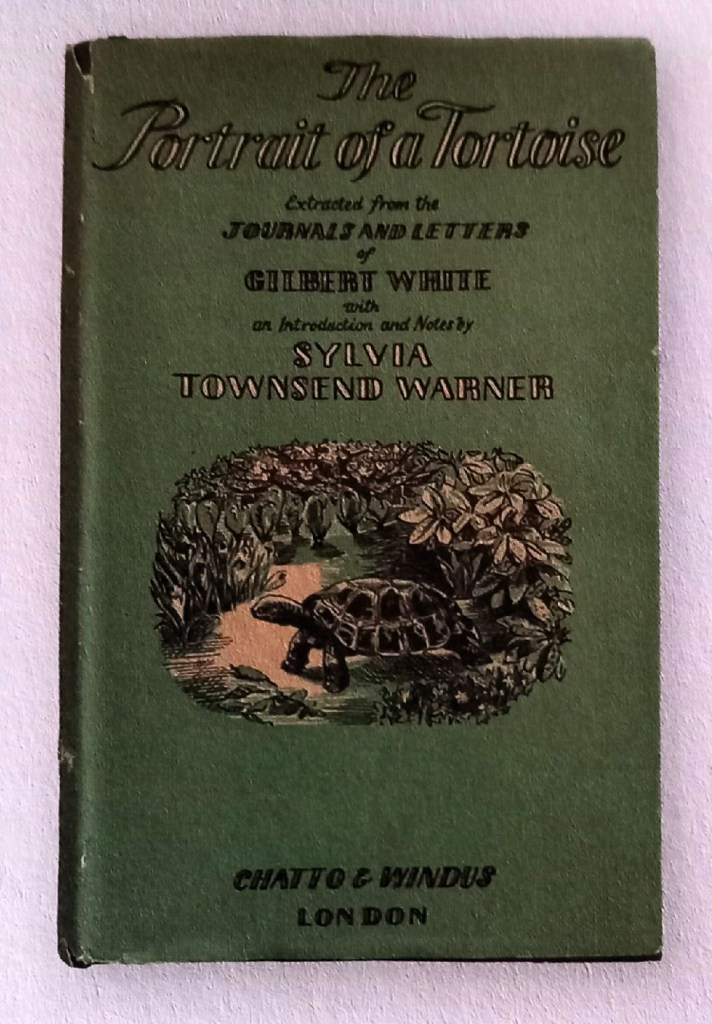
Sylvia Townsend Warner has extracted from the writings of Gilbert White references to the old tortoise he inherited in 1780 from his aunt.