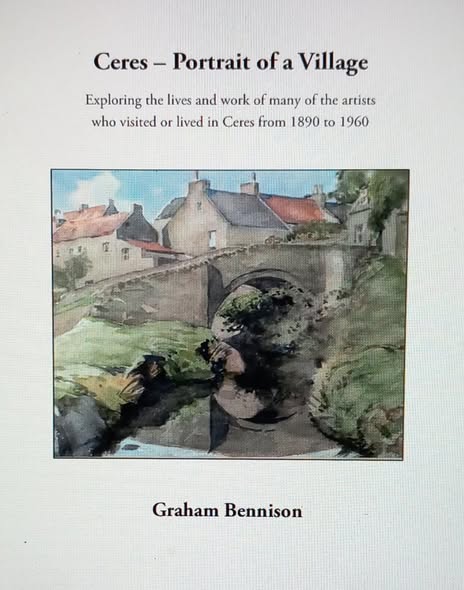
The picturesque Fife village of Ceres is well ‘in the frame’ with the March 2026 publication of Ceres – Portrait of a Village by Graham Bennison.
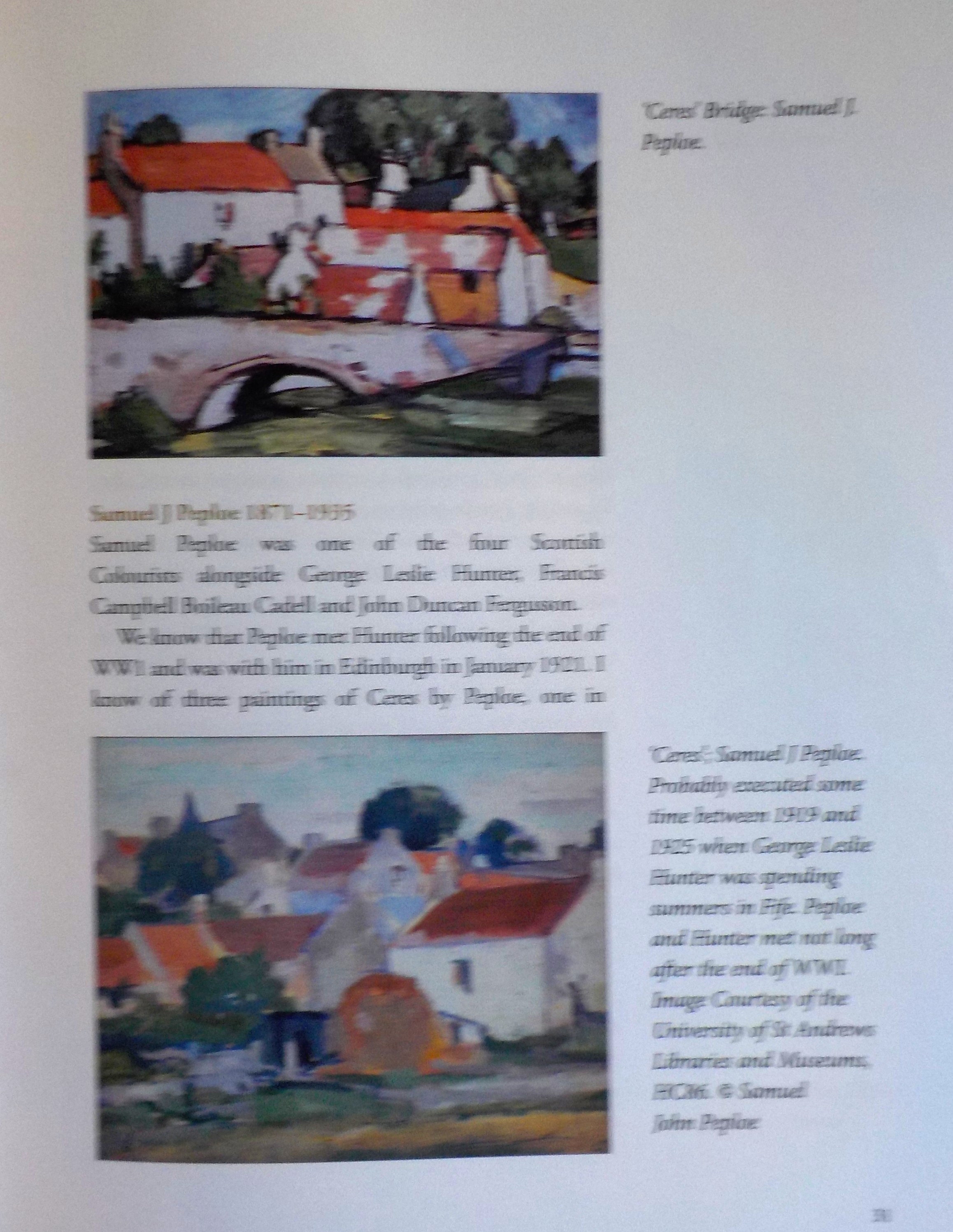
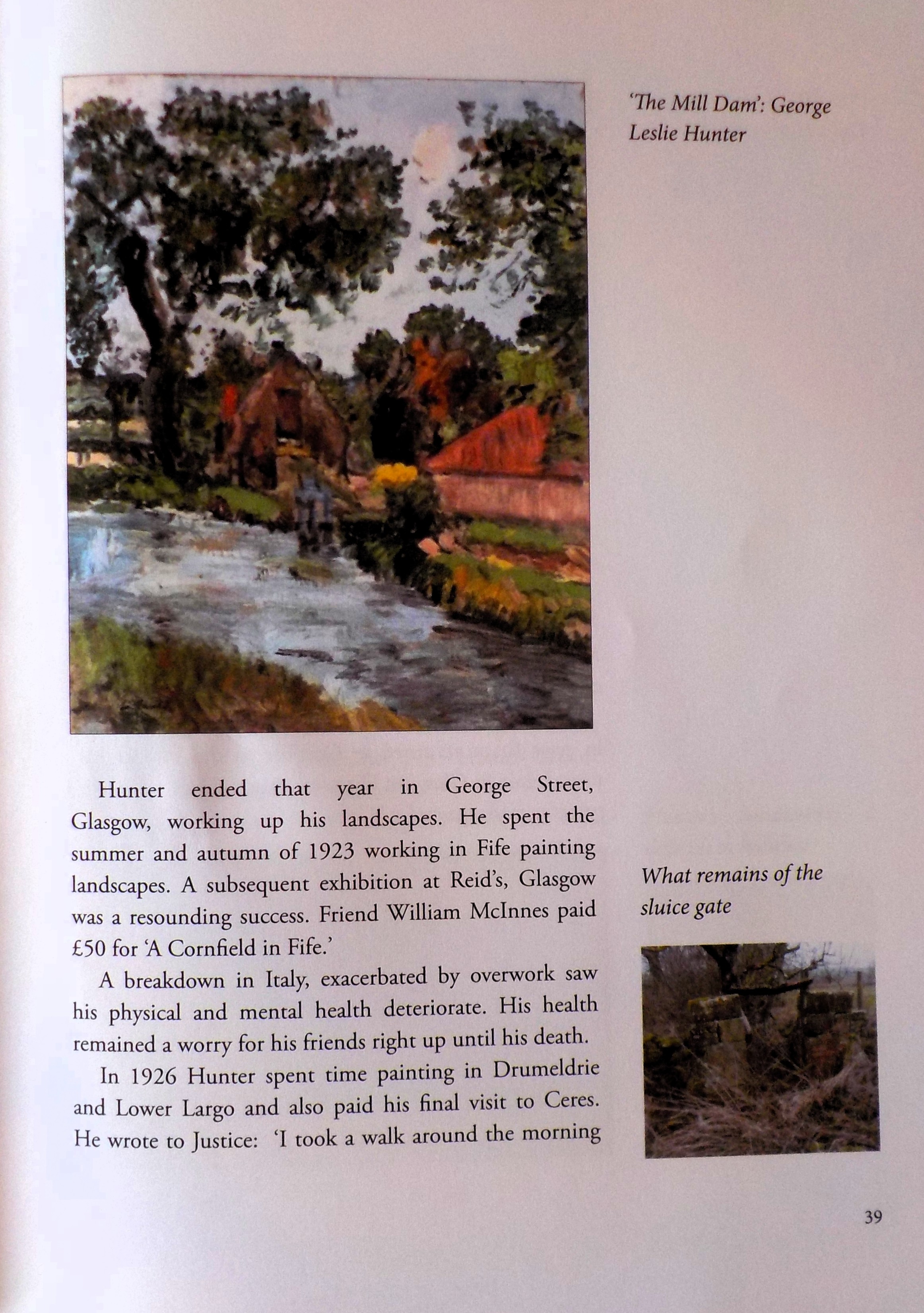
Bennison, a Ceres resident for twenty years, now resides in nearby Foodieash but retains strong links with Ceres through his artwork, notably linocut designs of the village. Many artists visited and worked in Ceres during the early twentieth century including two of the four Scottish Colourists, George Leslie Hunter and Samuel J Peploe. Arriving in the village in 1987, a lifetime background in art encouraged Bennison to learn more about the ‘Ceres artists.’ In 1997 following thirty-three years in education, the retired Headteacher found time to paint and study Scottish art. [SB2] A blog ‘Some of the Artists who Visited Ceres’ published in 2020 attracted 770 views with several Ceres residents suggesting that a book could be a good idea. Bennison initially resisted but now coming into his 80th year, relented and in 2025 intensified his efforts into more research efforts. The result is a detailed study of the ‘Ceres artists’ pitched alongside Bennison’s reminiscences of his family life in the village.
The book, printed by the University of St Andrews Print and Design team, is awash with pictures of the village and artwork. Published by Jenny Rooney, the design of the fifty-one pages is an artwork in its own right. Rooney resides in Great Bardfield, Essex: a village that was an art haven and the home of Edward Bawden, Eric Ravilious, John Aldridge and many eminent twentieth century artists. Graham Bennison will be selling copies of the book alongside his own artwork of Ceres at the Open Studios North Fife on the 2nd, 3rd and 4th of May 2026, at Venue 40, Beechbank, Foodieash.
The book printed in a booklet format (£10) can also be purchased by emailing: bennyelmwood@yahoo.co.uk
Betty ‘Duffy’ Ayers, artist, born 19 September 1915; died 10 November 2017.
Duffy was born Betty FitzGerald, with an identical twin, Peggy, in Great Missenden, Buckinghamshire. Their father, William FitzGerald, the feckless brother of the Irish nationalist politician and poet Desmond FitzGerald, abandoned the family when the twins were very young. Their American mother, Laura (nee Farlow), felt she had no alternative but to leave her daughters in a convent school on the Kent coast while she went to teach English in Turkey.
While the other pupils went home for their holidays, the FitzGerald girls stayed with the nuns, who treated them, they recalled, with great cruelty and starved them of affection. The girls did not recognise their mother on her return after seven years’ absence. Emotionally, Duffy was deeply scarred by this long childhood experience but it consolidated in her a remarkable stoicism and strength of character, and she was herself the gentlest of women.
Peggy and Duffy.
In the early 30s Duffy attended the Central School of Art in London where she met Michael Rothenstein, later to become one of the leading printmaker-artists of his generation. They married in 1936, she 21, and moved to Great Bardfield in 1941. They lived initially in Chapel House (in the grounds of John Aldridge’s Place House) before moving to Ethel House in the High Street.. The north Essex village was home to a distinguished community of artists from the 1930s to the 60s, including Eric Ravilious, Edward Bawden, Tirzah Garwood and John Aldridge.
Duffy’s emergence from the extreme unhappiness of her schooldays no doubt deepened her empathy, during their first years together, with Michael’s slow recovery from the melancholia of myxoedema (arising from a thyroid condition) that had afflicted him throughout his 20s.
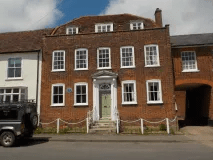
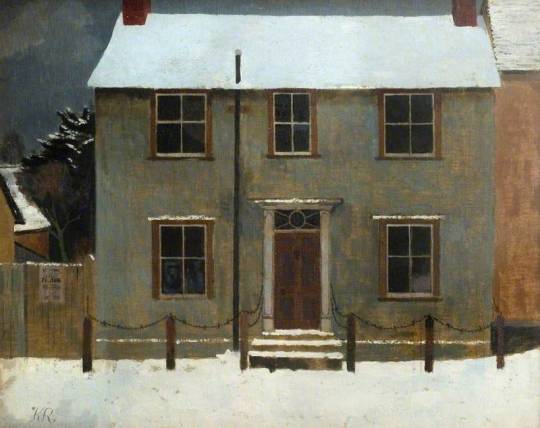
Kenneth Rowntree’s painting of Ethel House.
Duffy did little of her own work during these years, but she collaborated with Michael on large-scale paintings and later assisted his printmaking. During the second world war she made few paintings of her own but worked at times with the designer Peggy Angus on wallpaper designs.
Duffy was a gifted portrait painter and an early subject was Tirzah Garwood wife of Ravilious lost over Iceland in 1942.
Later she taught art to the local women of the Women’s Institute proving to be a gifted teacher who encouraged original work of remarkable quality. During the war she maintained a lively correspondence with Robert Graves, a pre-war friend who was a regular visitor to Great Bardfield now living back at home in Deya, Majorca following an exile during the Spanish Civil War and WW2.
During the war Duffy was almost killed when a bomb fell near a bus she was on. “I escaped because I was on the top floor,” she said.
Portrait of Kitty Wilson 1945. Fry Art Gallery. Kitty Wilson was a remarkable woman. Born in Deal, she worked for Dr Barnado’s in Essex for several years, caring for young disabled girls. In 1929 she travelled to Kalimpong in India to look after deprived children, returning to Essex after three years due to health problems.
Duffy and Michael’s son Julian, later founder of Redstone Press, was born in 1948, and daughter, Anne, who became an artist, was born in 1949.
By the mid-50s, Great Bardfield had become famous for its popular Open House exhibitions, initiated in 1951, when several of its artists were employed on murals and design work for the Festival of Britain. For several years, for a summer fortnight, thousands of art lovers descended on the village to traipse through the artists’ houses, delighted by a figurative English modernism that was accessible and stylish, often depicting the life of the village and the landscape around it. During the 40s and early 50s Duffy was a lively presence at the heart of this social and artistic activity. Michael had by this time set up printmaking facilities at Ethel House on the High Street (later enlarged with a studio extension by Frederick Gibberd).
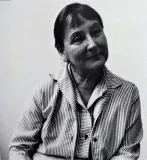
Left: This painting has a strange history. Duffy painted herself, or her twin sister, in the 1950s (she was then Duffy Rothenstein). But she threw the painting away (perhaps she was dissatisfied with it) and it was literally rescued from the wastepaper basket by the babysitter, Mrs Perkins. Her son Don Perkins gave it to the Great Bardfield Historical Society in 2011. Right: Self Portrait by Peggy Fitzgerald, Tullie House Gallery, Carlisle.
In 1955 Duffy and Michael separated, and they divorced in 1956. Duffy married the graphic artist, Eric Ayers (1921-2001). “He was always waiting in the wings,” she said. Duffy left Great Bardfield, and stopped painting for many years. Following her second marriage, to Eric Ayers, she moved to a Georgian house in Bloomsbury, central London, where she lived for the rest of her life. She showed regularly at the Royal Academy Summer Exhibitions, and in commercial galleries.
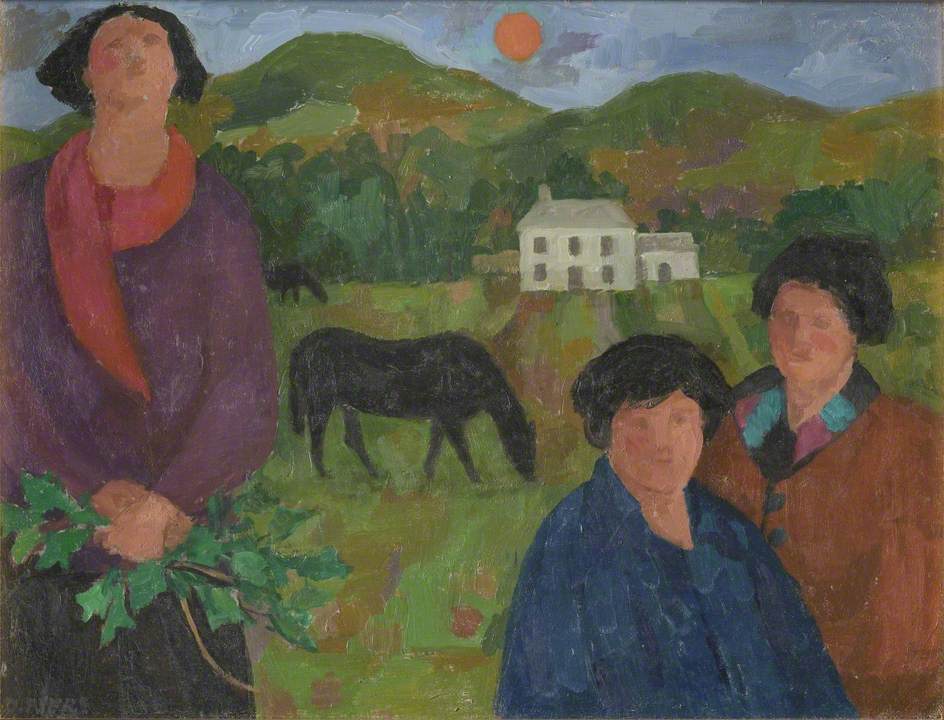
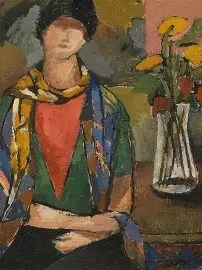
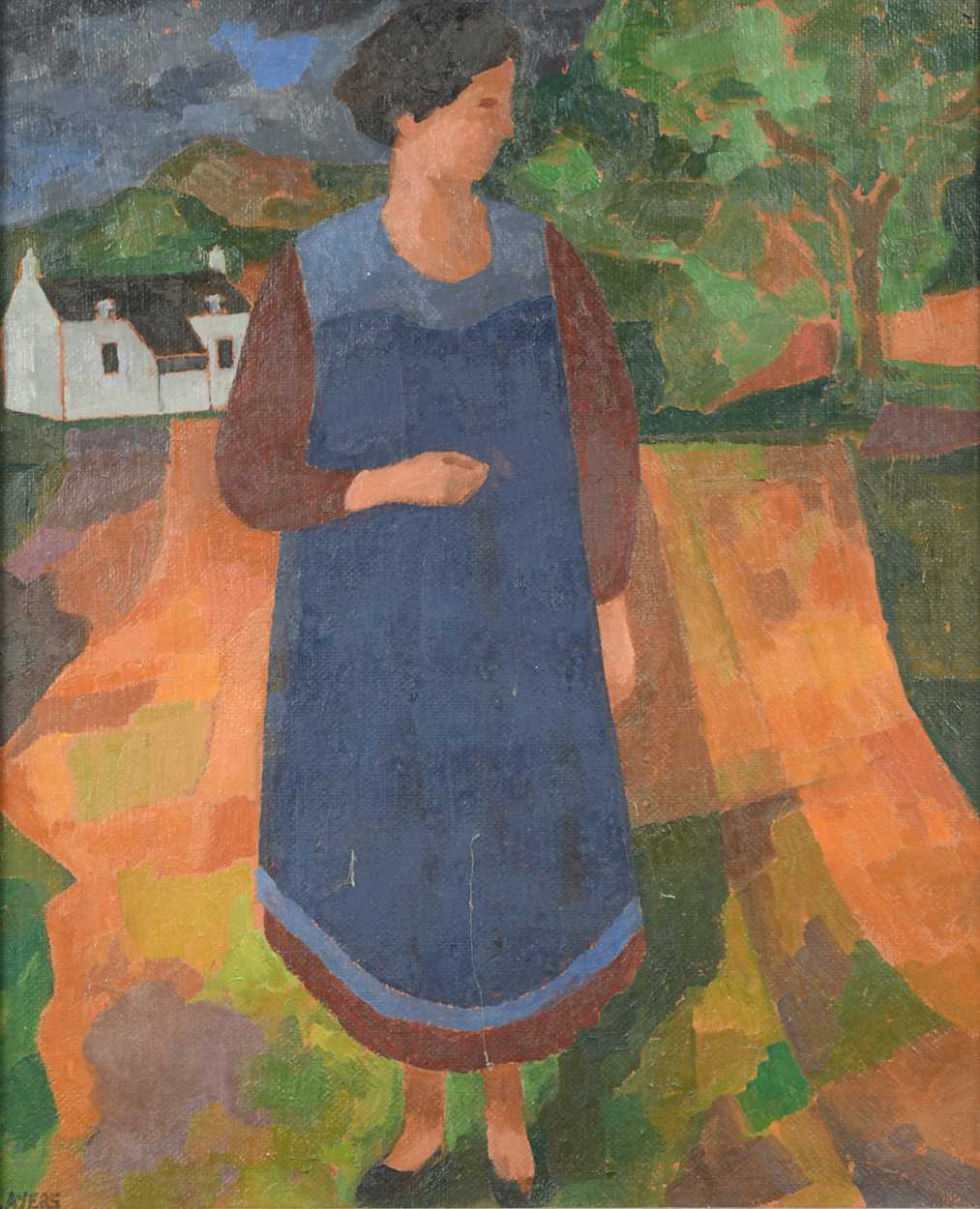
Still Life Reclining Nude The Hill Farm Girls
Duffy’s work included a few still life paintings but mainly women, full face in ageless garments. She avoided landscapes, “leaves are horrid repetitious shapes !”
Top left: Scarves, date unknown, Fry Art Gallery. Middle: woman with Scarf. Top right: Unknown. Bottom left: Olive in her garden, presume friend Olive Cook. women in White, 1996.Right: Family Group.
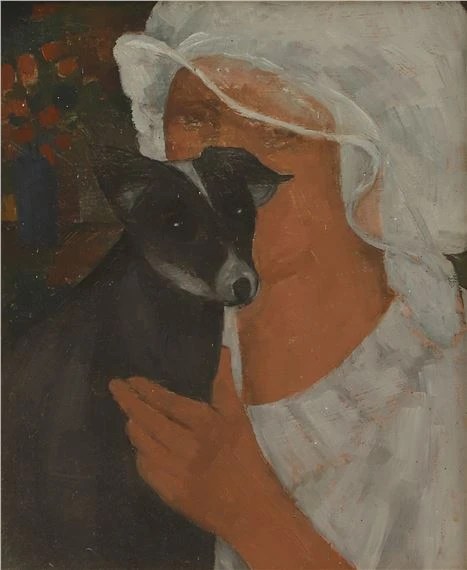
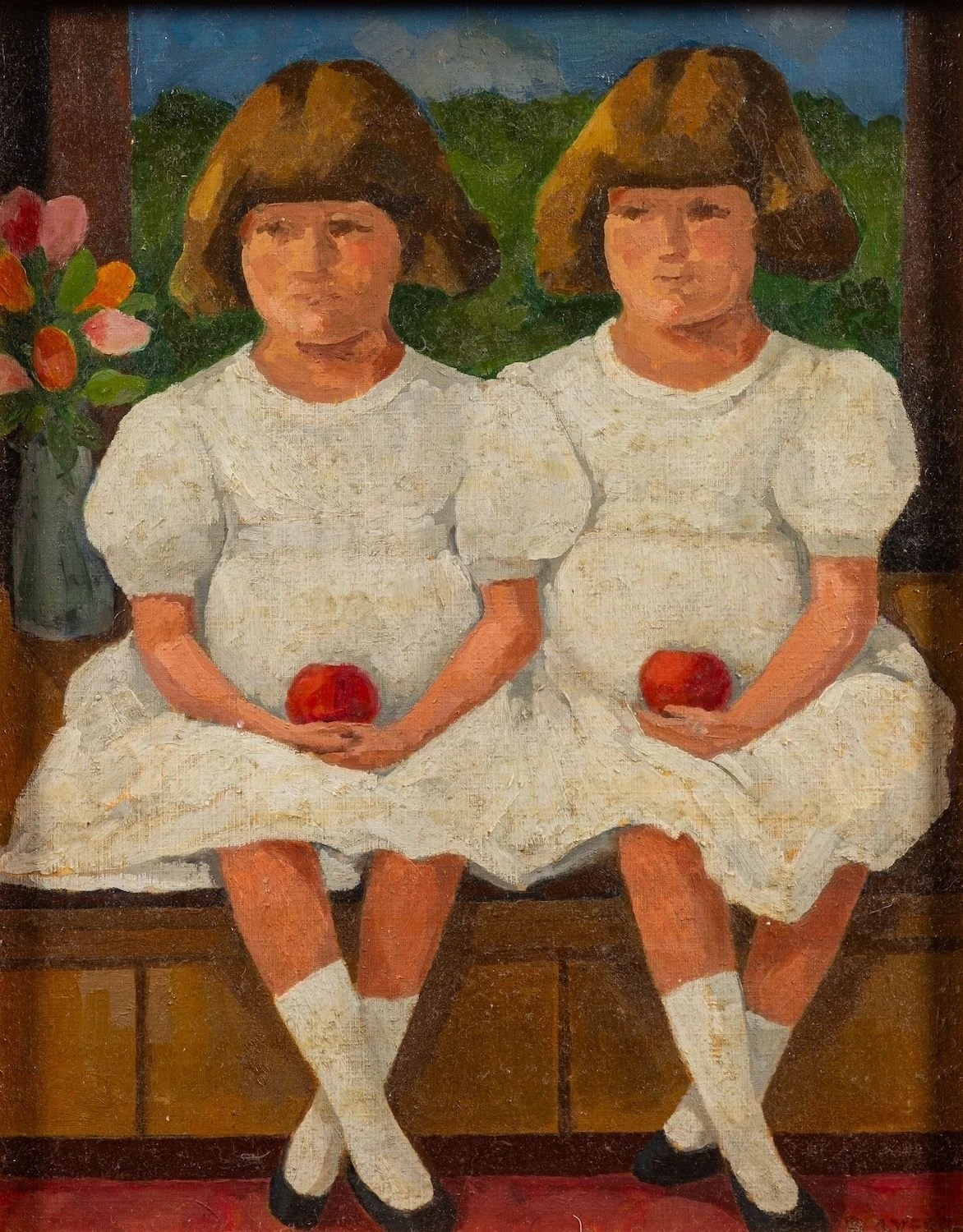
Top left: Girls with Dog. Middle: Girl with Fishes. Tope right: The Apple Eaters. Bottom left: Girls in Blue (portrait of Anne), Fry Art Gallery. Bottom right: Ink Drawing of Daughter Anne.
After Eric died in 2001, Duffy carried on painting until a fall left her frail. In 2006 an Australian couple, Sven Klinge and Belinda Murphy, moved in as temporary carers; they stayed for 11 years. They kept Duffy alive and alert, steered her through many interviews about her years in Great Bardfield and monitored her increasing dementia. Despite the late onset of blindness, her final decade may well have been one of her happiest. Duffy died in November 2017 at the age of 102
Under the Sun, 1999.
Duffy attributed her long life to simple living. “I used to smoke but I stopped years ago, and for a long time now I have lived an austere life, never eating too much or drinking – though I still like the odd glass of red wine.”
Duffy at home, 4 Regent Square, by Richard Bawden 2009.
Graham Bennison, November 2025, Thanks to Wikipedia but mostly to Mel Gooding, Guardian 11th Dec. 2017 who penned Duffy’s obituary which forms most of the text here given the lack of other sources.
Charles Isaac Ginner CBE, ARA was born 4th March 1878 in Cannes, south of France, the second son of Isaac Benjamin Ginner, a British medical doctor. His mother Lydia Adeline Wightman was born in Scotland. He was educated in France at the Institut Stanislas (Cannes) and spoke and looked like a Frenchman.
At an early age, Ginner formed the intention of becoming a painter, but his parents disapproved. When he was sixteen, he suffered from typhoid and double pneumonia and travelled in a tramp steamer around the south Atlantic and the Mediterranean to convalesce; on returning to Cannes, he worked in an engineer’s office, and in 1899, at the age of 21, moved to Paris to study architecture. He worked in an architect’s office in Paris from 1899 to 1904. He then entered the Academic Vitti and trained as a painter with Spaniard Anglada y Camarasa who also taught at the Ecole des Beaux-Arts. Camarasa disapproved of Ginner’s admiration for Vincent van Gogh.
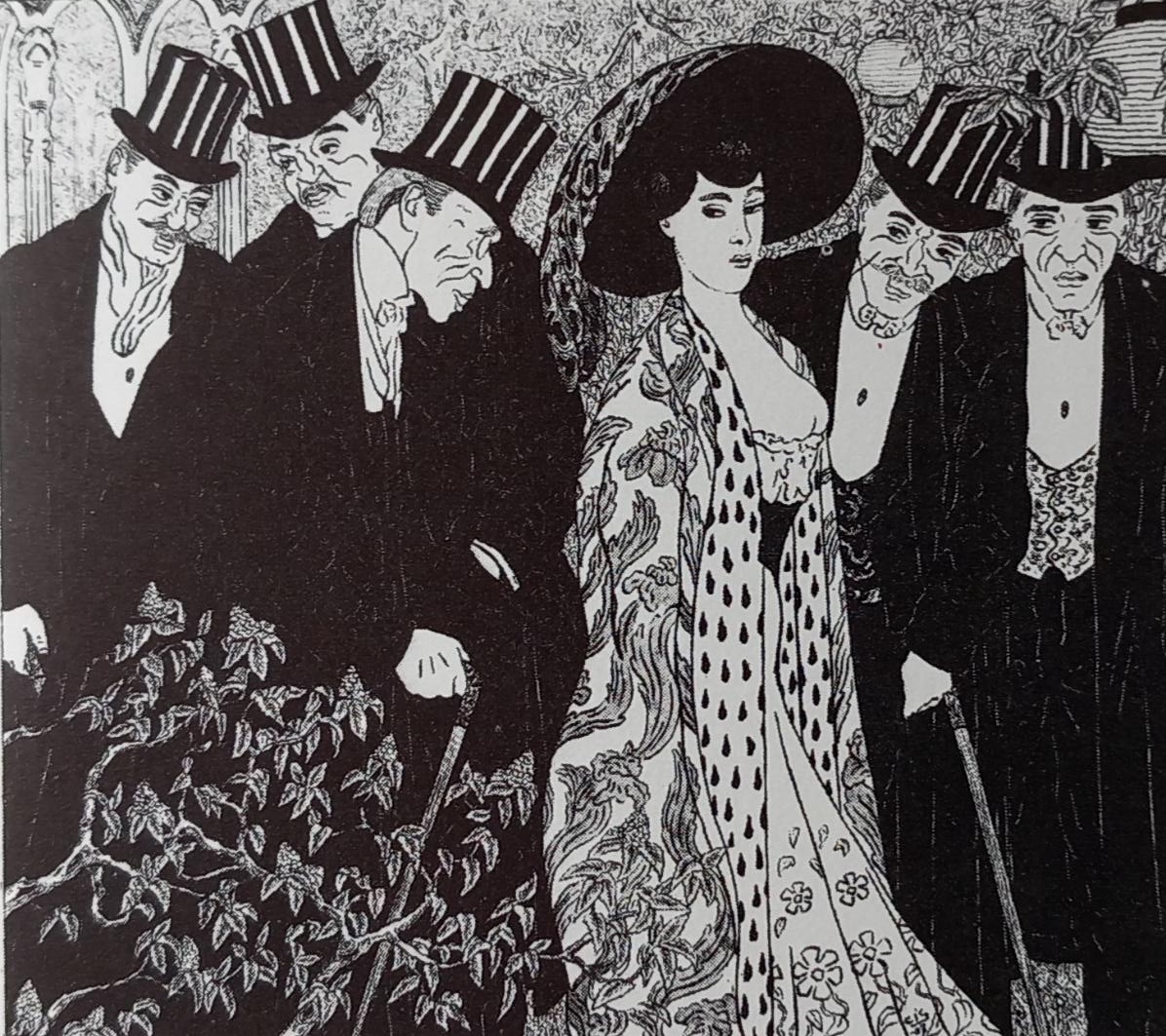
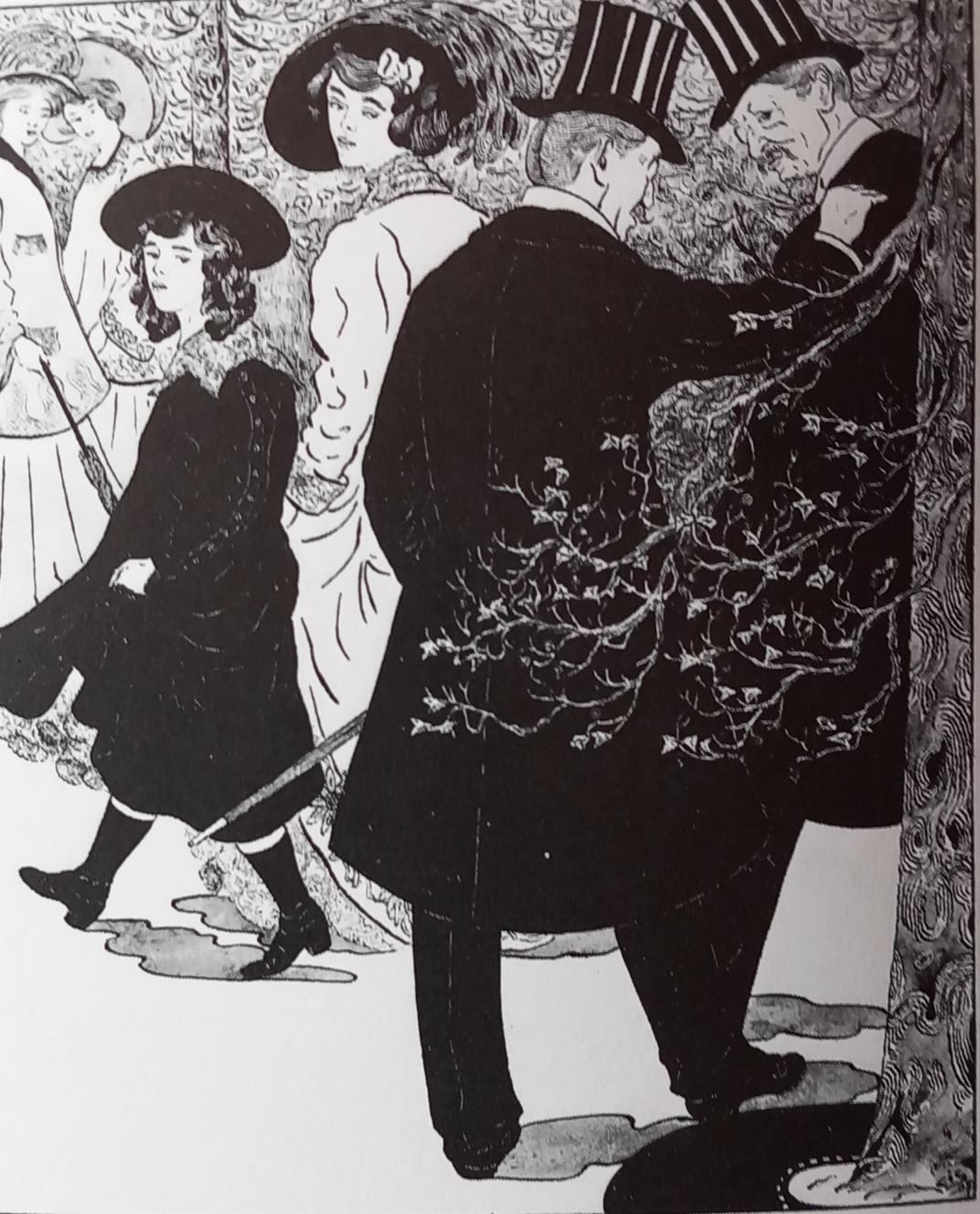
Question d’ Actualite 1904. Du Tic Au Tac 1907. Les Suiveurs 1907. Ginner’s early French work – illustrations for magazines. In one of these illustrations, Les Suiveurs 1907, depicts people in a public park, he drew a tree trunk densely covered with art nouveau patterns, showing his liking from the beginning for a saturated decoration of busy, concentric linear shapes.
Charles Ginner: La Vieille Balayeuse, Dieppe 1913. The Tate.
Ginner’s painting depicts a crowd gathered in the Fish Market beside the Avant Port in Dieppe. In the centre of the work the old street sweeper of the title brushes the road. On the left, an old fisherwoman stands with hands on hips, carrying a large fish basket on her back, while to the right a young, middle class woman wearing a bright red jacket looks in the opposite direction. Characteristically, Ginner has painted the foreground and background in a consistent level of detail.
Charles Ginner Le Quai Duquesne, Dieppe 1913
In 1908, Ginner left Vitti’s and worked on his own in Paris, inspired by van Gogh, Paul Gauguin and Paul Cezanne. His earliest surviving oil painting dates from 1908 now aged thirty. I
While still resident in Paris, Ginner contributed to his first London exhibition: the open-submission Allied Artists’ Association at the Royal Albert Hall in 1908. The organiser, Frank Rutter, later recalled:
Few people took much notice of his work when it was first shown here in 1908, but several artists were literally attracted by his lavish use of pigment, and the canvas being still wet, took away samples of his paint in their finger-nails. Some few, however, approached his work with more respect, and I well remember Spencer Gore coming up to me before the Ginners and saying with conviction, ‘This man is a painter.’
In 1909, Ginner visited Buenos Aires, Argentina, where he held his first one-man show, which helped to introduce post-Impressionism to South America. His oil paintings showed the influence of Van Gogh, with their heavy impasto paint.
Ginner held a joint exhibition in September at the Salón Costa in Buenos Aires with a fellow student from the Académie Vitti, the Danish painter Dora Erichsen (died 1943), where he sold at least five paintings. The art historian Wendy Baron reasons that the two probably travelled to and from Argentina together, and that Dora was most likely the married woman described in Benjamin Fairfax Hall’s first-hand account of Ginner: ‘He never married and adopted a slightly cynical attitude towards sex, affecting to regard his mistress as a constitutional necessity like the T.C.P. with which he gargled every morning. He was much in love as a young man with a woman who preferred to marry someone else. The marriage was not a success and would have been disastrous for the two daughters born of it, had not Ginner, who had a great fondness for children, made himself responsible for their education and welfare.‘
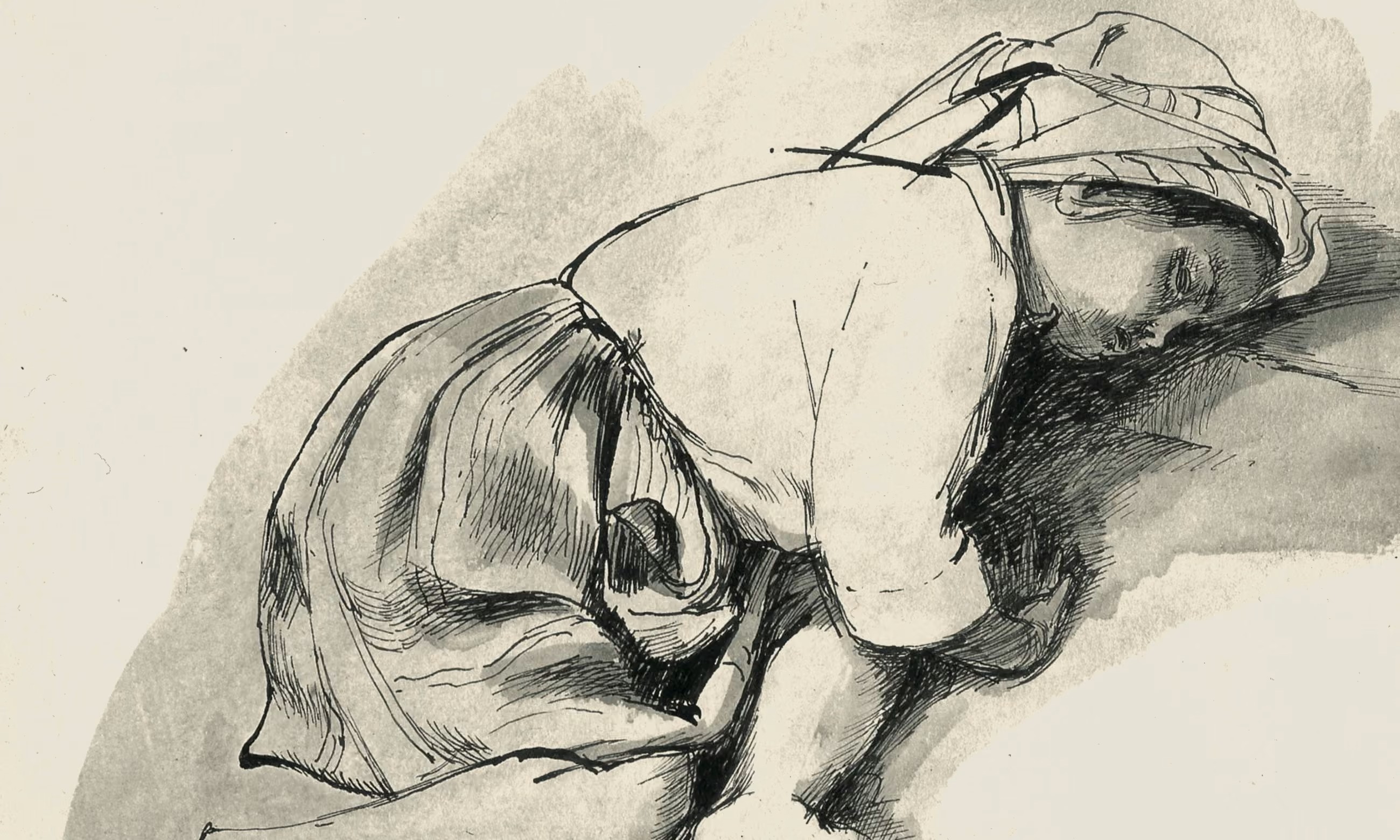
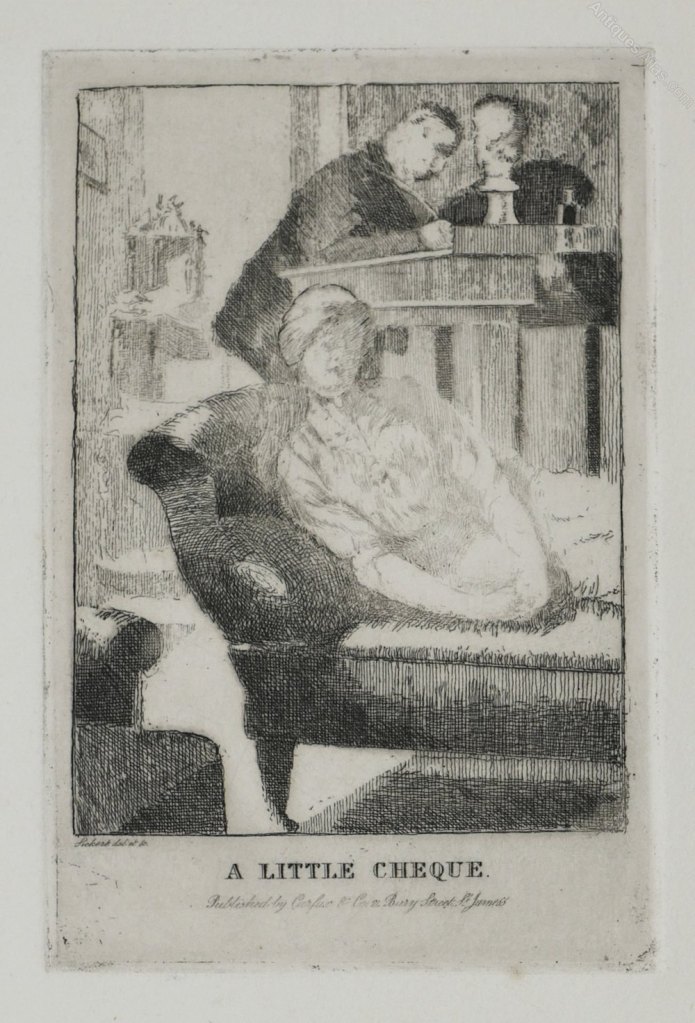
Harold Gilman: Portrait of Mrs Victor Sly.Walter Richard Sickert: ‘A Little Cheque’ (Sickert alludes to the financial arrangement between Ginner and Dora Sly in helping her children).
Charles Ginner: Evening, Dieppe. 1911.
Charles Ginner: Le quai ensoleille, Dieppe 1911, Walker Art Gallery.
In 1910, perhaps at the suggestion of Walter Sickert, whom he knew in Dieppe, he came to live and work in London. Ginner lived in England for the rest of his life but retained a French accent for many years. Around 1910 Ginner began recording his paintings and drawings in a series of four notebooks in which is listed the titles, dates and sizes of works, as well as where they were exhibited and to whom they were sold, exchanged or given away. He backdated his records to 1908, where the first oil painting is listed.
He served on the Hanging Committee of the Allied Artists Association’s third exhibition. He was immediately absorbed into the circle of Harold Gilman, Spencer Gore, Robert Bevan and the influential art critic Frank Rutter. Initially living in Battersea, he later moved to Camden Town where he was a neighbour of Gilman and Gore. He regularly attended the Saturday afternoons at 19 Fitzroy Street, meeting John Nash, Albert Rothenstein CRW Nevinson, Jacob Epstein, Walter Bayes and Lucien Pissarro.
In 1911, he became a member of the newly formed Camden Town Group, a male only group.
Ginner, Nash, Bevan and Gilman.
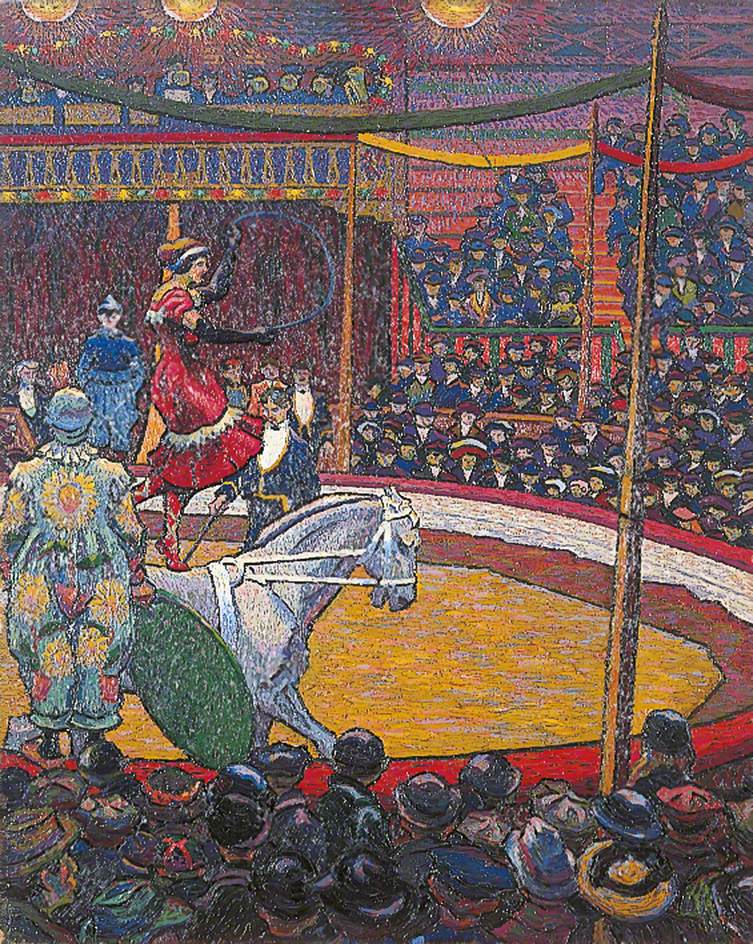
Charles Ginner, The Circus 1912. Leeds Museums.
Sickert wrote to artists Ethel Sands and Nan Hudson: ‘As you probably know, the Camden Town Group is a male club. There are lots of 2 sex clubs, and several one sex clubs, and this is one of them and women are not eligible.’
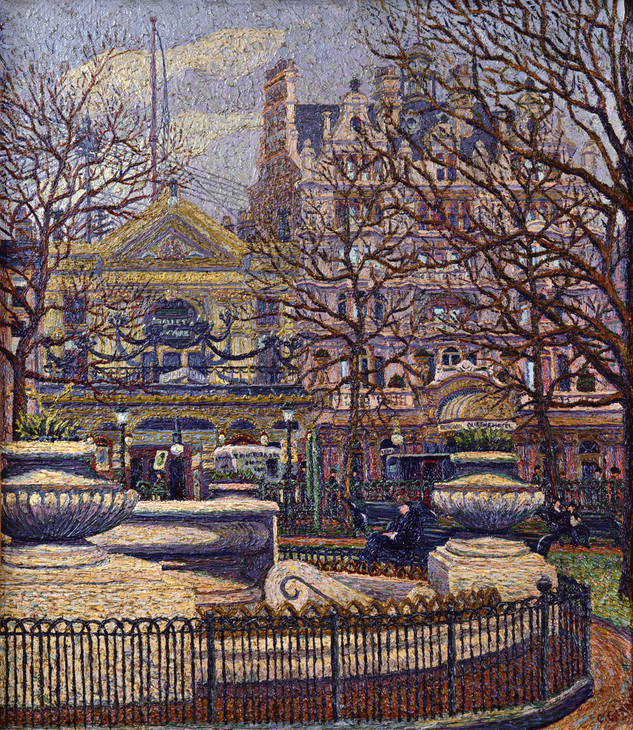
Café Royal 1911. Victoria Embankment Gardens 1912. Leicester Square 1912. Piccadilly 1912.Neuville Lane 1911.
In 1913 the London Group was formed from the merger of the Camden Town Group an all-male group, and the Fitzroy Street Group. In 1914 in the New Age Ginner spelt out the artistic creed known as New Realism. In the same year he showed jointly with Gilman at the Goupil Gallery. The two artists shared their combined philosophy: – All great painters by direct intercourse with Nature have extracted from her facts which others have not observed before and interpreted them by methods which are personal and expressive of themselves – this is the great tradition of Realism.
Sickert responded ironically to Ginner’s article: Have Mr. Ginner and Mr. Gilman reflected that, when they put their heads between the sandwich-boards of this or any classification, they will have to carry the blasted boards about for another thirty or forty years?
Ginner and Gilman also saw Sickert’s comments re thick impasto as a veiled attack on their manner of painting. Ginner deftly responded, ‘Sir, – Paint is thicker than turpentine. In answer to Mr. Sickert I have but one statement to make: I shall paint as thick as I damn well please.
Ginner also commented in his ‘Neo-Realism’ article for New Age, 1st January 1914. ‘Each age has its landscape, its atmosphere, its cities, its people. Realism, loving Life, loving its Age, interprets its Epoch by extracting from it the very essence of all it contains of great or weak, of beautiful or sordid, according to the individual temperament.’
In 1914 Ginner also joined the Cumberland Market Group, a short-lived artistic grouping meeting in the studio of Robert Bevan in Cumberland Market. The group consisted of Ginner, Bevan, Gilman and a young John Nash. Later members of the group were McKnight Kauffer and Nevinson. The group held only one exhibition. The group lapsed after Gilman’s death in 1919.
Leeds Canal, 1914
During World War 1 Ginner was called up, serving firstly in the Royal Army Ordnance Corps, secondly in the Intelligence Corps, being bi-lingual he was promoted sergeant and stationed at Marseilles, and lastly for the Canadian War Records.
Royal Ordnance Stores
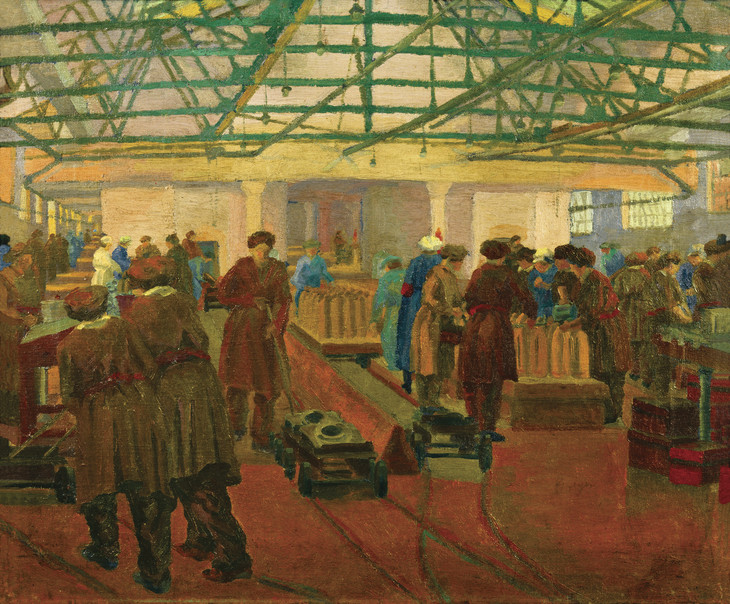
Ginner’s earnings from painting were pitifully low until a breakthrough came in 1918 when he was commissioned by the Canadian War Record to paint the vast ten foot by eleven-foot No.14 Filling Station, Hereford. He was paid £350 plus living expenses received in 1919. He received only £2 for the blouse factory painted in 1917.
Study for No. 14 Filling Station, Hereford.
Back in London 1919 Ginner contracted Spanish Flu and Gilman came to nurse him, caught it himself, and died. Ginner published an appreciation of Gilman in Art and Letters. The group lapsed after Gilman’s death.In 1920 Ginner joined the New English Art Club.
Following Gilman’s death, Ginner moved to 61 Hampstead High Street where he lived until 1938. During this period, he became friends with Edward Le Bas, who was to be a great patron, he painted the artist in 1930.
Edward le Bas: Portrait of Charles Ginner, 1930.
In 1938 he moved to 66 Claverton Street in Pimlico, close to the Tate Gallery.
During World War II he was again an Official War Artist and specialised in painting harbour scenes and bombed buildings in London. In 1942 he became an Associate of the Royal Academy, where he advocated the admission of younger artists. Even now Ginner never made much money from his art, a Northern dealer called T W Spurr bought his work, paying five or six guineas for them. They were then sold at Christie’s, usually for a loss.
In 1942 at the age of sixty-for Ginner was elected an ARA. He wrote to his friend and fellow artist, Stanislawa de Karlowska, Bevan’s widow, ‘Last April I was elected an A.R.A.! Just imagine it, me in the Royal Academy – wonders will never cease! In 1950 Ginner was awarded a CBE.
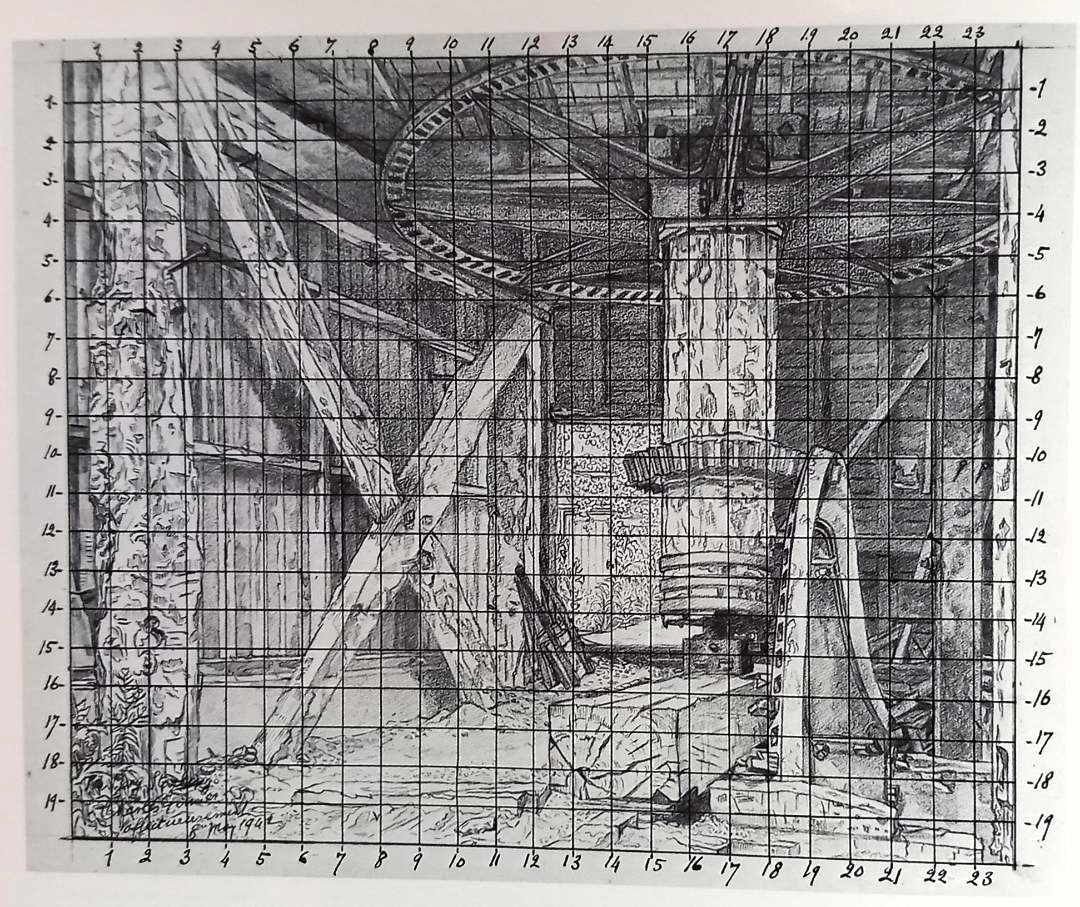
The Sawmill, pencil squared in ink. Inscribed to Mary Starling, Charles Ginner, 8th May, 42. The Sawmill 1942?
Ginner has been described as a private man, a bachelor, well-mannered and genial.
Ginner died in London on 6th January 1952 of pneumonia, aged seventy-three. Stanislawa de Kalowska died in December 1952 aged 76. The Arts Council of Great Britain held a touring memorial of forty-three of his works in 1953-4.
Edwin La Dell was born 7th January 1914 in Rotherham, Yorkshire. La Dell was the son of Thomas La Dell, a Sheffield-born bookbinder, and Ellen (née Boardman) He was christened Thomas (after his father and grandfather) Edwin (following a family tradition on his mother’s side) but appears always to have been known as Edwin.
One of La Dell’s earliest lithographs is ‘The Rush,’ 1937,a typical London street scene from the 1930’s.
After attending Sheffield School of Art in 1935 he won a scholarship to study at the Royal College of Art where his tutors included John Nash, Percy Horton, Charles Mahoney, Gilbert Spencer, Barnett Freedman and Robert Austin. On finishing, he was, in 1938, included in the 28th annual exhibition at Zwemmers of the Senefelder Club of which Frank Brangwyn was President and Matisse and Sir Muirhead Bone were Honorary members. He sold well; his career began successfully, and it wasn’t long before he began teaching – at Camberwell School of Art.
La Dell had begun to establish himself as a lithographer before the war. In 1939 he joined the Civil Defence Camouflage Establishment in Leamington Spa and worked as a camouflage designer. He became involved with the Artists International Association and also submitted work to the War Artists Advisory Committee.
The Camouflage Workshop Leamington Spa. Testing netting at a Camouflage Station Leamington Spa.
In 1943 he was sent on active service, stopping first in Belgium (billeted with Mme Berger, the sister-in-law of Magritte) and then moving to the German Front.
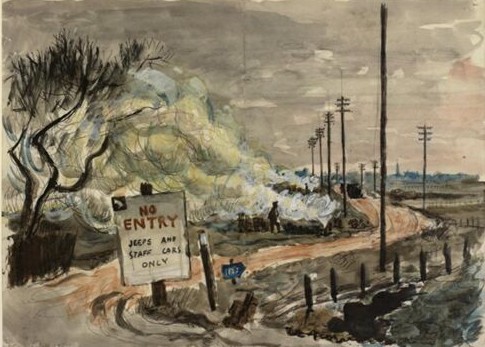
Calcar, smoke screen over the Rhine 1945. Ruined Landscape, Reichwald Forest 1945.VE Street Party 1945.
From 1946 to 1949, he produced paintings, lithographs and murals for the Central Office of Information. One of the artists La Dell worked with during the war was Charles Mozley whose wife’s sister, Joan Kohn, married La Dell in 1940. In 1948, his work was included in a survey of 150 years of lithography that began with its invention in 1798. Exhibited alongside Piper, Aldridge, Scott and Bawden, it cemented his reputation.
Colour lithograph by Edwin La Dell depicting a steam boat on the River Thames with the Tower of London in the background, 1946.
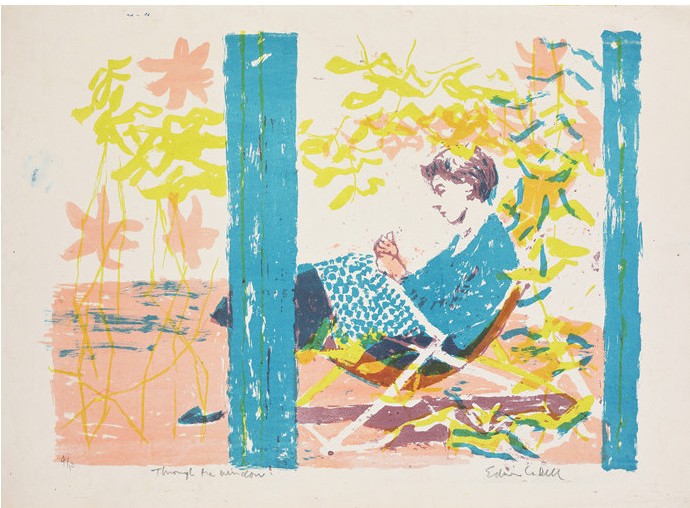
Through-the-Window wife Joan at their home at Grafty Green in Kent, 1948.
After the War, he continued making art and was employed as a teacher, initially working as a tutor at the RCA in 1948 before becoming Head of the Printmaking. In this role, his impact on post-war printmaking and future generations of printmakers was enormously influential. He was instrumental in raising the appeal of printmaking and was involved in many of the commissions such as the Lyons Lithographs and the School Prints together with his own series of Oxford, Cambridge, Kent and New York. His vibrantly coloured lithographs drew inspiration from French artists such as Vuillard, Denis and Bonnard.
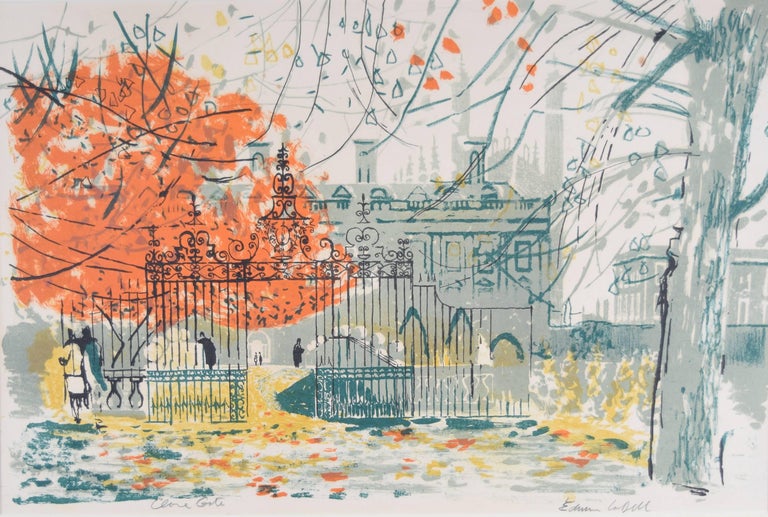
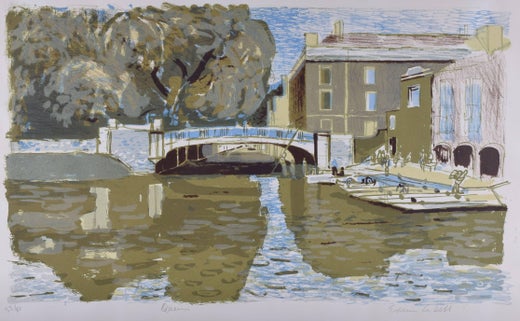
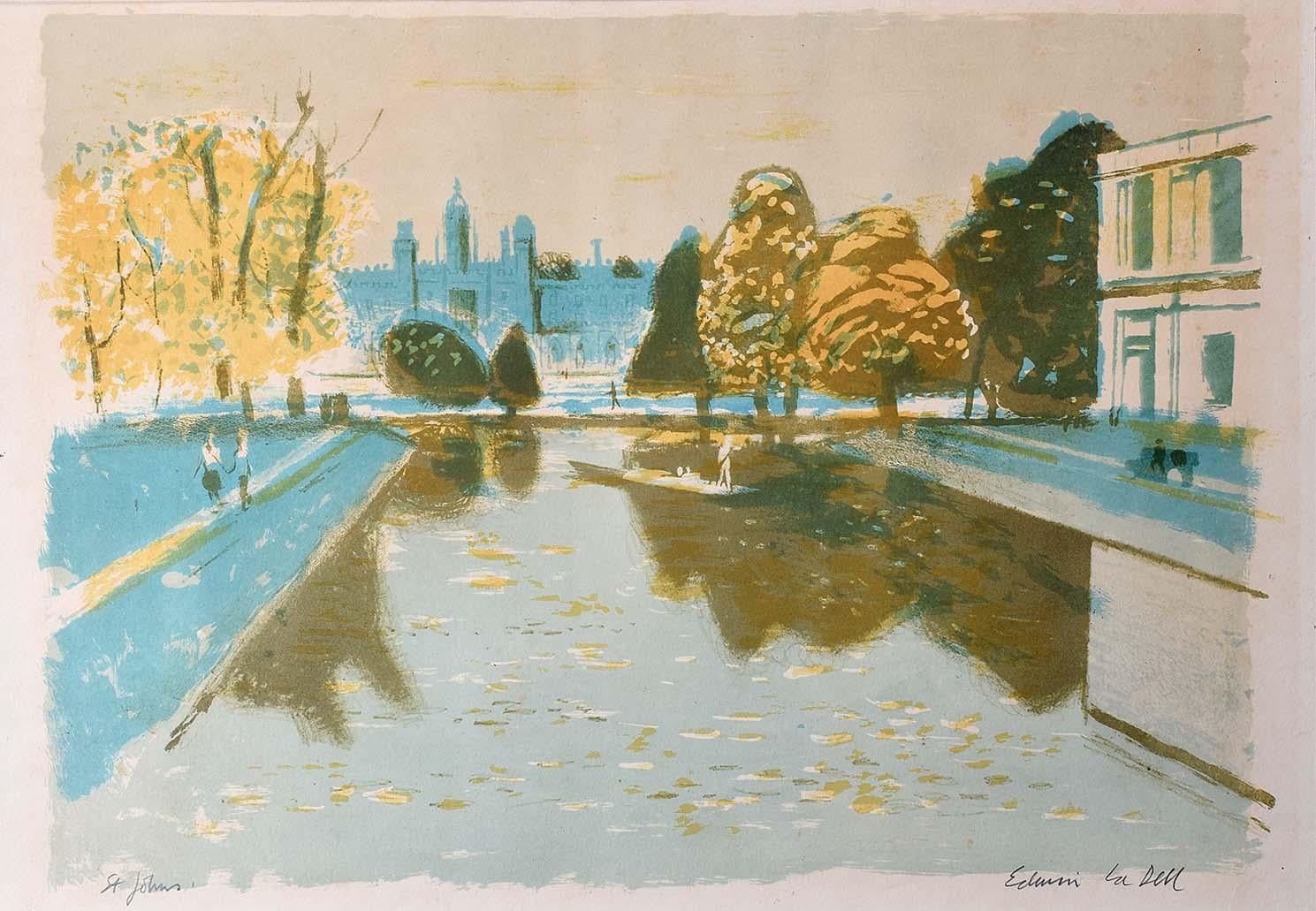
The Oxford and Cambridge series of lithographs.
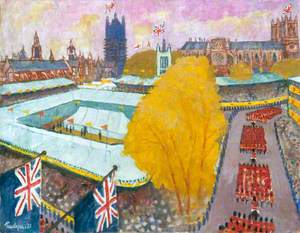
La Dell’s best known works are those from the post-war era, in particular the lithographs he created for the coronation of Queen Elizabeth II in 1953. For the Coronation a group of artists were invited to create lithographs for the Royal College of Art. Following the success of the Schools Prints series and Contemporary Lithographs, these prints were sold in limited editions and helped boost the RCA’s skills at reviving lithographic techniques. They were exhibited at the Redfern Gallery from April – May, 1953.
Bandsmen in the City. Rehearsal for the Coronation. Royal Homecoming. The Crowd In the Mall, Coronation 1953. Horse Guards Parade.
Another contribution was ‘Newmarket,’ one of six lithographs by various artists commissioned for Guinness in 1956. Originally the title was ‘Newmarket Races’ but it was shortened to just ‘Newmarket.’ La Dell chose a subject relevant to the pub audience. In the Guinness Book of Records Newmarket is listed as the world’s largest racecourse.
He wrote and illustrated Your Book of Landscape Drawing and illustrated Wilkie Collins’ novel The Moonstone.
He was elected to the Royal Academy of Arts on 24th April 1969. His work was exhibited throughout the world under the auspices of the British Council.
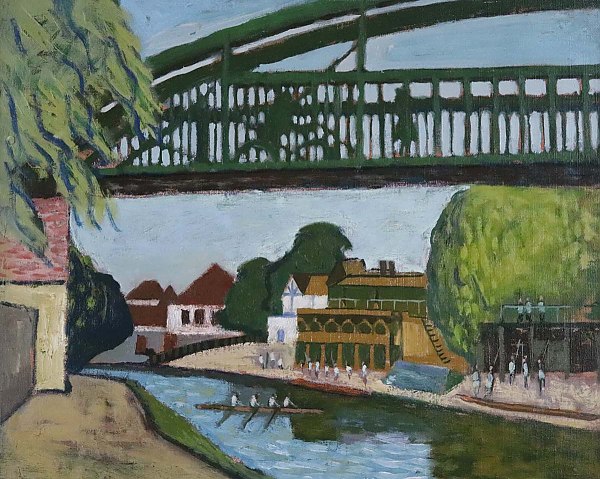
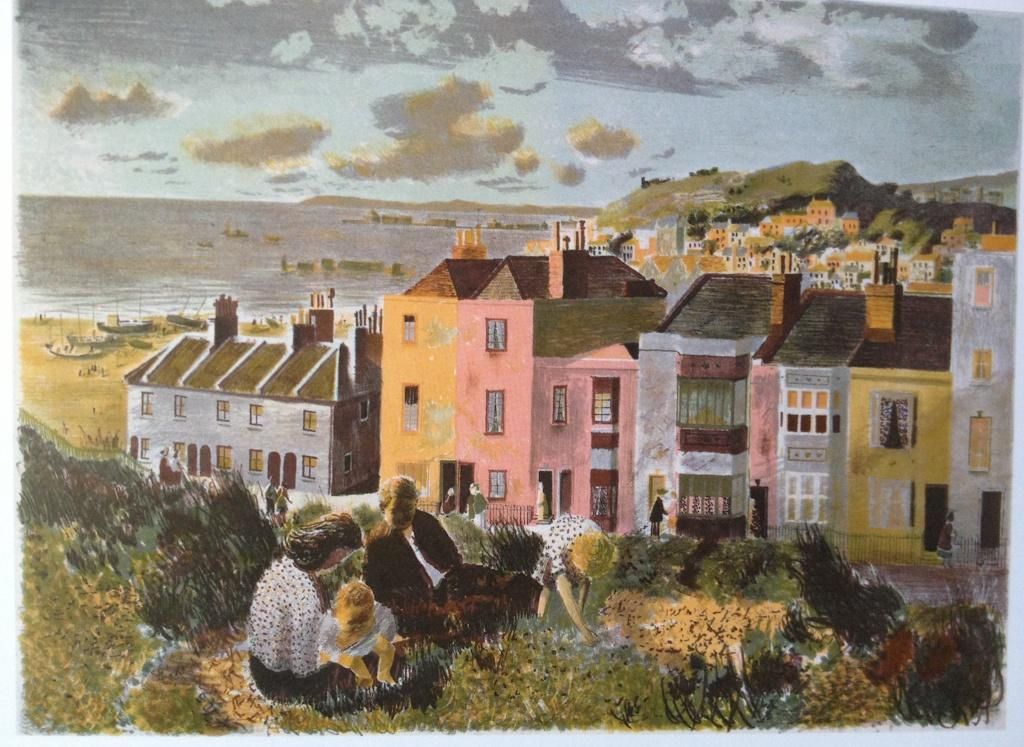
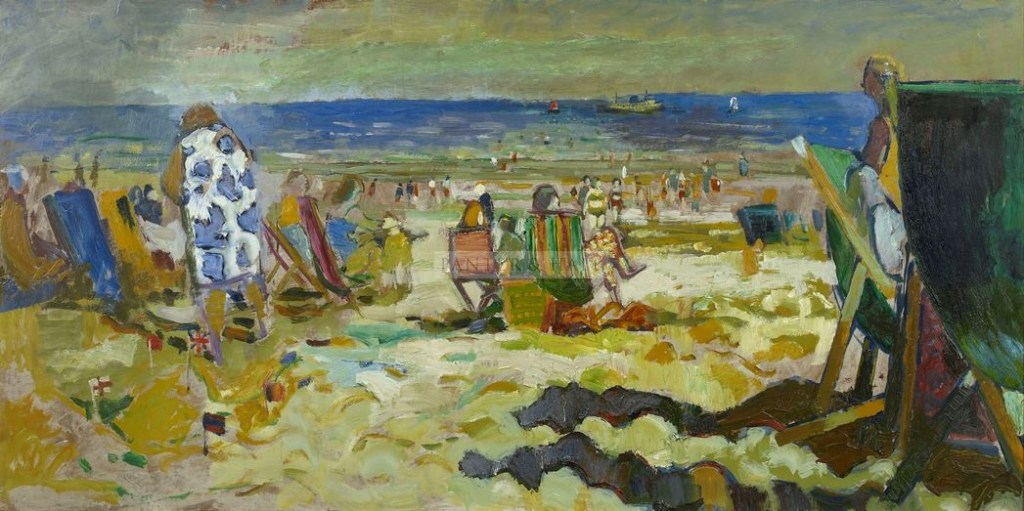
Stubble FieldsStamford Bridge 2Rowers on the ThamesLeaving BoulogneHastings litho’Ampleforth, York litho c1950Beach
La Dell continued as head of the Department of Lithography at the RCA until his death on 27th June 1970, aged 56.
Edwin La Dell by Robert Darwin RCA 1910 – 1974. Self Portrait
La Dell’s work is currently held in many collections, including those of the Royal Academy, Government Art Collection, the Tate and the Victoria & Albert Museum.
There is no definitive text re Edwin la Dell therefore this blog is cobbled together from many small sources, Wikipedia did give me a start though. HOWEVER 4th Nov. 2025. Today I received ‘Edwin La Dell,’ Lithographs and Etchings, edited by Tom and Maria La Dell, cheap at £10.to buy at Emma Mason Gallery, https://www.emmamason.co.uk/p/edwin-la-dell—lithographs-and-etchings
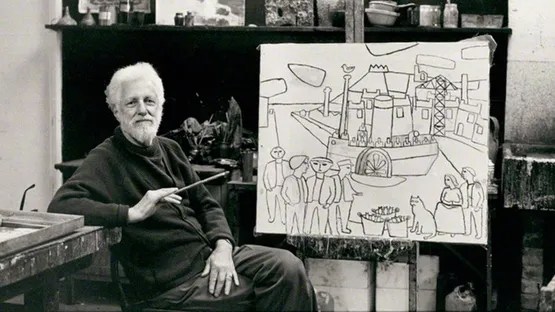
Julian Trevelyan was educated at Bedales School and Trinity College, Cambridge, where he read English Literature. He joined a lively avant-garde group that was responsible for the first published Surrealist statement in Britain – in it, Trevelyan exclaimed, “Let us gladly shout: to dream is to create.”
He moved to Paris in 1931 to become an artist, enrolling at Atelier 17, Stanley William Hayter‘s engraving school, The 1930s were fertile years for the young Trevelyan who benefitted from three years in Paris where he met Max Ernst, Oskar Kokoschka, Joan Miró, Paul Klee, Alberto Giacometti, André Masson, and Pablo Picasso. It was in this atmosphere that he turned to Surrealism and became a founding member of the British Surrealist Group.
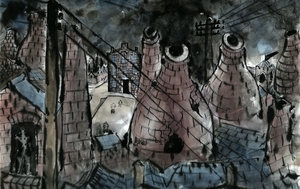
Burslem……. ‘It was a landscape full of drama and pathos, very much after my own heart. At that time there were thousands of bottle kilns, stuffed with saggers full of pottery…
As one of the first participants of Mass Observation, which aimed to record the routines and rituals of everyday life in Britain using volunteer observers, diarists and participants. Trevelyan spent a month in Bolton’s industrial streets, painting and creating collages from his suitcase full of materials. Trevelyan’s collages from his involvement with Mass Observation are regarded as a critical part of his development bringing together so many strands of his artistic development during the late 1930s.
Bolton Collages: ‘Bolton’, 1937. The work depicts an industrial mill scene, but also incorporates newspaper and magazine cuttings from the Spanish Civil War, reflecting fears of the rise of Fascism. Rubbish May Be Shot Here, 1937. Bolton Mills, 1938. 1,000 Volts, 1939.
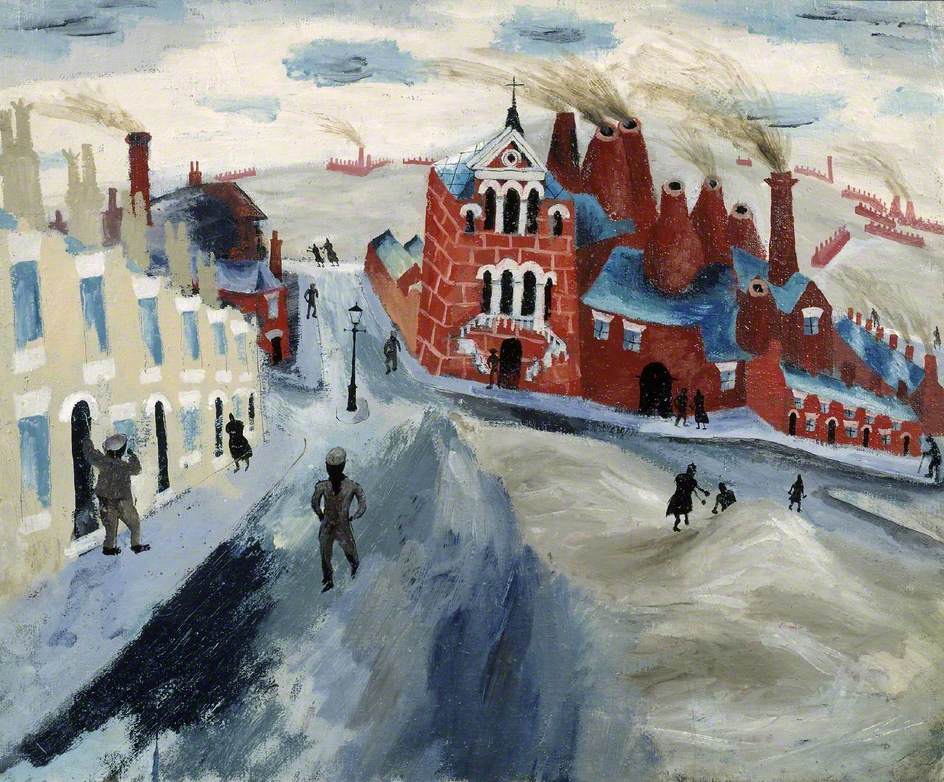
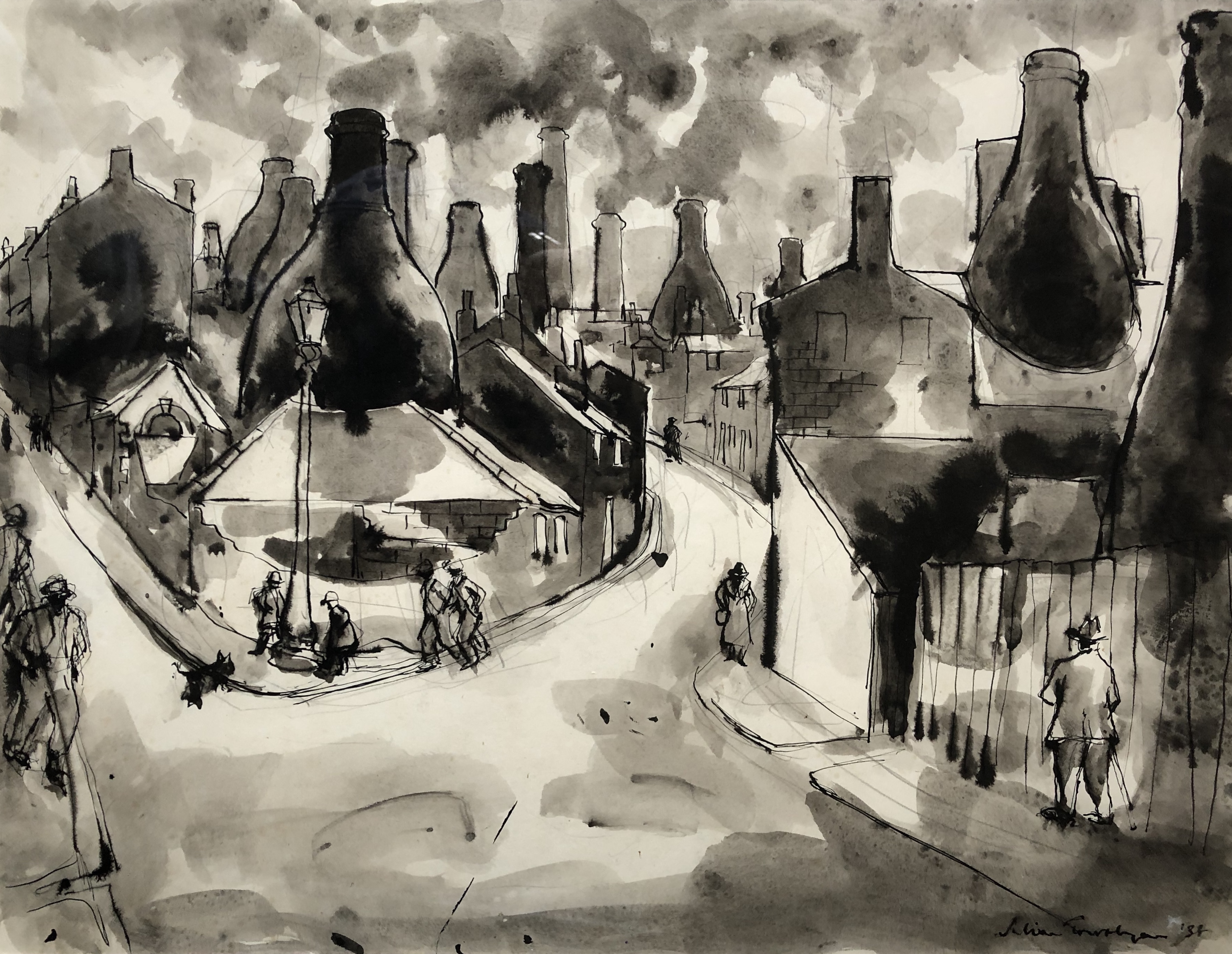
Trevelyan created a powerful series of collages and paintings of the industrial north. The collages, including Rubbish May be Shot Here (1937), incorporated allusions to contemporary politics and popular culture by way of magazine and newspaper cuttings, old catalogues and bills, and the paintings, including The Potteries (1938), were darkly expressive yet deeply personal in their evocation of poverty and deprivation.
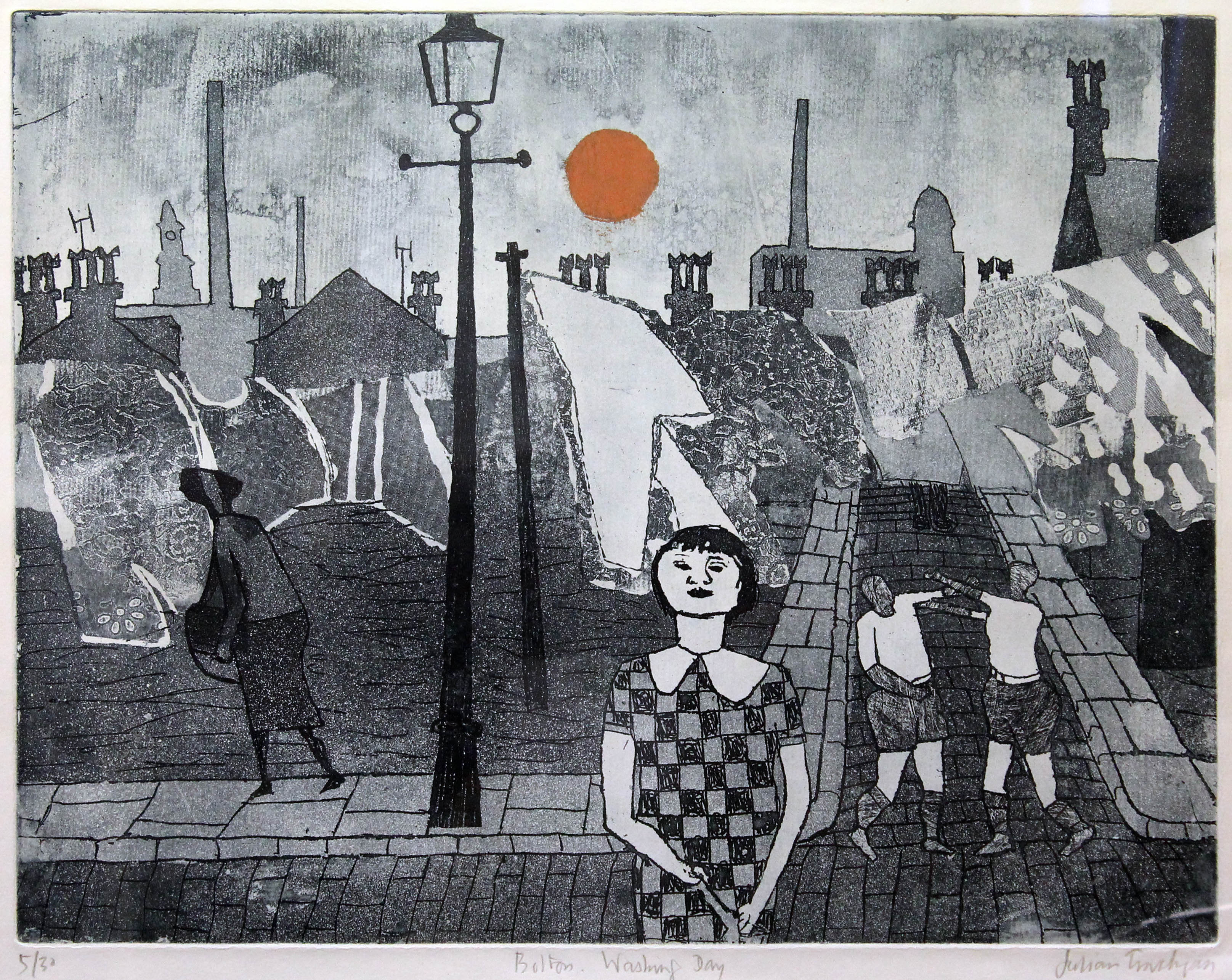
Bolton: Washday, etching, 1938. Landscape With Pylons, pen and ink, 1938. Bolton, etching, a much later return to Bolton 1964.
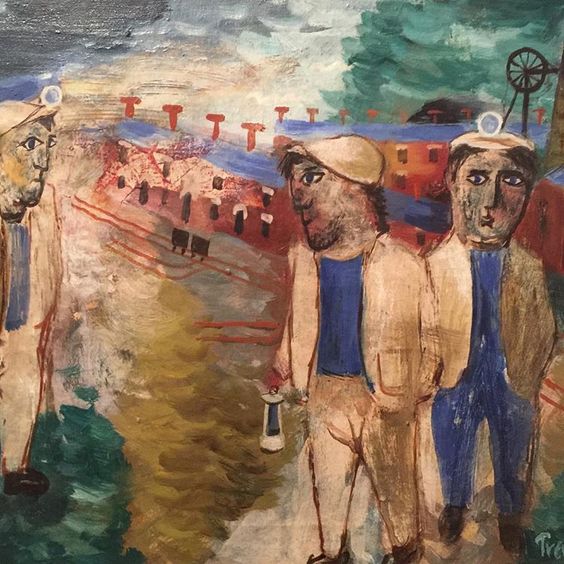
During this time he became interested in ‘Sunday painters’ and championed the self-taught group of Ashington Miners, known today as the ‘Pitmen Painters’. Having had little formal training himself, Trevelyan was fascinated by these self-taught painters, believing strongly that anyone could be an artist. In 1939, shortly after resigning from the London Surrealist Group, he organised an exhibition of their work at the Peckham Health Centre.
Along with other artists such as Roland Penrose, during the Second World War, Trevelyan served as a Camouflage Officer. He was a member of the Royal Engineers from 1940 to 1943, serving in North Africa and Palestine.
You cannot hide anything in the desert.
Arriving in the “Western Desert” town of Tobruk, North Africa, Trevelyan realized that standard British army green and brown splotches were ineffective as desert camouflage. He and the other camoufleurs, working under Hugh Cott and Geoffrey Barkas, became expert at desert camouflage and deception. By 1942, they were able to deceive the German Afrika Korps, creating a dummy army which successfully tied down German forces, while real tanks were concealed or disguised as trucks and other equipment.
The Artist’s Garden 1947. Parliament Square 1953. Albert Bridge 1953.
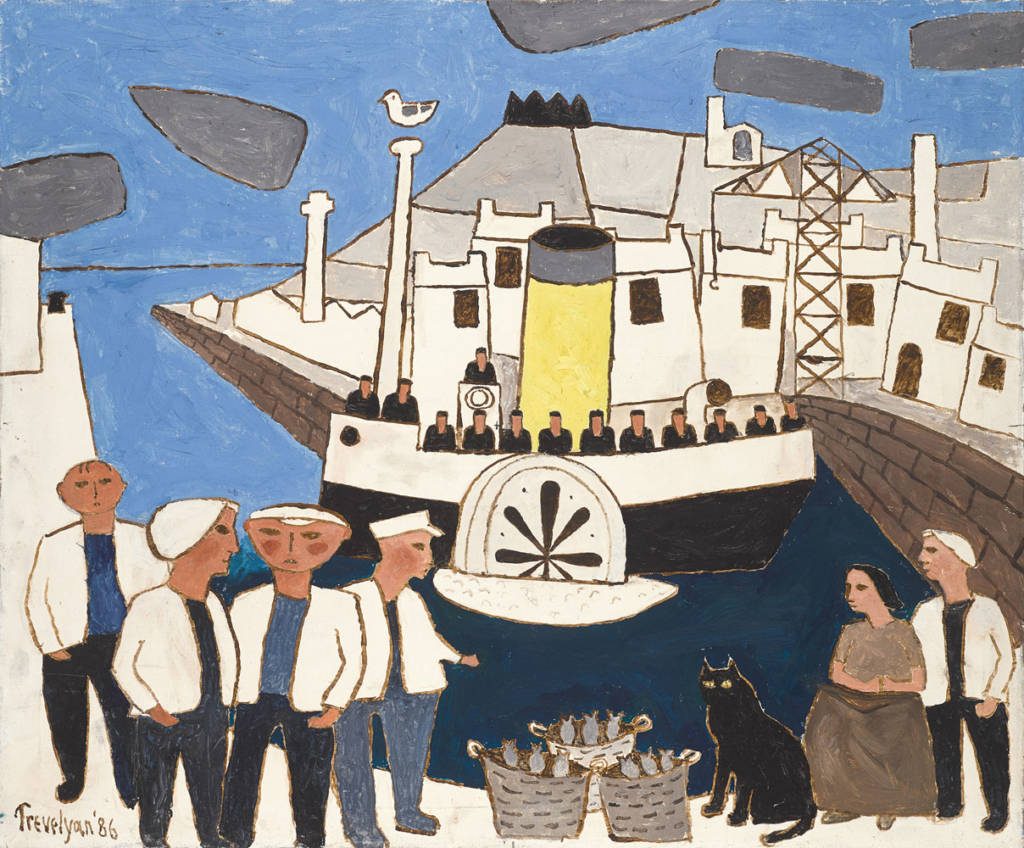
Trevelyan’s second wife was the celebrated painter Mary Fedden; they married in 1951, They lived together at Trevelyan’s home at Durham Wharf, a collection of small warehouses on the Thames in Hammersmith. The couple travelled in Europe, India and America.
Washing Day, Freetown 1942. Sienese Creti 1956.
From 1955 to 1963, Trevelyan worked at the Royal College of Art and became Head of the Etching Department. Because of his enthusiasm in his work and the desire to share it with others, Trevelyan became a highly influential teacher, with students including David Hockney, Ron Kitaj and Norman Ackroyd. He was an important leader of modern print techniques and today is regarded as a silent driving force behind the etching revolution of the 1960s.
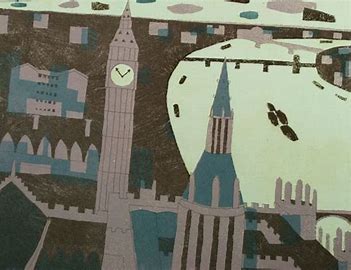
In 1969, he produced the Thames Suite, a collection of 12 views of the Thames from its upper reaches in Oxford and Henley-on-Thames down to the tidal stretches of London and the Estuary.
Westminster, from Thames Suite 1969.
In July 1986, Trevelyan was awarded a senior fellowship at the Royal College of Art and in September 1987 he was appointed a Royal Academician.




























































 Artistic Horizons