

Portrait of Ginner by Malcolm Drummond 1911
Charles Isaac Ginner CBE, ARA was born 4th March 1878 in Cannes, south of France, the second son of Isaac Benjamin Ginner, a British medical doctor. His mother Lydia Adeline Wightman was born in Scotland. He was educated in France at the Institut Stanislas (Cannes) and spoke and looked like a Frenchman.
At an early age, Ginner formed the intention of becoming a painter, but his parents disapproved. When he was sixteen, he suffered from typhoid and double pneumonia and travelled in a tramp steamer around the south Atlantic and the Mediterranean to convalesce; on returning to Cannes, he worked in an engineer’s office, and in 1899, at the age of 21, moved to Paris to study architecture. He worked in an architect’s office in Paris from 1899 to 1904. He then entered the Academic Vitti and trained as a painter with Spaniard Anglada y Camarasa who also taught at the Ecole des Beaux-Arts. Camarasa disapproved of Ginner’s admiration for Vincent van Gogh.

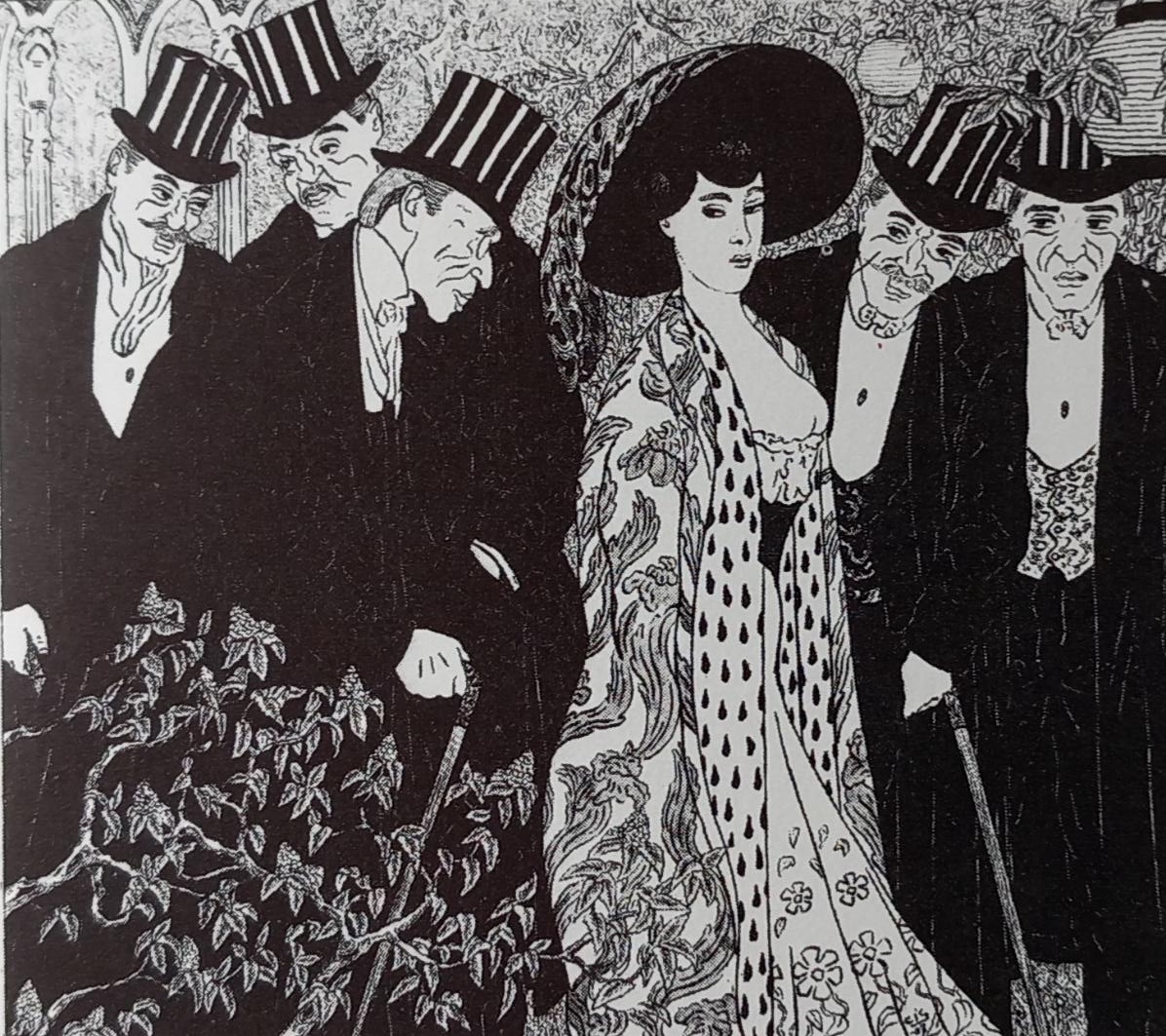
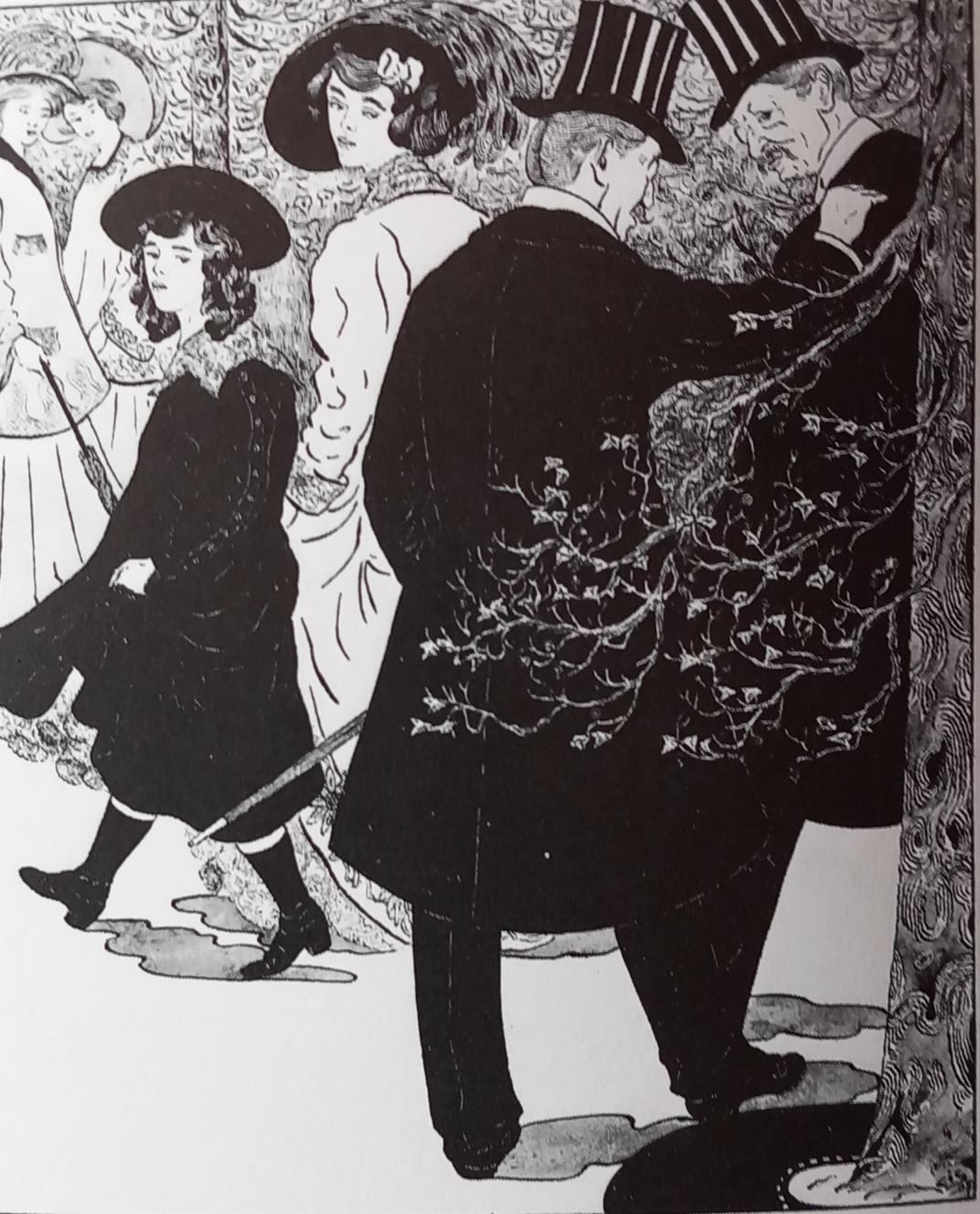
Question d’ Actualite 1904. Du Tic Au Tac 1907. Les Suiveurs 1907. Ginner’s early French work – illustrations for magazines. In one of these illustrations, Les Suiveurs 1907, depicts people in a public park, he drew a tree trunk densely covered with art nouveau patterns, showing his liking from the beginning for a saturated decoration of busy, concentric linear shapes.

Charles Ginner: La Vieille Balayeuse, Dieppe 1913. The Tate.
Ginner’s painting depicts a crowd gathered in the Fish Market beside the Avant Port in Dieppe. In the centre of the work the old street sweeper of the title brushes the road. On the left, an old fisherwoman stands with hands on hips, carrying a large fish basket on her back, while to the right a young, middle class woman wearing a bright red jacket looks in the opposite direction. Characteristically, Ginner has painted the foreground and background in a consistent level of detail.

Charles Ginner Le Quai Duquesne, Dieppe 1913
In 1908, Ginner left Vitti’s and worked on his own in Paris, inspired by van Gogh, Paul Gauguin and Paul Cezanne. His earliest surviving oil painting dates from 1908 now aged thirty. I
While still resident in Paris, Ginner contributed to his first London exhibition: the open-submission Allied Artists’ Association at the Royal Albert Hall in 1908. The organiser, Frank Rutter, later recalled:
Few people took much notice of his work when it was first shown here in 1908, but several artists were literally attracted by his lavish use of pigment, and the canvas being still wet, took away samples of his paint in their finger-nails. Some few, however, approached his work with more respect, and I well remember Spencer Gore coming up to me before the Ginners and saying with conviction, ‘This man is a painter.’
In 1909, Ginner visited Buenos Aires, Argentina, where he held his first one-man show, which helped to introduce post-Impressionism to South America. His oil paintings showed the influence of Van Gogh, with their heavy impasto paint.
Ginner held a joint exhibition in September at the Salón Costa in Buenos Aires with a fellow student from the Académie Vitti, the Danish painter Dora Erichsen (died 1943), where he sold at least five paintings. The art historian Wendy Baron reasons that the two probably travelled to and from Argentina together, and that Dora was most likely the married woman described in Benjamin Fairfax Hall’s first-hand account of Ginner: ‘He never married and adopted a slightly cynical attitude towards sex, affecting to regard his mistress as a constitutional necessity like the T.C.P. with which he gargled every morning. He was much in love as a young man with a woman who preferred to marry someone else. The marriage was not a success and would have been disastrous for the two daughters born of it, had not Ginner, who had a great fondness for children, made himself responsible for their education and welfare.‘

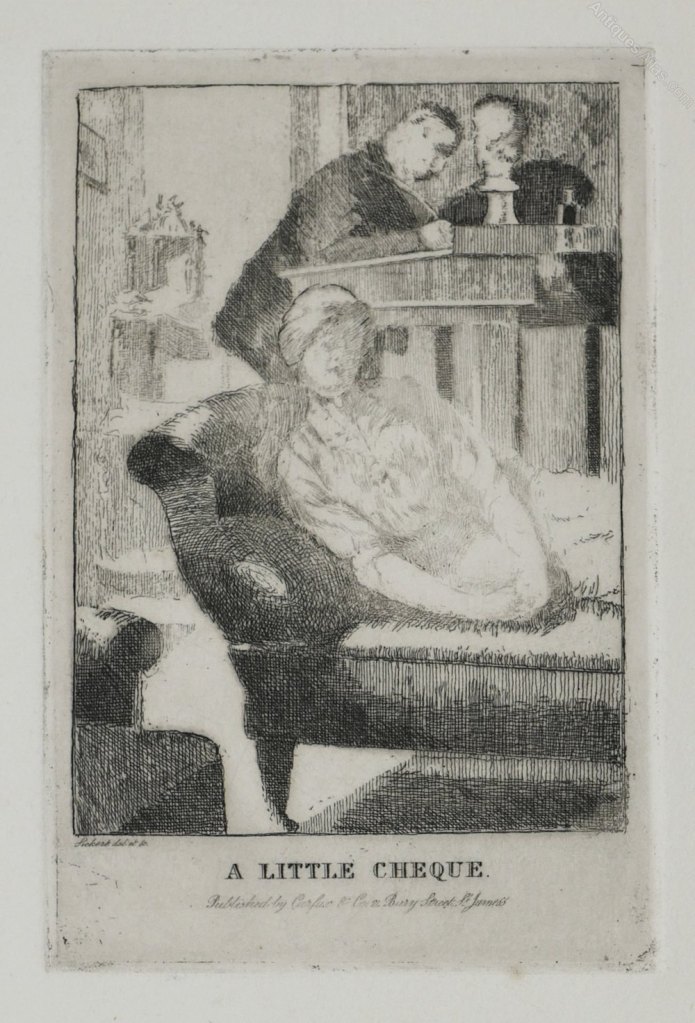
Harold Gilman: Portrait of Mrs Victor Sly. Walter Richard Sickert: ‘A Little Cheque’ (Sickert alludes to the financial arrangement between Ginner and Dora Sly in helping her children).

Charles Ginner: Evening, Dieppe. 1911.

Charles Ginner: Le quai ensoleille, Dieppe 1911, Walker Art Gallery.
In 1910, perhaps at the suggestion of Walter Sickert, whom he knew in Dieppe, he came to live and work in London. Ginner lived in England for the rest of his life but retained a French accent for many years. Around 1910 Ginner began recording his paintings and drawings in a series of four notebooks in which is listed the titles, dates and sizes of works, as well as where they were exhibited and to whom they were sold, exchanged or given away. He backdated his records to 1908, where the first oil painting is listed.

He served on the Hanging Committee of the Allied Artists Association’s third exhibition. He was immediately absorbed into the circle of Harold Gilman, Spencer Gore, Robert Bevan and the influential art critic Frank Rutter. Initially living in Battersea, he later moved to Camden Town where he was a neighbour of Gilman and Gore. He regularly attended the Saturday afternoons at 19 Fitzroy Street, meeting John Nash, Albert Rothenstein CRW Nevinson, Jacob Epstein, Walter Bayes and Lucien Pissarro.
In 1911, he became a member of the newly formed Camden Town Group, a male only group.

Ginner, Nash, Bevan and Gilman.
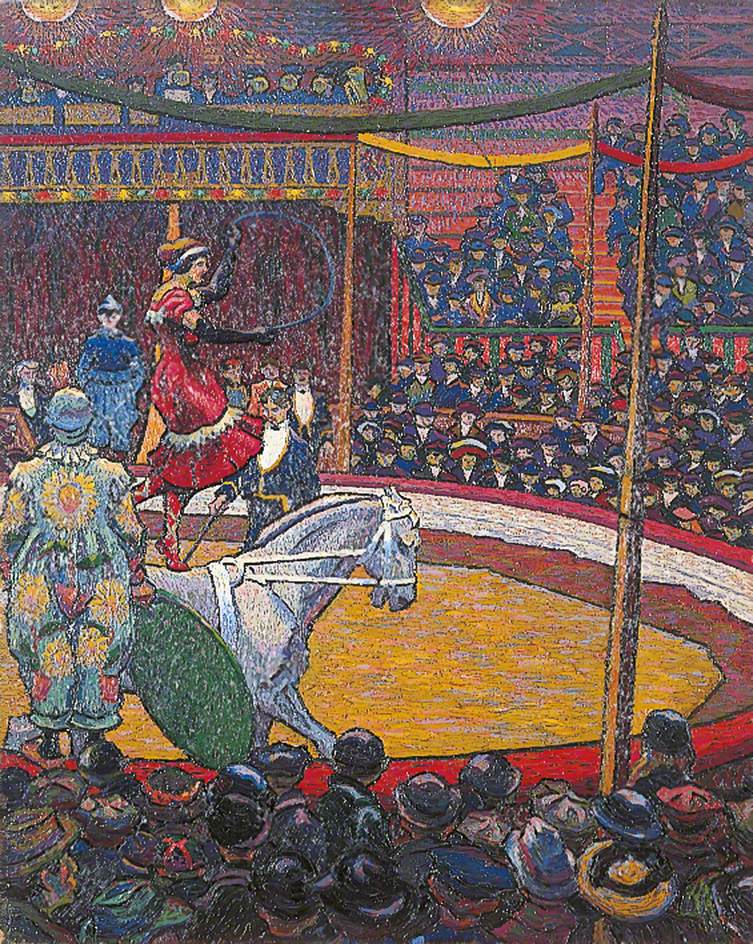
Charles Ginner, The Circus 1912. Leeds Museums.
Sickert wrote to artists Ethel Sands and Nan Hudson: ‘As you probably know, the Camden Town Group is a male club. There are lots of 2 sex clubs, and several one sex clubs, and this is one of them and women are not eligible.’


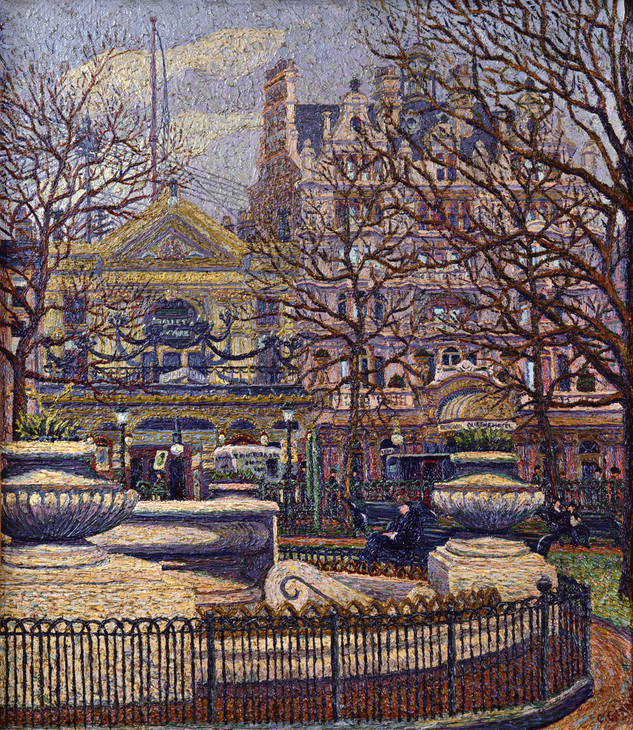

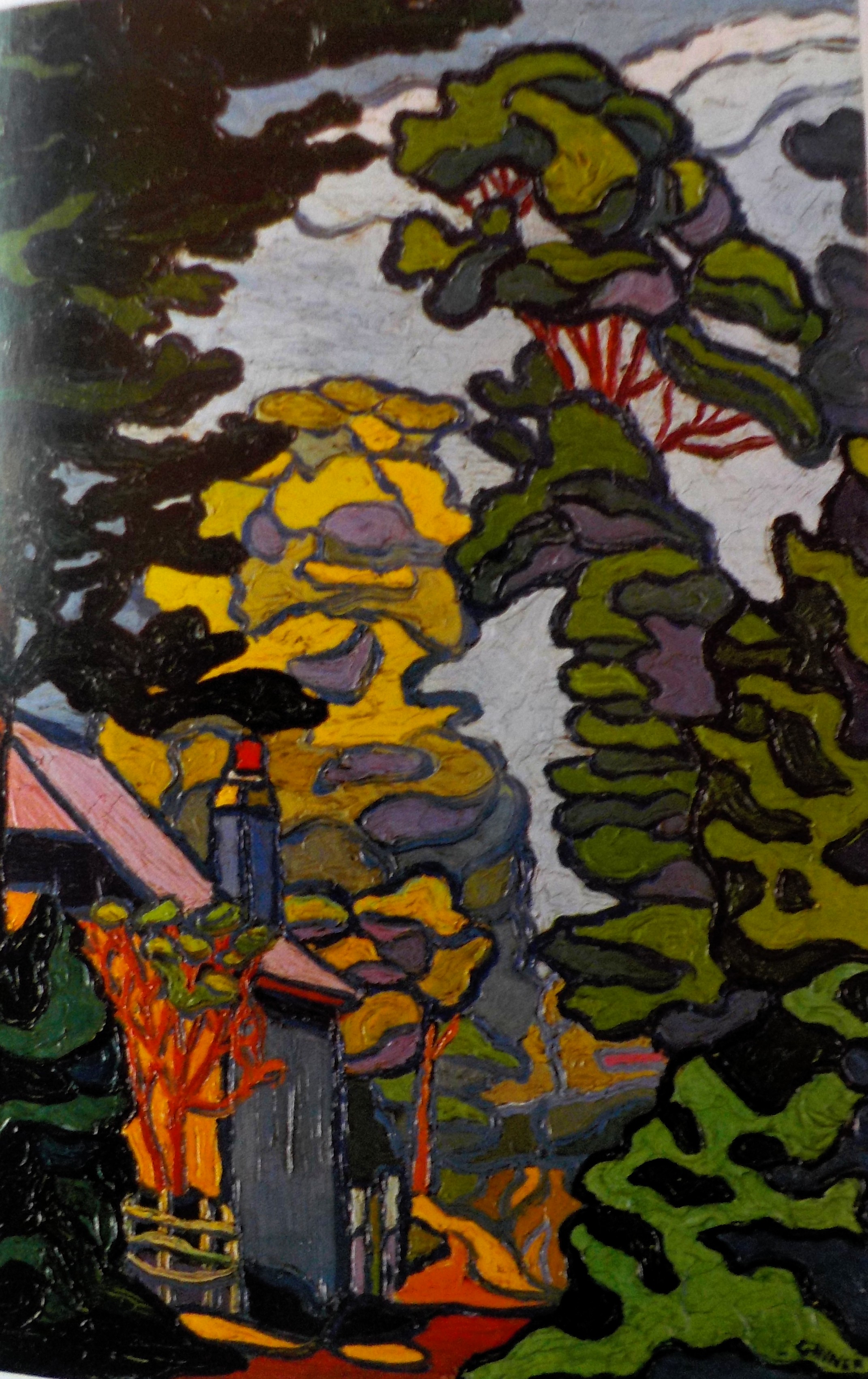
Café Royal 1911. Victoria Embankment Gardens 1912. Leicester Square 1912. Piccadilly 1912. Neuville Lane 1911.
In 1913 the London Group was formed from the merger of the Camden Town Group an all-male group, and the Fitzroy Street Group. In 1914 in the New Age Ginner spelt out the artistic creed known as New Realism. In the same year he showed jointly with Gilman at the Goupil Gallery. The two artists shared their combined philosophy: – All great painters by direct intercourse with Nature have extracted from her facts which others have not observed before and interpreted them by methods which are personal and expressive of themselves – this is the great tradition of Realism.
Sickert responded ironically to Ginner’s article: Have Mr. Ginner and Mr. Gilman reflected that, when they put their heads between the sandwich-boards of this or any classification, they will have to carry the blasted boards about for another thirty or forty years?
Ginner and Gilman also saw Sickert’s comments re thick impasto as a veiled attack on their manner of painting. Ginner deftly responded, ‘Sir, – Paint is thicker than turpentine. In answer to Mr. Sickert I have but one statement to make: I shall paint as thick as I damn well please.
Ginner also commented in his ‘Neo-Realism’ article for New Age, 1st January 1914. ‘Each age has its landscape, its atmosphere, its cities, its people. Realism, loving Life, loving its Age, interprets its Epoch by extracting from it the very essence of all it contains of great or weak, of beautiful or sordid, according to the individual temperament.’
In 1914 Ginner also joined the Cumberland Market Group, a short-lived artistic grouping meeting in the studio of Robert Bevan in Cumberland Market. The group consisted of Ginner, Bevan, Gilman and a young John Nash. Later members of the group were McKnight Kauffer and Nevinson. The group held only one exhibition. The group lapsed after Gilman’s death in 1919.

Leeds Canal, 1914
During World War 1 Ginner was called up, serving firstly in the Royal Army Ordnance Corps, secondly in the Intelligence Corps, being bi-lingual he was promoted sergeant and stationed at Marseilles, and lastly for the Canadian War Records.

Royal Ordnance Stores
Ginner’s earnings from painting were pitifully low until a breakthrough came in 1918 when he was commissioned by the Canadian War Record to paint the vast ten foot by eleven-foot No.14 Filling Station, Hereford. He was paid £350 plus living expenses received in 1919. He received only £2 for the blouse factory painted in 1917.
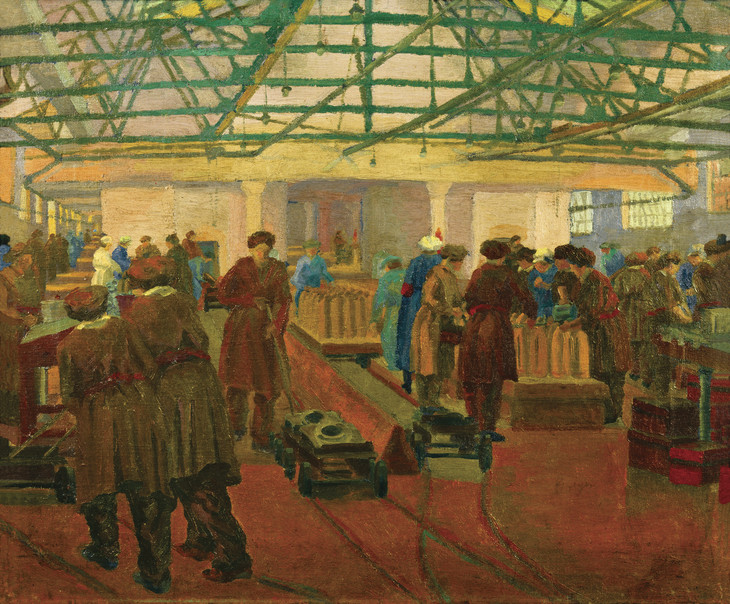
Study for No. 14 Filling Station, Hereford.
Back in London 1919 Ginner contracted Spanish Flu and Gilman came to nurse him, caught it himself, and died. Ginner published an appreciation of Gilman in Art and Letters. The group lapsed after Gilman’s death. In 1920 Ginner joined the New English Art Club.
Following Gilman’s death, Ginner moved to 61 Hampstead High Street where he lived until 1938. During this period, he became friends with Edward Le Bas, who was to be a great patron, he painted the artist in 1930.

Edward le Bas: Portrait of Charles Ginner, 1930.
In 1938 he moved to 66 Claverton Street in Pimlico, close to the Tate Gallery.


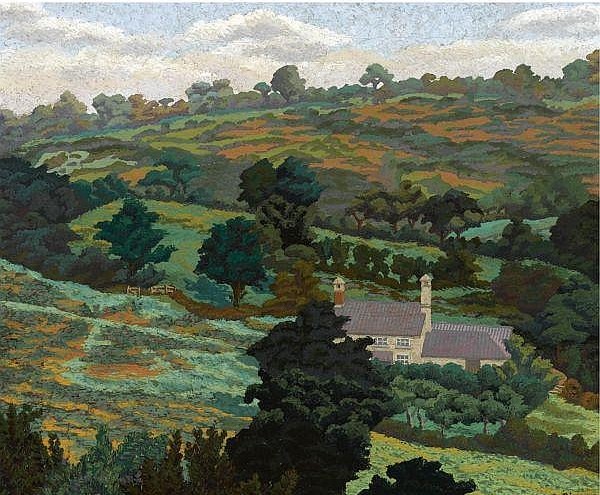
Pond Square, Highgate 1932. Salisbury 1935. Wych Platt, Devon 1945.
During World War II he was again an Official War Artist and specialised in painting harbour scenes and bombed buildings in London. In 1942 he became an Associate of the Royal Academy, where he advocated the admission of younger artists. Even now Ginner never made much money from his art, a Northern dealer called T W Spurr bought his work, paying five or six guineas for them. They were then sold at Christie’s, usually for a loss.
In 1942 at the age of sixty-for Ginner was elected an ARA. He wrote to his friend and fellow artist, Stanislawa de Karlowska, Bevan’s widow, ‘Last April I was elected an A.R.A.! Just imagine it, me in the Royal Academy – wonders will never cease! In 1950 Ginner was awarded a CBE.
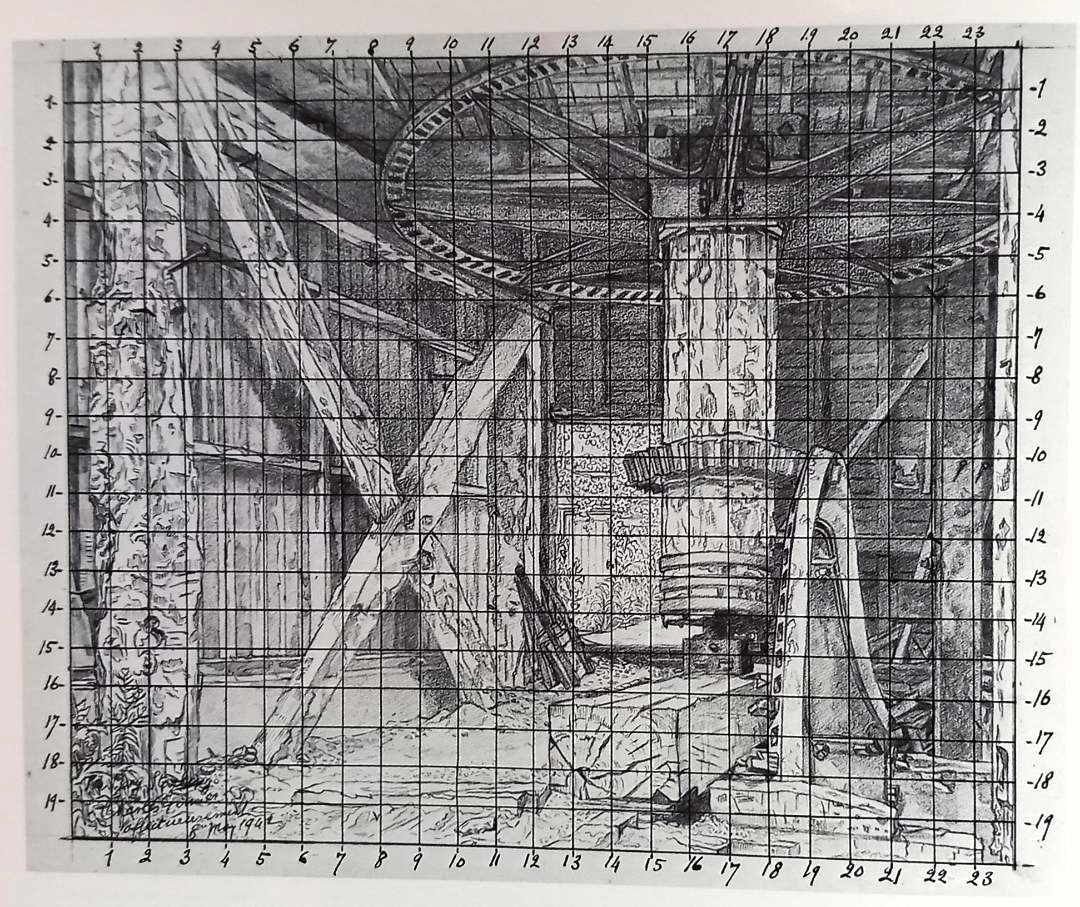

The Sawmill, pencil squared in ink. Inscribed to Mary Starling, Charles Ginner, 8th May, 42. The Sawmill 1942?
Ginner has been described as a private man, a bachelor, well-mannered and genial.
Ginner died in London on 6th January 1952 of pneumonia, aged seventy-three. Stanislawa de Kalowska died in December 1952 aged 76. The Arts Council of Great Britain held a touring memorial of forty-three of his works in 1953-4.
Graham Bennison, July 2025. https://www.facebook.com/BennisonArtist
Bibliography: Wikipedia. Charles Ginner, Fine Art Society. The Camden Town Group, edited Robert Upstone, Tate Publishing, 2008.
 Artistic Horizons