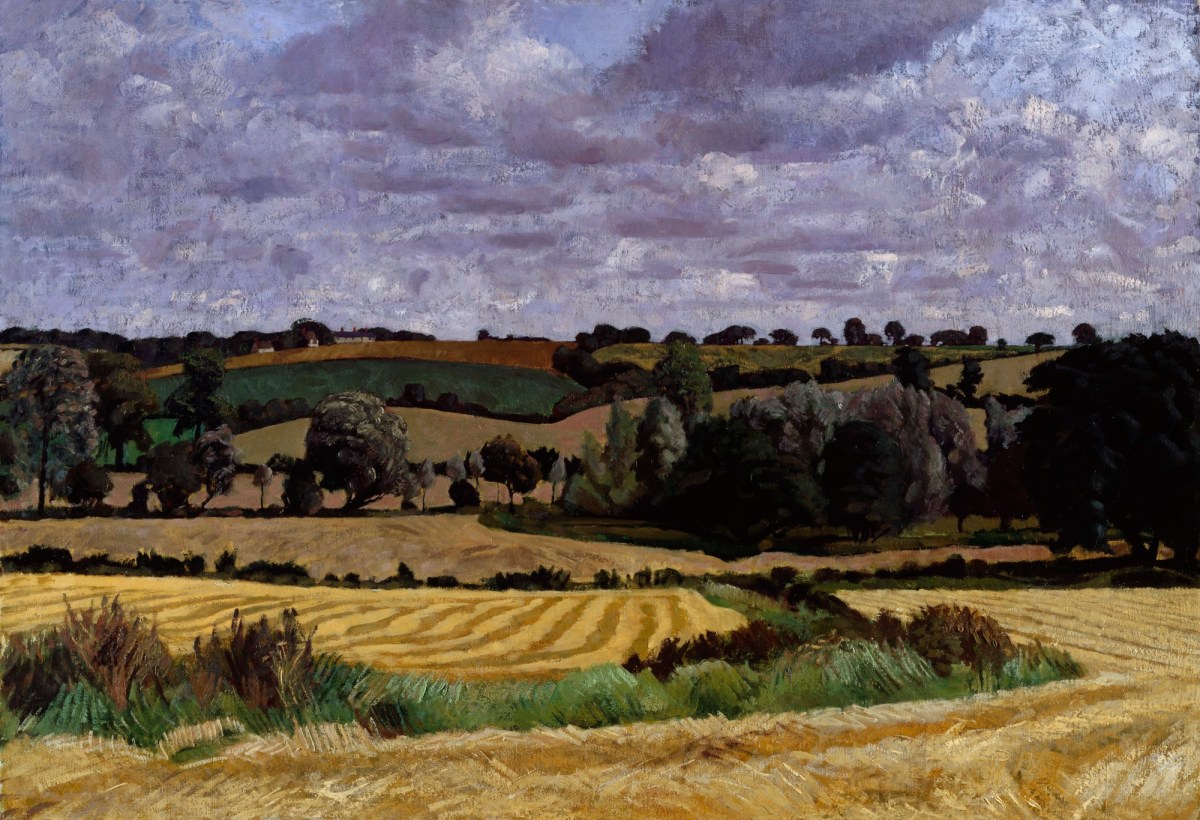

Ravilious visited Newhaven in late July, staying at the Hope Inn during August and September 1935 with friend and fellow artist Edward Bawden, Ravilious had a brief visit to Newhaven in 1934 while staying at Furlongs the cottage of artist friend Peggy Angus. Newhaven was within walking distance of Furlongs, approximately 7 miles. Ravilious first visited Furlong’s at Peggy’s invitation in February 1934 spending four days there before returning home to Brick House, Great Bardfield, Essex, he returned with wife Tirzah in the Spring of 1934. https://httpartistichorizons.org/2020/06/12/eric-ravilious-and-furlongs/

The Hope Inn, Newhaven
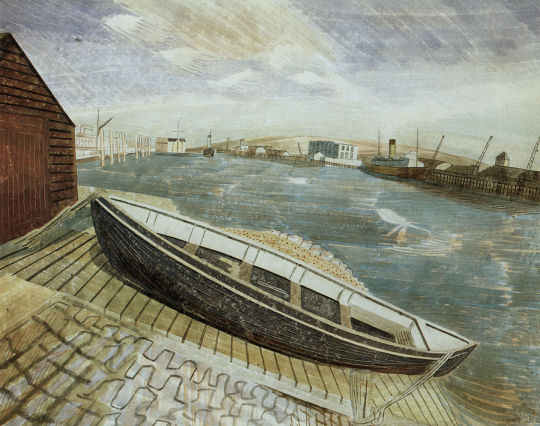
Arriving in Newhaven late July Eric was spurred on by a commission to produce a lithograph for schools, he found his inspiration among the ‘attractive jetties and dredgers’ of the harbour. He picked out the small lighthouses at the harbour mouth, including one with a signalling mast seen in the foreground of Newhaven Harbour, pictured against a cloudless blue sky.
The painted sketch dates from 1935 when ER and Edward Bawden were enjoying their painting holiday together. In August 1935 Tirzah’s diary records: ‘Drove with Daddy (F.S. Garwood) to Newhaven afternoon and saw Eric and Edward. Eric has 7 starts of watercolours.’
We know Ravilious was working down at the harbour on 1st August as Peggy Angus reported: ‘I looked out for you when we embarked and waved to a lanky figure near the angler’s pub.’ Ravilious replied: ‘The lanky figure was me alright.’
The watercolour painting is dated 19th September, 1935. This provided the basis for the lithograph
When Ravilious arrived back at Newhaven in September, 1935, a terrific storm blew up, the worst for years. He walked to the end of the jetty to look at the lighthouse: ‘The spray from the breakers crashing on the weather-side of the breakwater was a quite extraordinary sight – I got very wet and think now it was almost a dangerous walk out there, but worth it.’


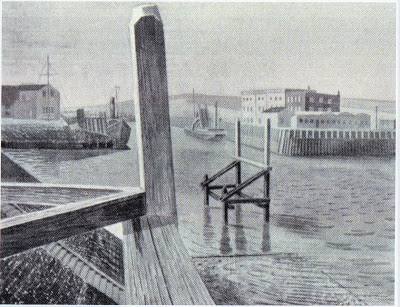
Sketch, Newhaven Harbour. Lighthouses at Newhaven. Newhaven Harbour. Trial for the lithograph ?
The watercolour Newhaven Harbour was bought from the Zwemmer Gallery by Beryl Sinclair, nee Bowker. She studied with Edward and Eric at the Royal College of Art. Nicknamed Bowk. Ravilious painted her twice, once in the Colwyn Bay Pier Murals in the kitchen with a plant and then again in a lost oil painting – ‘Bowk at the sink’, 1929-30.
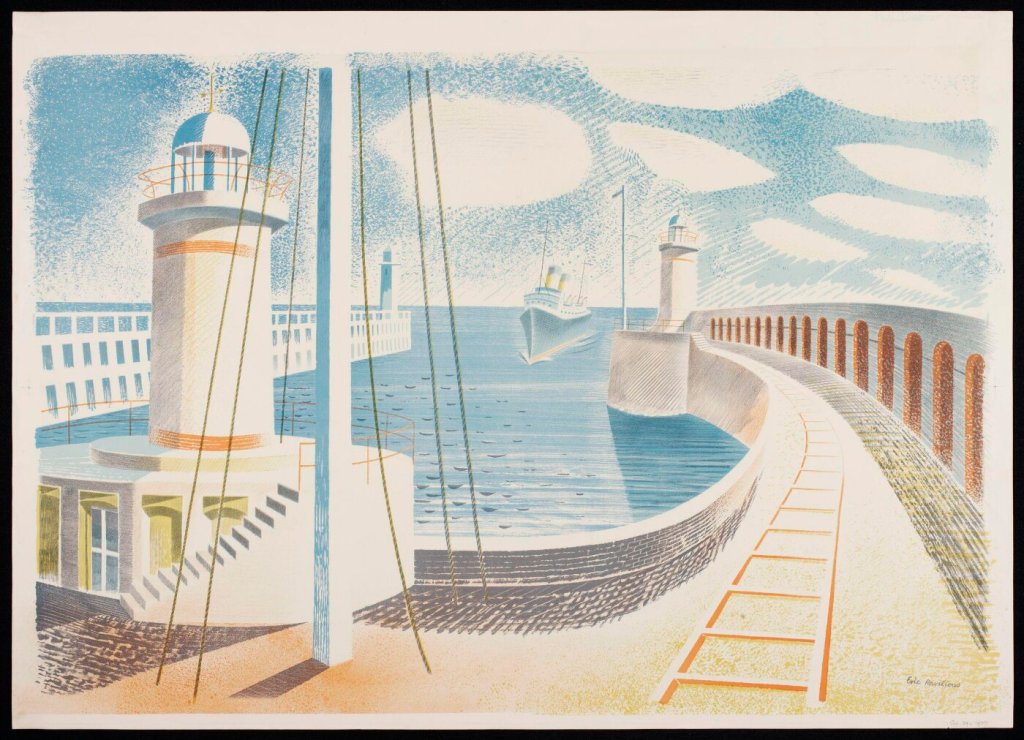
Newhaven Harbour was originally produced in 1937 as part of the Contemporary Lithographs programme.
The lithograph was part of the brave pre-WW2 experiment Lithographs for Schools, a series issued by Contemporary Lithographs Ltd. The lithographs didn’t sell at the time but are now highly sought after. John Piper was drawn into the project as a general assistant, but it was Barnett Freedman that was the foremost exponent of lithography working with Harold Curwen from the early 1930’s. Freedman was key in persuading friend Ravilious to try his hand at lithography.
Dredgers 1934, a watercolour that merited inclusion in a 1937 Studio magazine. Sadly now lost, whereabouts unknown.

The James and the Foremost Prince, also dated August 1934.
‘The James’ and ‘The Foremost Prince’ worked from Brighton Pier in the summer and were laid up at Newhaven out of season.

Channel Steamer Leaving Harbour
This watercolour depicts the steamer SS Rouen as it left for Dieppe, and was completed by Ravilious at the Hope Inn in Newhaven, within a day of the initial sketch. Ravilious wrote to his mistress Helen Binyon: ‘Sweetie the holiday crowd downstairs is making a great noise with concertinas and pianos and drunken song, I rather like it.’

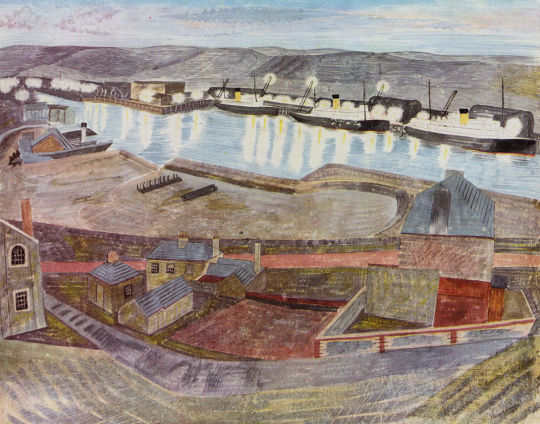
Brighton Queen at Night 1935.
The Brighton Queen, was dive-bombed and destroyed in 1940 during the evacuation of troops from Dunkirk. This watercolour was a product of the second stay in September. Back at Castle Hedingham writing to Helen Binyon, Ravilious told how he had sold this work for 12 guineas to W H (Pink) Crittal, a member of the window manufacturing company. See….. https://httpartistichorizons.org/2023/07/25/ariel-crittall/

Edward Bawden: Ferryboat Entering Newhaven Harbour.
In the autumn of 1933 Peggy visited Zwemmer’s Gallery in London to view works by Eric Ravilious and Edward Bawden. Visiting on the last day of the exhibition Peggy longed to buy a painting but by then they had all been sold. So, Peggy wrote to former RCA fellow student Bawden offering to buy a watercolour painting if he would accept an arrangement of paying by instalments of £1 at a time. Bawden replied inviting Peggy to visit Brick House for a weekend so she could choose a watercolour. Peggy duly visited Brick House in January 1934 and arranged to buy a painting. Ferryboat Entering Newhaven Harbour was completed later,
I understand she didn’t receive the watercolour until February 1936 when it was framed. At Brick House Peggy was bowled over by the decorations on the walls, the ceiling and floor. Peggy was pleased to see Eric again having only bumped into him once on Westminster Bridge since leaving the Royal College of Art. She was also able to meet Tirzah, Charlotte Bawden had been a fellow student at RCA.


Bawden was more prolific than Ravilious in Newhaven, here are four more of his Newhaven watercolours.
The friendship between Bawden and Ravilious was not always harmonious, Edward strongly disapproving of Eric’s affair with Helen. Ravilious stated on one occasion that he was fed up of Edward’s malicious digs. In February 1936 Ravilious wrote to Helen: ‘I won’t go away with him this summer if I can tactfully avoid it. Newhaven was a strain and I feel twinges of it still.’
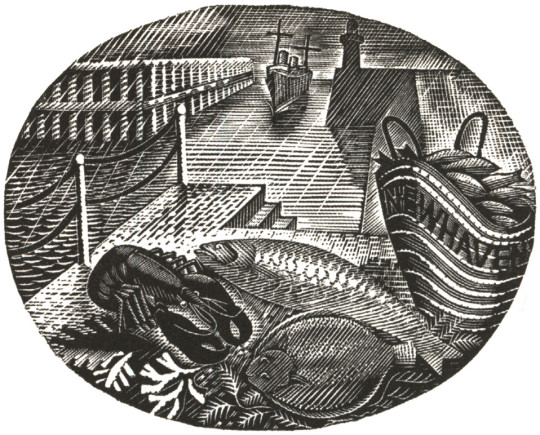
February, Wood-engraving for the Country Life Cookery Book, 1937
Graham Bennison, October 2025. https://www.facebook.com/BennisonArtist

