
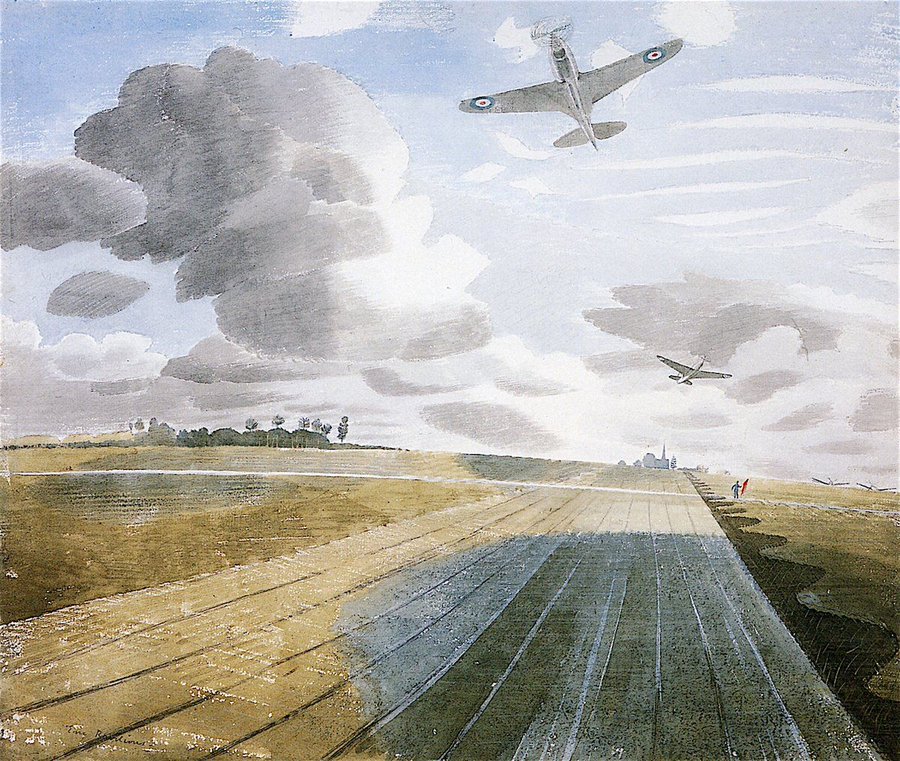
Runway Perspective, Sawbridgeworth 1942.
In 1942 Eric Ravilious was first at RAF Clifton near York. With Tirzah struggling with illness, he returned home in March. Tirzah had a mastectomy on the 11th March aged 33. Eric was next stationed at Debden near Saffron Walden so as to be near home. When Tirzah convalesced in Eastbourne in May 1942, he was posted to RAF Sawbridgeworth, an airfield in Hertfordshire, he lodged in a hut. “The brown tea at 7 is the most powerful ‘gunfire’ I’ve come across since war began. The batman boils it on his stove. This place is more primitive than most and my hut is I think made of cardboard and the bed, iron hard with no pillow, looking glass for shaving, chair, or towel. I shave by touch alone and dry my face on a shirt.”
Over May and June, he produced a series of watercolours that provided a flavour of everyday life at RAF Sawbridgeworth, from the types of aircraft stationed there to the recreational activities which took place.
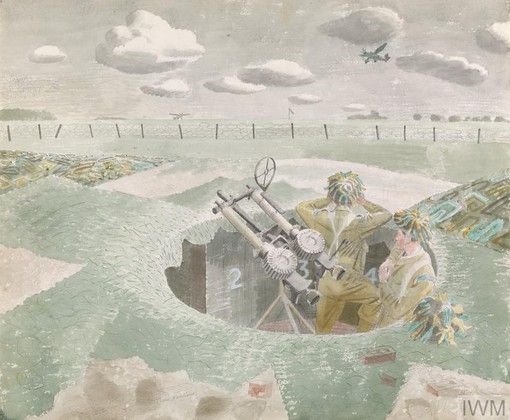
RAF Regiment Ack Ack Post, Sawbridgeworth, Herts. Imperial War Museum.
During his time at RAF Sawbridgeworth, Ravilious wrote of his experiences to Tirzah. On 9th May 1942, he stated, “the weather gets finer all the time but I feel bored of pictures of planes on the ground and want to go flying. At the moment I am having a shot at these very nice interiors but it is too early to say too much about them. A friendly major has lent me a large mirror so I can shave with a new blade.”

This watercolour of the operations room was acquired by the Fitzwilliam Museum in Cambridge while a second work was acquired by the Imperial War Museum in 2020.
The operations room was a small hut used for controlling aircraft on the ground, as well as for studying maps and reconnaissance photographs. The picture shows the yellow and blue-green colour scheme used for such rooms, chosen because it was considered easy on the eyes. On the wall is a sector clock used for tracking aircraft, and through the windows can be seen a stationary Westland Lysander plane. Ravilious’ handwritten annotations are visible in the unfinished areas of the picture. This historic painting is amongst the Imperial War Museums’ strong holdings of work by the artist, providing an important record of his methods, as well as insight into working life on a wartime RAF base.

The windows in the second watercolour reveal that the scene is unfinished; these areas are sketched in pencil, yet to be painted with watercolour. A large arrow can be seen through the window and airfield markings and the vague shape of an aircraft are shown through the right, both accompanied by handwritten annotations by Ravilious – handy notes to assist him in completing the work at a later date. On 9th May 1942, he stated, “the weather gets finer all the time but I feel bored of pictures of planes on the ground and want to go flying. At the moment I am having a shot at these very nice interiors (eg Operations Room) but it is too early to say too much about them.”

Breakfast in an RAF Mess, Stringle Hall, Sawbridgeworth, Herts. A view along a table laid for breakfast in a mess room, where three officers are sitting down to eat. Imperial War Museum.

Corporal Stediford’s Mobile Pigeon Loft. Even in WW2 carrier pigeons were a vital part of communications, with many used on D-Day. Corporal Stediford had raced pigeons since 1924.

The Fairey Battle was one of the most promising aircraft chosen for the rapidly expanding RAF in the 1930s. When introduced into service in 1937 it could carry twice as many bombs over twice the distance as the Hawker Hart and Hind bombers it replaced. By 1939 it was obsolescent but due to the lack of more modern types it remained in front line service. Battles of No.226 Squadron were the first RAF aircraft to be sent to France on the outbreak of war.

A view of five Spitfires on an airfield. The two Spitfires in the foreground stand side by side, with a brick wall between them. Imperial War Museum.
Despite his primitive hut living conditions, Ravilious enjoyed documenting everyday life on the airfield including aircraft in flight and recreational activities. In this watercolour, Ravilious has depicted five Supermarine Spitfires at the base, shown in the colours of a unit that never flew Spitfires from the airfield, however, this scene is wholly fabricated. Spitfires were not present at the site until August 1942. Perhaps Ravilious had heard of their impending arrival, or he was eager to illustrate the famous fighter plane in detail – the answer remains a mystery.

‘Practice,’ 1942. This watercolour was sent to the New England University, Armidale, New South Wales but was destroyed by fire in 1958.

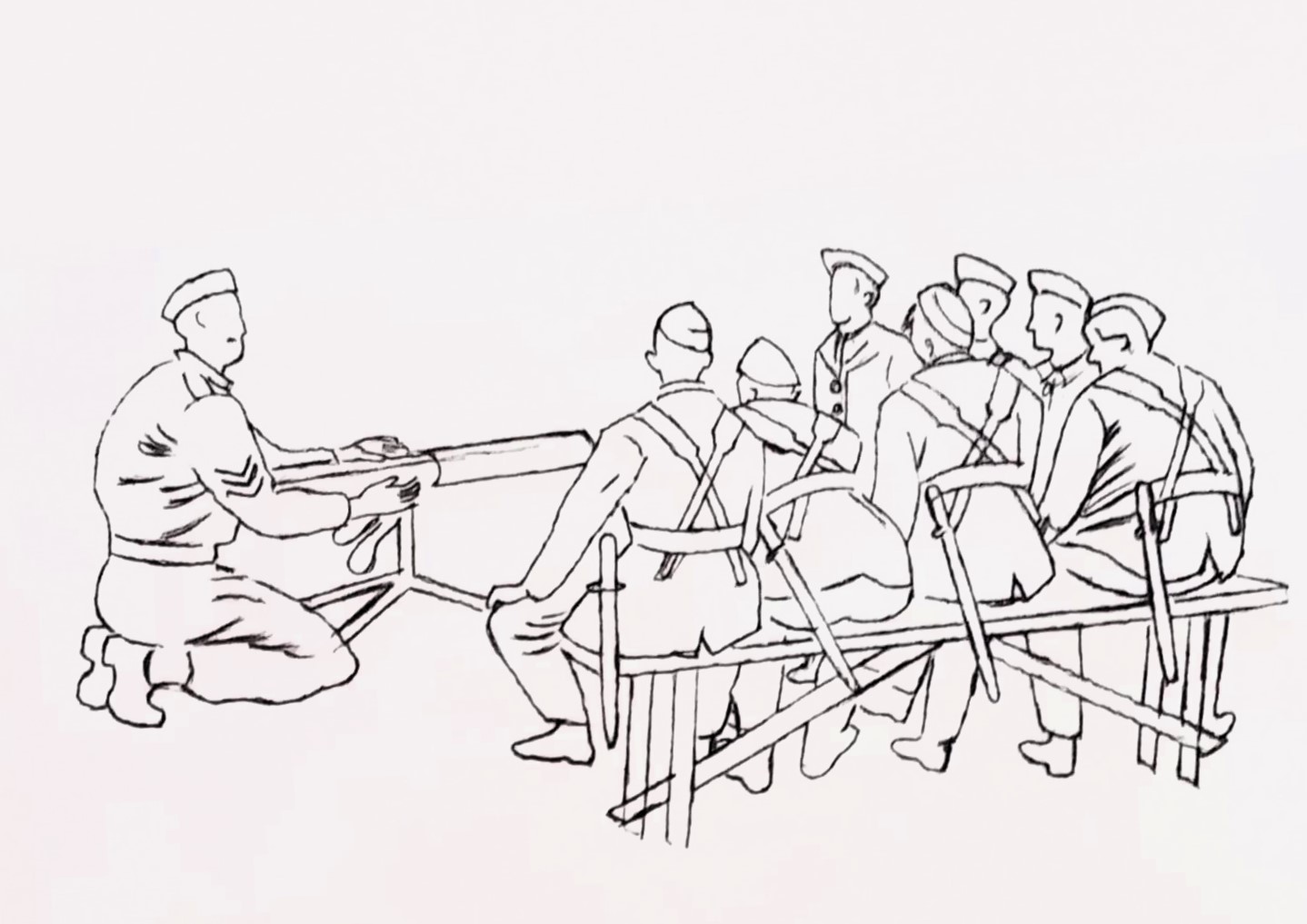
Demonstrating a machine gun. He painted as much as possible of the watercolour on the spot but did not complete the group having the machine gun demonstrated. Demonstrating a machine gun – pencil sketch.
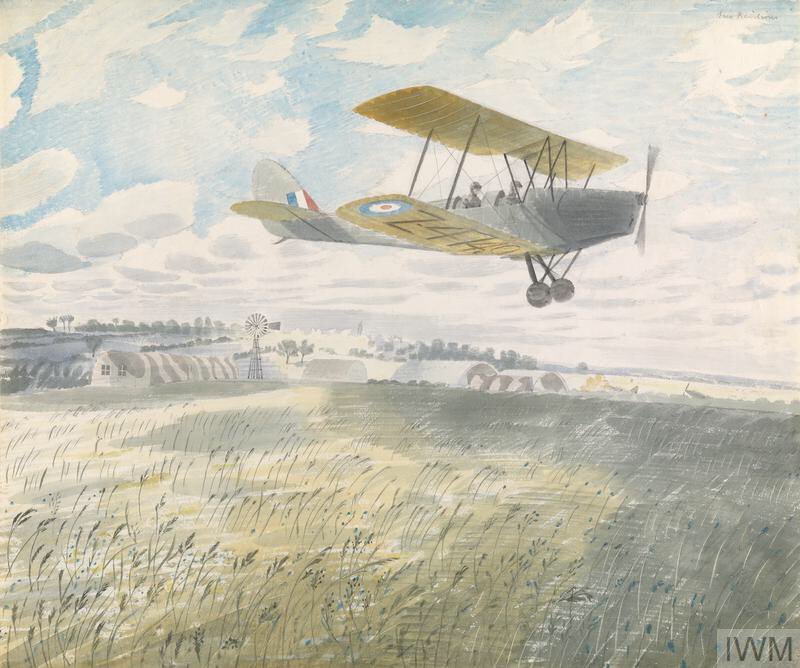
Elementary Flying Training School, 1942. Imperial War Museum.
June 1942. Eric’s drawing of a Tomahawk Taking Off was given to Wing Commander P J A Riddell as a thank you for providing Eric with the facilities he needed while at Sawbridgeworth. The drawing has not been traced. The site is now defunct as a military base and few of the original buildings exist, many subsumed by modern industrial buildings and farmland. the Sick Quarters Site has become a small industrial estate.
At the end of July 1942 Eric moved on, a brief stay at Weston Zoyland near Bridgewater. For some months Eric had been discussing possible placements in Russia, Ireland and Iceland. By the 12th July Eric was at home in Shalford working on unfinished paintings from Sawbridgeworth.
” I’m busy on about six painting’s, mostly made from notes made in Tigers from the air. It is a tricky but amusing job and I hope to produce something in a week or two if they don’t all take a wrong turning.”
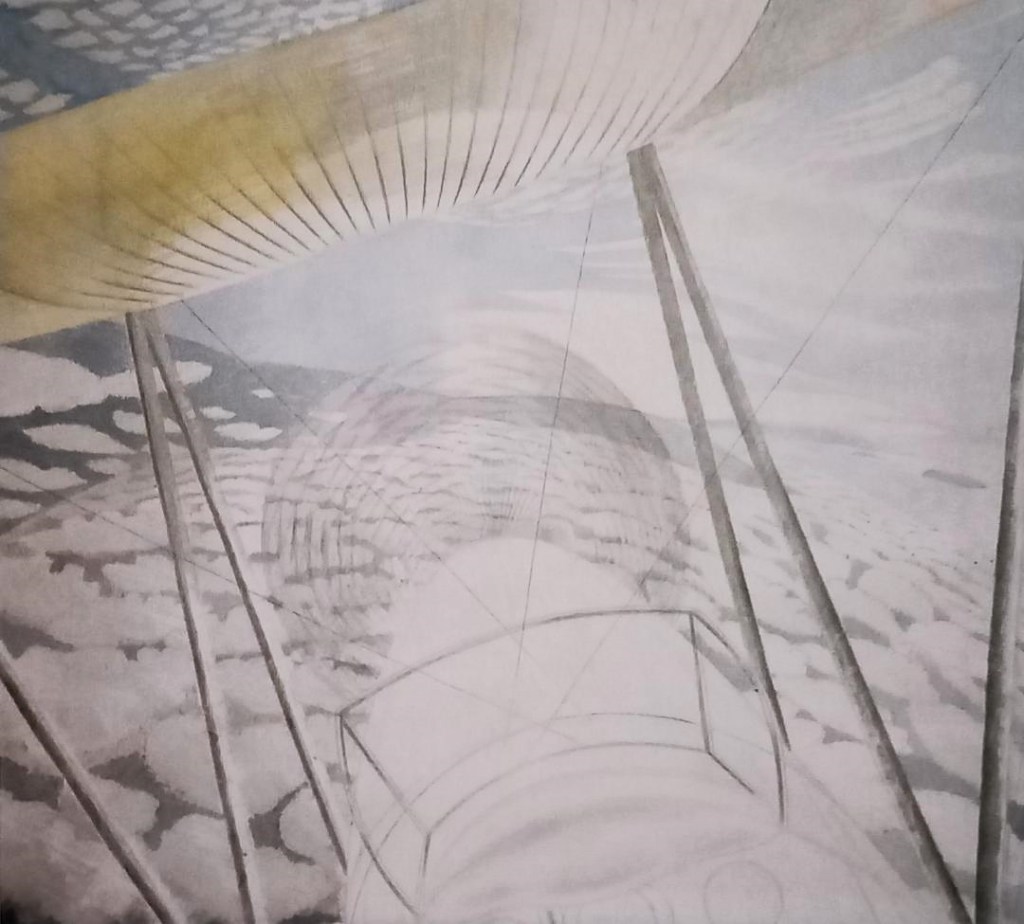
View from the Cockpit of a Moth, unfinished, 1942.
Graham Bennison, January 2025. https://www.facebook.com/BennisonArtist Credit to the Imperial War Museum, London for the majority of pics here. See also https://httpartistichorizons.org/2023/12/29/the-ravilious-family-at-ironbridge-farm/
 Artistic Horizons