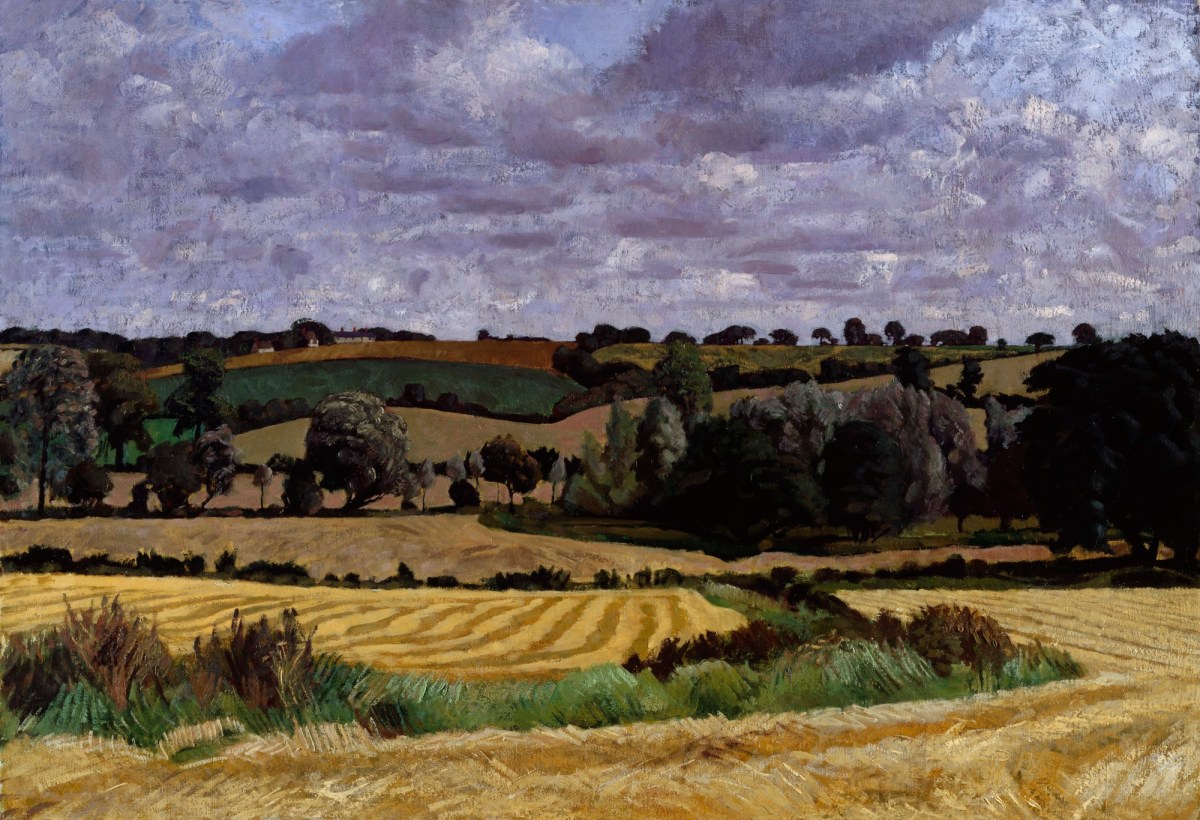


Geoffrey Hamilton Rhoades self-portrait woodcut 1941
GEOFFREY HAMILTON RHOADES was born in 1898 in Balham, London, to a middle-class family. His father, Walter, was a senior civil servant and author, mainly of boys’ adventure stories. As a youth, Walter was quite an athlete, both as a runner and a cricketer.
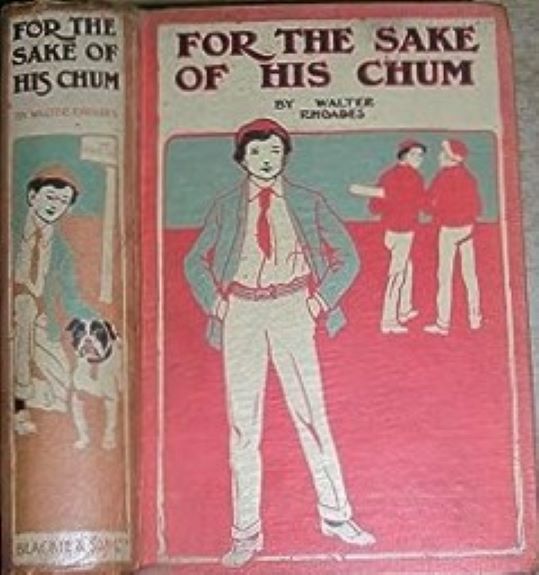

Walter Rhoades: For the Sake of his Chum Quills A Tale of School days at Bedinghurst
Geoffrey attended Dulwich College where his education involved the Latin language and Roman and Greek culture which included drawing from classical casts. After Dulwich he spent two years at Clapham Art School 1915-17 under the direction of Leonard Charles Nightingale 1851-1941 before serving in the Mercantile Marine from 1917 to 1919 as a naval wireless operator.

Rhoades: Venice 1919. Etching.
On completing his war service he took a portfolio of drawings to show Professor Tonks at the then, most prestigious Slade School, University of London, who accepted him onto the course immediately. His landscapes, figure studies and flower paintings reflect his love of natural history and interest in the classical world.
Later, at the conclusion of his time at the School, Tonks remarked: “You have something which I have not – imagination.”
During the Slade years between 1919 and 1924 he socialized with both fellow students and a number of established artists at Barnett Freedman’s studio off the Tottenham Court Road, among whom were Albert Houthueson, Percy Horton, Charles Mahoney and James Laver who was just beginning his work at the Victoria and Albert Museum (Keeper of Prints, Drawings and Paintings for the Victoria and Albert Museum between 1938 and 1959). During this Slade period Geoffrey met fellow artist Charles Mahoney, they met at the bedside of Barnett Freedman’s during one of Barnett’s serious illnesses.
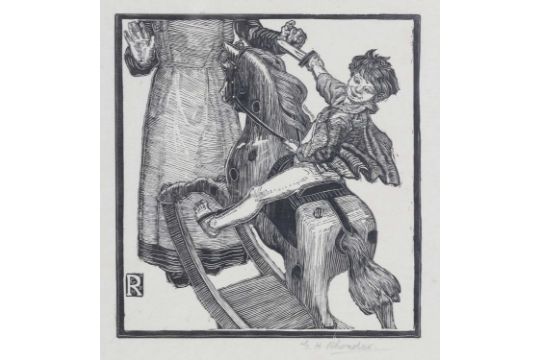
Rhoades: Hobby Horse, wood engraving 1921.
A fellow student of Geoffrey’s at the Slade was John Mansbridge through whom he met author and architect Christopher Turnor ( MP, JP, DL 1809 – 1886)) and his wife Sarah who were in the process of opening their large country house, Stoke Rochford in Lincolnshire, for summer schools. Geoffrey was invited to go there and make paintings for an indefinite length of time. He stayed for two years (1925-27) painting family portraits, some murals, landscapes and making many drawings. The Turnor’s were very kind to him and he became very much part of the household.
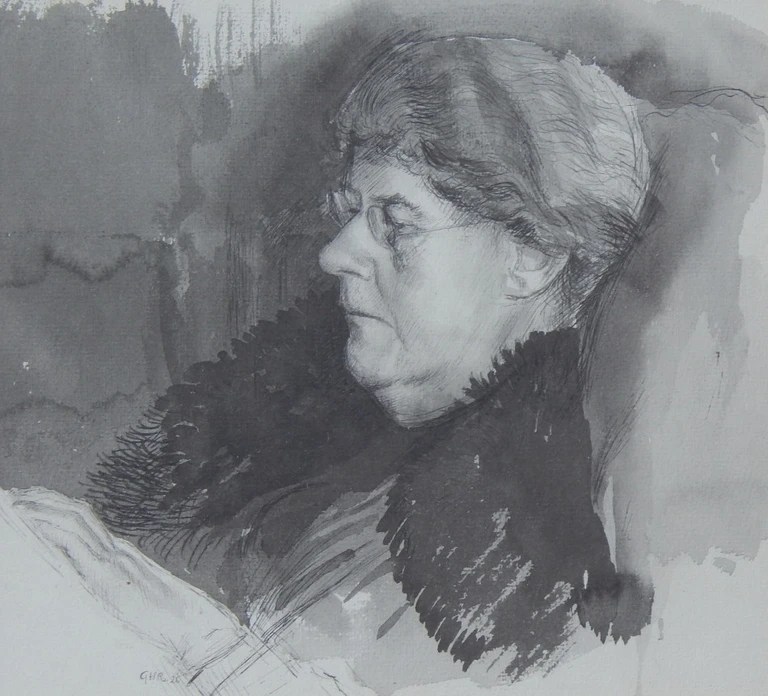
Rhoades: Miss Turnor
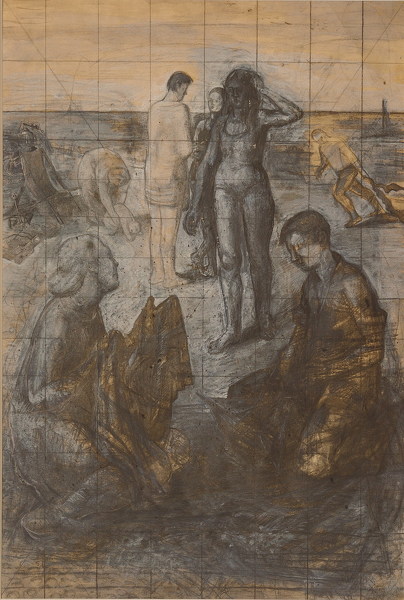
Rhoades: Study for The Bathers 1925.
Geoffrey moved back to London in 1928 and was invited to undertake some teaching at the Working Man’s College in Crowndale Road. Founded in 1854 the college was amongst the earliest adult education institutions established in the United Kingdom. Geoffrey and Charles Mahoney were now living in Kensington Crescent, W14, a charming Regency crescent, now demolished. In 1930 they went on holiday with Percy Horton to Blackmore Farm near Marden in Kent where Mahoney made studies of the orchard for the Morley College murals.

Rhoades: The Offering 1929

Charles Mahoney: Study for the Morley College Murals. *
In 1928 Eric Ravilious, Edward Bawden and Charles Mahoney were commissioned to provide murals for Morley College, Mahoney worked in the Concert Hall, and Bawden and Ravilious in the student Refreshment Room. By 1930 the murals were due to be unveiled by the Prime Minister Stanley Baldwin, Geoffrey was called in to help with the murals to meet the deadline. The murals became some of the most influential British murals of the time but were unfortunately destroyed by bombing in the 1940 Blitz.

Charles Mahoney: Portrait of Geoffrey Hamilton Rhoades
Geoffrey was not initially confident about his suitability for teaching but became much admired and loved as a teacher of studio studies. In 1929 Geoffrey followed Percy Horton as the art master at Bishop’s Stortford College, remaining in this post for fifteen years. A distinguished colleague and friend on the College staff was Walter Strachan 1903-1994, poet, translator and champion of the arts, Head of Modern Languages at Bishop Stortford College for over 40 years.
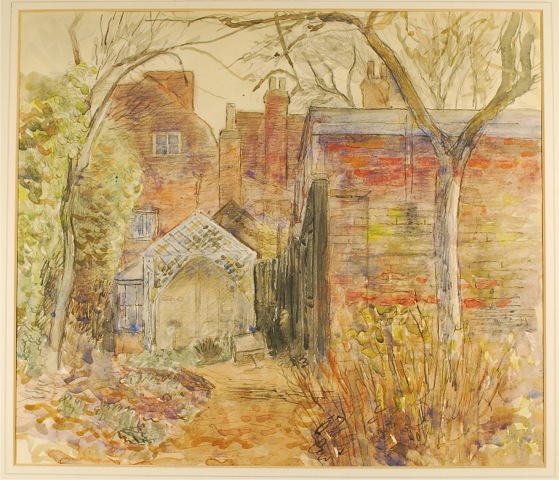
Rhoades: Brick House, Great Bardfield. painted on a later visit in 1940.
During the winter of 1932/33 Geoffrey was at Brick House, Great Bardfield, the newly acquired home of Edward and Charlotte Bawden, with part of the house let to Eric Ravilious and Tirzah Garwood.
In her autobiography ‘Long Live Great Bardfield’ Tirzah recalled:
‘Charlie Mahoney, with Geoffrey Rhoades stayed for a long time and helped Edward with the garden. During the winter the four men (Ravilious too) had cleared the yard which was feet deep in years of rubbish. They unearthed all kinds of relics from the trade of past owners: it had been a girls’ school, and a saddler’s and coffin maker’s and there were pieces of old coffin and piles of old harness which they had buried in a huge pit which they had dug in the garden. Geoffrey Rhoades made a painting of the others working in the snow.’


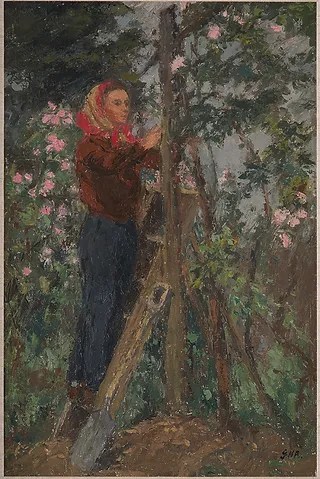
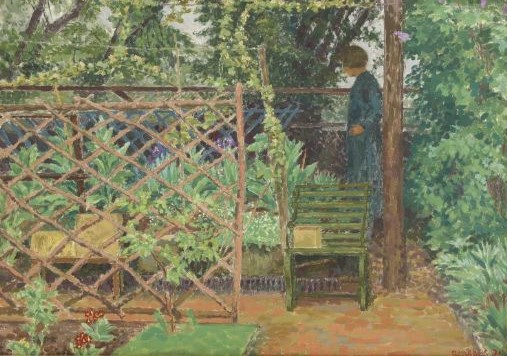
Rhoades: Joan Jenner 1935. Joan (Jenner) the Artist’s Wife, 1940’s. Joan Rhoades In a London Garden 1941
In 1934 Geoffrey married Joan Jenner whom he is reputed to have met at a Royal College Ball, and they remained together until his death in 1980. Joan was in the Ministry of Agriculture with Mrs Horton, both were fond of doing Torquemada and The Listener crosswords and won prizes. Tirzah recalled that visiting Brick House Joan would sing songs in German pottering around the house. Their son, Peter, was born in 1938 while they were still resident in London.

Rhoades: Winter Afternoon Chalk Farm
Geoffrey’s reputation must have been high because in 1935 the Tate (Britain) bought his “Winter Afternoon, Chalk Farm” landscape, but, after Peter’s birth and the onset of the Second World War blitz, they moved house to Stebbing in Essex. It was as well they did so because their London Street, Greville Road, in Kilburn, was subsequently bombed.
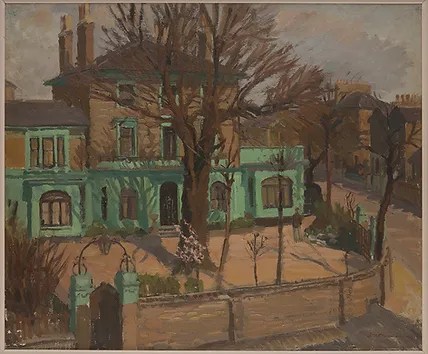

Rhoades: Greville Road Garden at Bran End, Stebbing
The move brought them close to Great Bardfield where the very prestigious artists’ group including Bawden, Ravilious, Michael Rothenstein and a number of other distinguished artists who had collected away from London. Geoffrey and Joan were intimate members of this creative community and remained so during the war.


Rhoades: The White Gate 1941 Essex Landscape 1940’s
After a short period residing near Chesham, Buckinghamshire the Rhoades family made a final move to Cuddington on the Buckinghamshire and Oxfordshire border. This change of location was stimulated by the necessity of being closer to Oxford. Percy Horton had been appointed Ruskin Master of Drawing at the Ruskin School, University of Oxford, and had invited Joan to be his secretary there. He subsequently engaged Geoffrey as a tutor at the School and this began a very long relationship with the Ruskin and Oxford for both of them, Joan continued to be secretary with Percy Horton followed by Richard Naish, and, just before her retirement in 1974, Philip Morsberger. Both Joan and Geoffrey were much admired and loved at the Ruskin which was then housed in the Ashmolean Museum.
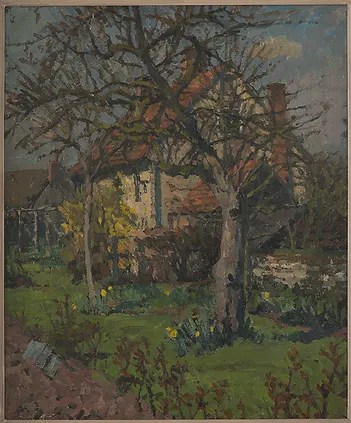
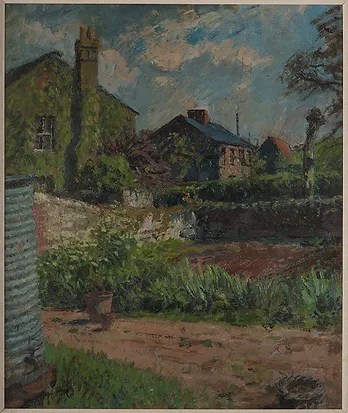


Rhoades: Apple Tree at Seven Stars, Cuddington The Yard Seven Stars The Artist’s Garden River Evenlode, Oxfordshire Landscape at Charlbury

Rhoades: Snow at Seven Stars, Cuddington 1970’s
The final phase of Geoffrey’s life was lived happily at Seven Stars, Cuddington with Joan and his son Peter who is also an artist. This concluding period, however, was marred by the tragic death of his sister, Esmee, in a traffic accident near the family home in Balham, which affected him very deeply.

Rhoades: In Memoriam to Esme 1966
Rhoades steadily produced landscape and mythological figure compositions in oils and in a variety of graphic media. Joan developed quite a large garden with both horticultural expertise and aesthetic judgement, a lovely foil to the artwork of her husband and son.


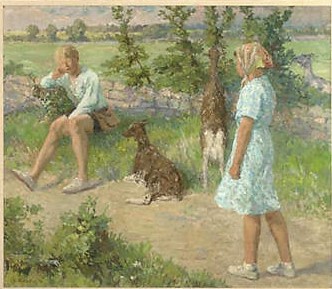
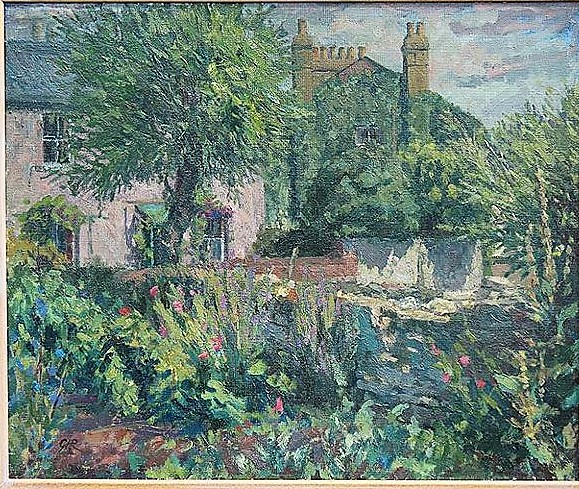
Rhoades: The Valley 1952 or before Right: Late Summer Morning, Hampstead. A Young Boy and a Girl with two goats on a path. Garden ??
Geoffrey continued to teach at the Ruskin School until his retirement in 1972 and also conducted therapeutic art classes at St John’s Hospital, Stone, through the 1960s. He died, after suffering from cancer, in 1980.
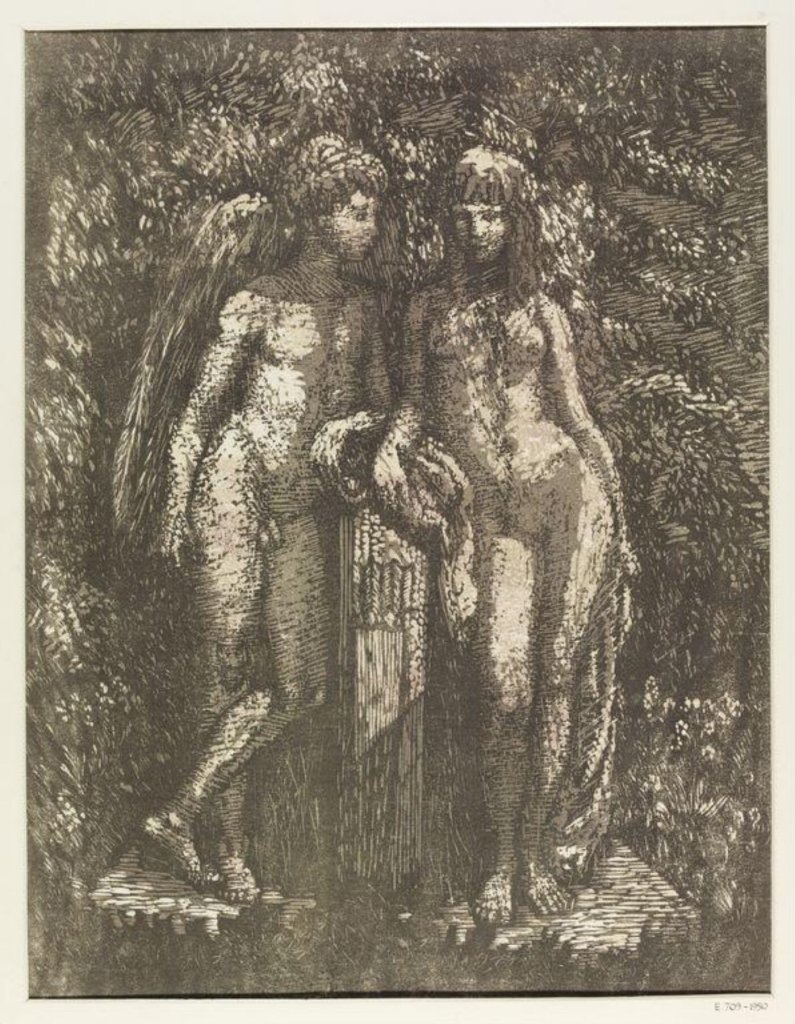
Rhoades: Anacreon’s Tomb. This linocut print won 2nd prize in the Giles Bequest competition of 1950, for colour prints from wood and lino.
Joan lived until she was ninety-seven years old at Seven Stars having helped to raise two generations of Peter’s children, her grandchildren, in the house; Lucy and Marion by Peter’s first marriage to Rosemary Bell; and Alice and Oliver by the second marriage to Jane Harrison. Marion and Oliver are both professional graphic designers. Peter, Jane and Oliver still live (in 2018) at Seven Stars.
Geoffrey exhibited at the New English Art Club, Royal Institute and Goupil Gallery and had one-man shows at Maltzahn Gallery, Ashmolean Museum, Mall Galleries and Sally Hunter Fine Art, 1987. The Tate Gallery, Ashmolean Museum, Victoria & Albert Museum and provincial galleries hold his work.
*The Morley College murals were part of a scheme for artists arranged by Mrs Eva Hubback, the Principal, with advice from Sir John Rothenstein. Funding of £1,300 was received in 1928 from Sir Joseph Duveen for the murals.

This blog would not have been possible without the help of Peter Rhoades who kindly gave me permission to use information from his own website re his father. Many thanks Peter.
Loves Labours Sadly Lost – Bawden on Ravilious and the Morley, Morecambe and Colwyn Bay Murals.

Ps. Above my head as I write is ‘The Smithy’ an early etching by Geoffrey Hamilton Rhoades, a much loved work !
Blogs re Horton, Freedman, Mahoney, Garwood and others can be found here :- https://httpartistichorizons.org/menu/
Graham Bennison, September 2023. https://www.facebook.com/BennisonArtist


Thank you for that interesting review of Geoffrey Rhoades. What a very able painter from a lovely period in English art.
LikeLike
Thanks for that Martin.
LikeLike
Many thanks for writing this about G H Rhoades. He is someone that I had never heard of … but there are so many artists in that category! I particularly like, “The White Gate”.
LikeLike
Many thanks for that Dave.
LikeLike