

Trevelyan was the only child to survive to adulthood of Robert Calverley Trevelyan and his wife Elizabeth van der Hoeven. His grandfather was the liberal politician Sir George Trevelyan, 2nd Baronet, and his uncle the historian George Macaulay Trevelyan; he is the great-uncle of his namesake, Julian Trevelyan the pianist.
Julian Trevelyan was educated at Bedales School and Trinity College, Cambridge, where he read English Literature. He joined a lively avant-garde group that was responsible for the first published Surrealist statement in Britain – in it, Trevelyan exclaimed, “Let us gladly shout: to dream is to create.”
He moved to Paris in 1931 to become an artist, enrolling at Atelier 17, Stanley William Hayter‘s engraving school, The 1930s were fertile years for the young Trevelyan who benefitted from three years in Paris where he met Max Ernst, Oskar Kokoschka, Joan Miró, Paul Klee, Alberto Giacometti, André Masson, and Pablo Picasso. It was in this atmosphere that he turned to Surrealism and became a founding member of the British Surrealist Group.
He married the potter Ursula Darwin, daughter of Bernard Darwin and his wife Elinor (née Monsall) on 30 July 1934. She was a great-granddaughter of Charles Darwin; their marriage was dissolved in 1950. Their son is the film-maker Philip Trevelyan.
Ursula………https://www.facebook.com/groups/488249232182567/permalink/1111077453233072/
In 1935, Trevelyan bought Durham Wharf, beside the river Thames in Hammersmith, that had once been the studio of sculptor Eric Kennington. London. This became his home and studio for the rest of his life and was a source of artistic inspiration to him. He became a confirmed Surrealist and exhibited at the International Surrealist Exhibition, held at the New Burlington Galleries in London.


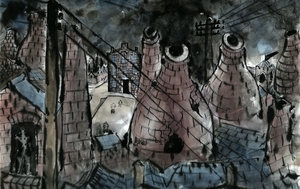
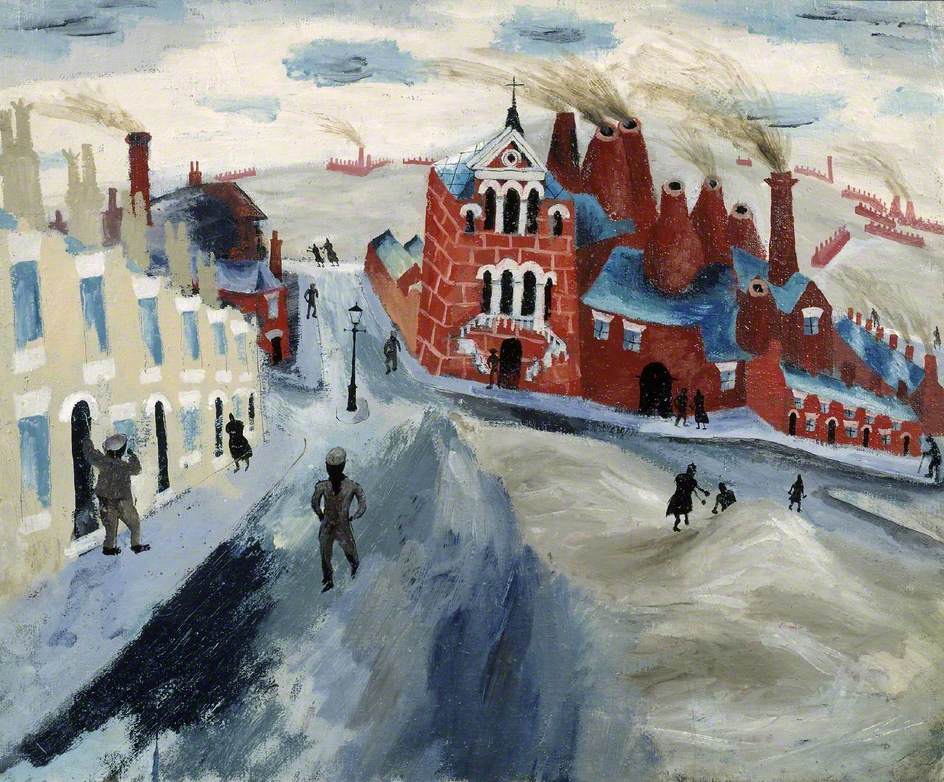
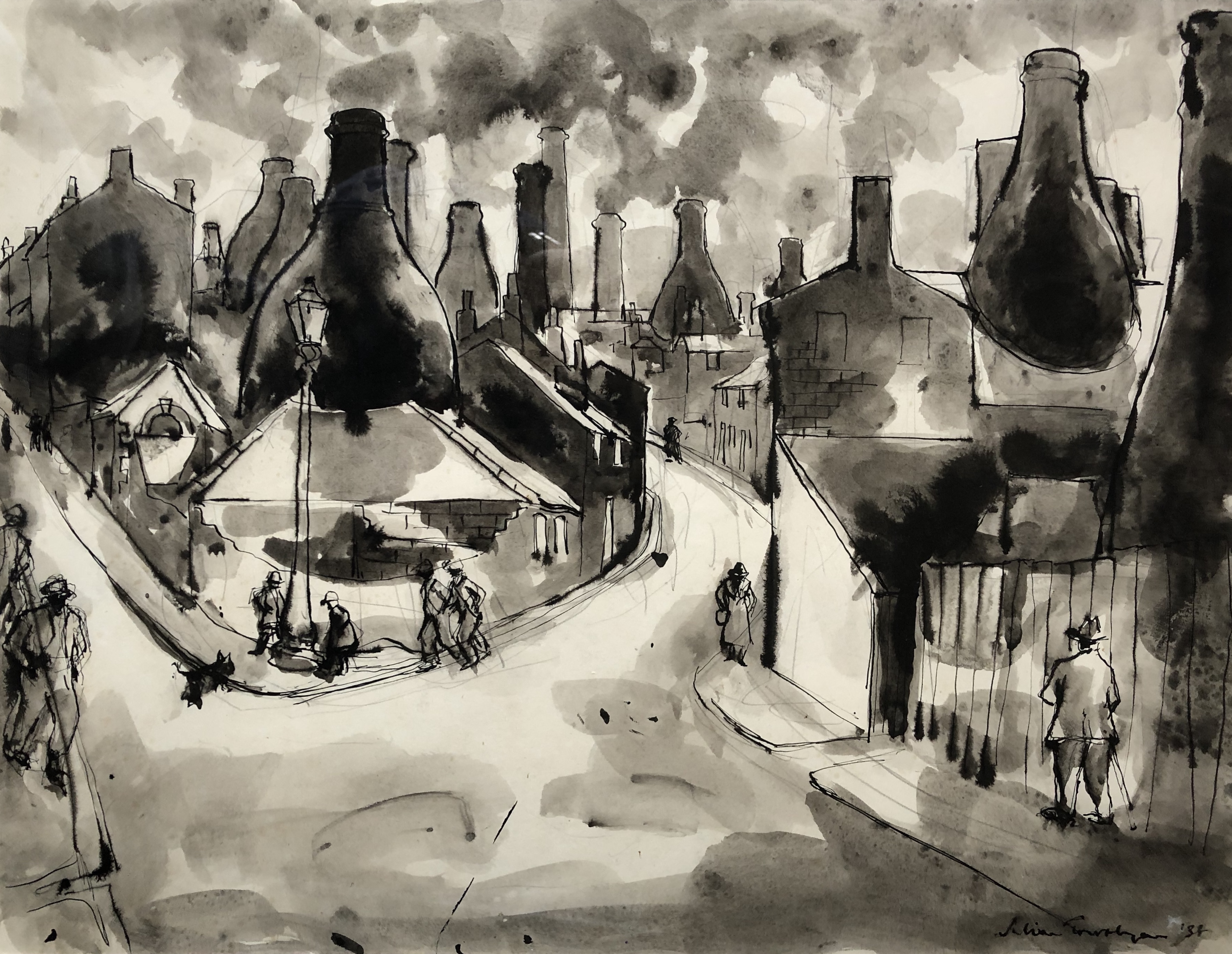
Burslem……. ‘It was a landscape full of drama and pathos, very much after my own heart. At that time there were thousands of bottle kilns, stuffed with saggers full of pottery…
As one of the first participants of Mass Observation, which aimed to record the routines and rituals of everyday life in Britain using volunteer observers, diarists and participants. Trevelyan spent a month in Bolton’s industrial streets, painting and creating collages from his suitcase full of materials. Trevelyan’s collages from his involvement with Mass Observation are regarded as a critical part of his development bringing together so many strands of his artistic development during the late 1930s.


Bolton Collages: ‘Bolton’, 1937. The work depicts an industrial mill scene, but also incorporates newspaper and magazine cuttings from the Spanish Civil War, reflecting fears of the rise of Fascism. Rubbish May Be Shot Here, 1937. Bolton Mills, 1938. 1,000 Volts, 1939.
Trevelyan created a powerful series of collages and paintings of the industrial north. The collages, including Rubbish May be Shot Here (1937), incorporated allusions to contemporary politics and popular culture by way of magazine and newspaper cuttings, old catalogues and bills, and the paintings, including The Potteries (1938), were darkly expressive yet deeply personal in their evocation of poverty and deprivation.
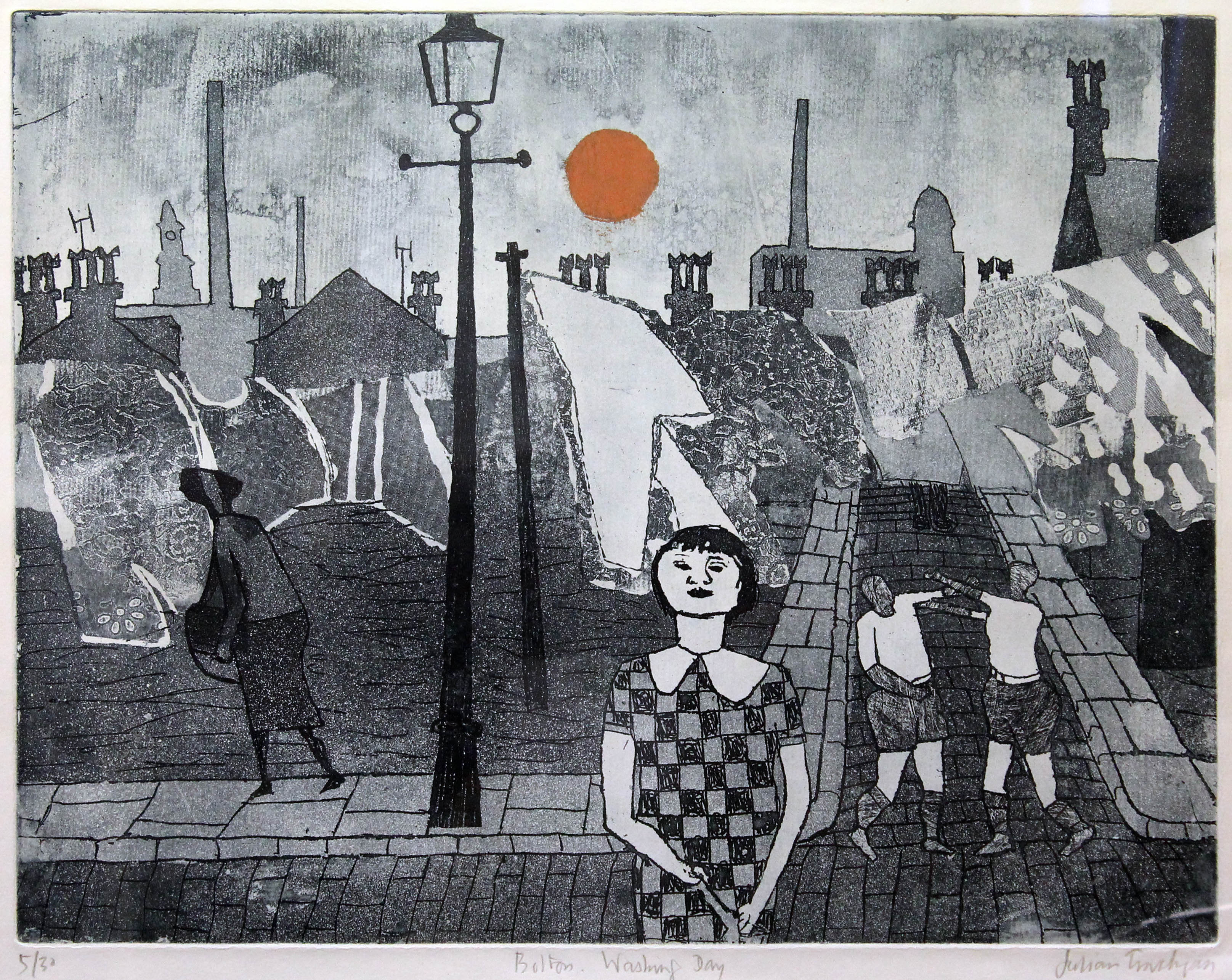


Bolton: Washday, etching, 1938. Landscape With Pylons, pen and ink, 1938. Bolton, etching, a much later return to Bolton 1964.
During this time he became interested in ‘Sunday painters’ and championed the self-taught group of Ashington Miners, known today as the ‘Pitmen Painters’. Having had little formal training himself, Trevelyan was fascinated by these self-taught painters, believing strongly that anyone could be an artist. In 1939, shortly after resigning from the London Surrealist Group, he organised an exhibition of their work at the Peckham Health Centre.
Along with other artists such as Roland Penrose, during the Second World War, Trevelyan served as a Camouflage Officer. He was a member of the Royal Engineers from 1940 to 1943, serving in North Africa and Palestine.
You cannot hide anything in the desert.
Arriving in the “Western Desert” town of Tobruk, North Africa, Trevelyan realized that standard British army green and brown splotches were ineffective as desert camouflage. He and the other camoufleurs, working under Hugh Cott and Geoffrey Barkas, became expert at desert camouflage and deception. By 1942, they were able to deceive the German Afrika Korps, creating a dummy army which successfully tied down German forces, while real tanks were concealed or disguised as trucks and other equipment.

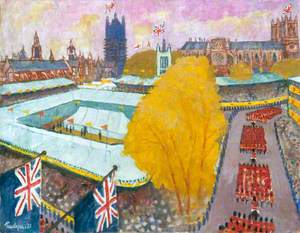

The Artist’s Garden 1947. Parliament Square 1953. Albert Bridge 1953.
From 1950 to 1955, Trevelyan taught history of art and etching at the Chelsea School of Art.
Trevelyan’s second wife was the celebrated painter Mary Fedden; they married in 1951, They lived together at Trevelyan’s home at Durham Wharf, a collection of small warehouses on the Thames in Hammersmith. The couple travelled in Europe, India and America.


Washing Day, Freetown 1942. Sienese Creti 1956.
From 1955 to 1963, Trevelyan worked at the Royal College of Art and became Head of the Etching Department. Because of his enthusiasm in his work and the desire to share it with others, Trevelyan became a highly influential teacher, with students including David Hockney, Ron Kitaj and Norman Ackroyd. He was an important leader of modern print techniques and today is regarded as a silent driving force behind the etching revolution of the 1960s.
In 1969, he produced the Thames Suite, a collection of 12 views of the Thames from its upper reaches in Oxford and Henley-on-Thames down to the tidal stretches of London and the Estuary.
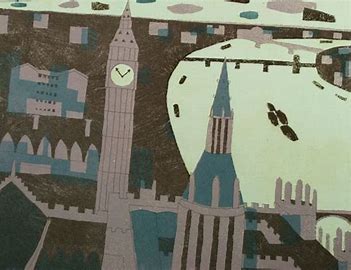
Westminster, from Thames Suite 1969.
In July 1986, Trevelyan was awarded a senior fellowship at the Royal College of Art and in September 1987 he was appointed a Royal Academician.
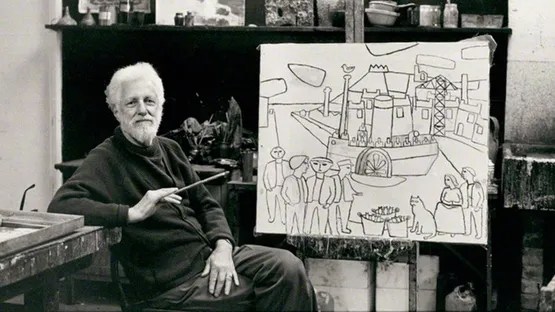
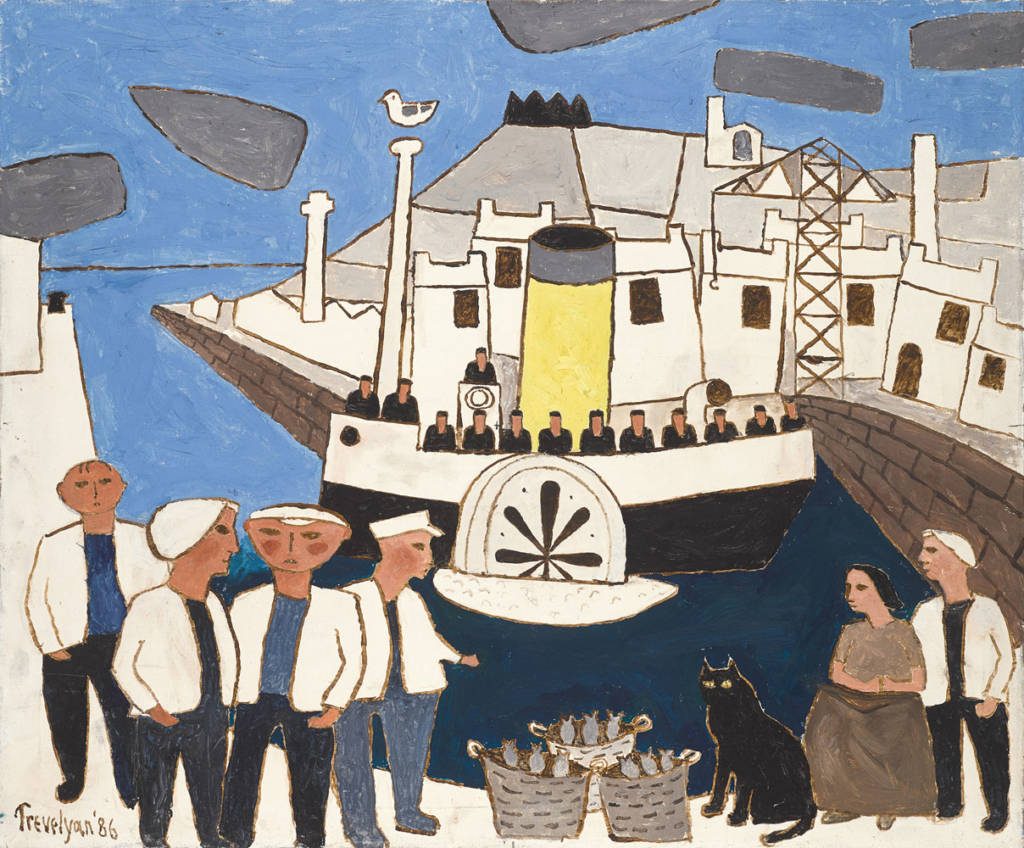
Paddle Steamer underway. 1986. Paddle Steamer 1986.
Trevelyan died on 12 July 1988 in Hammersmith, London.
To celebrate the centenary of his birth, an exhibition of his prints was held at Pallant House Gallery in Chichester from 10 May to 13 June 2010.


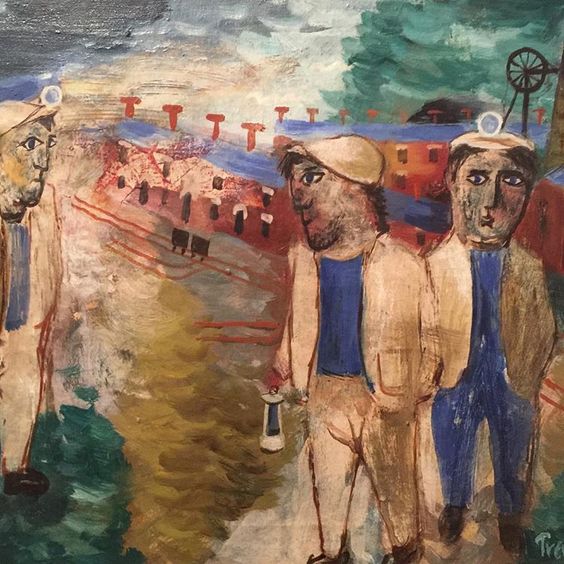
Trevelyan Self-Portrait 1940. Swans 1943. Miners 1943.
https://httpartistichorizons.org/2020/09/09/bolton-work-town-survey-1937-38/
https://httpartistichorizons.org/2020/09/27/the-pitmen-artists-of-ashington/
Thanks go to Wikipedia, Pallant Gallery and Art UK for help with the text here.
Graham Bennison https://www.facebook.com/BennisonArtist
 Artistic Horizons
Julian taught my etching Tutor, Walter Chamberlain, at the RCA together with David Hockney 1958-61
LikeLiked by 1 person