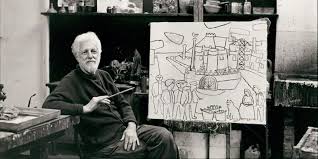
Robert Home, Ceres artist.

Robert Home.

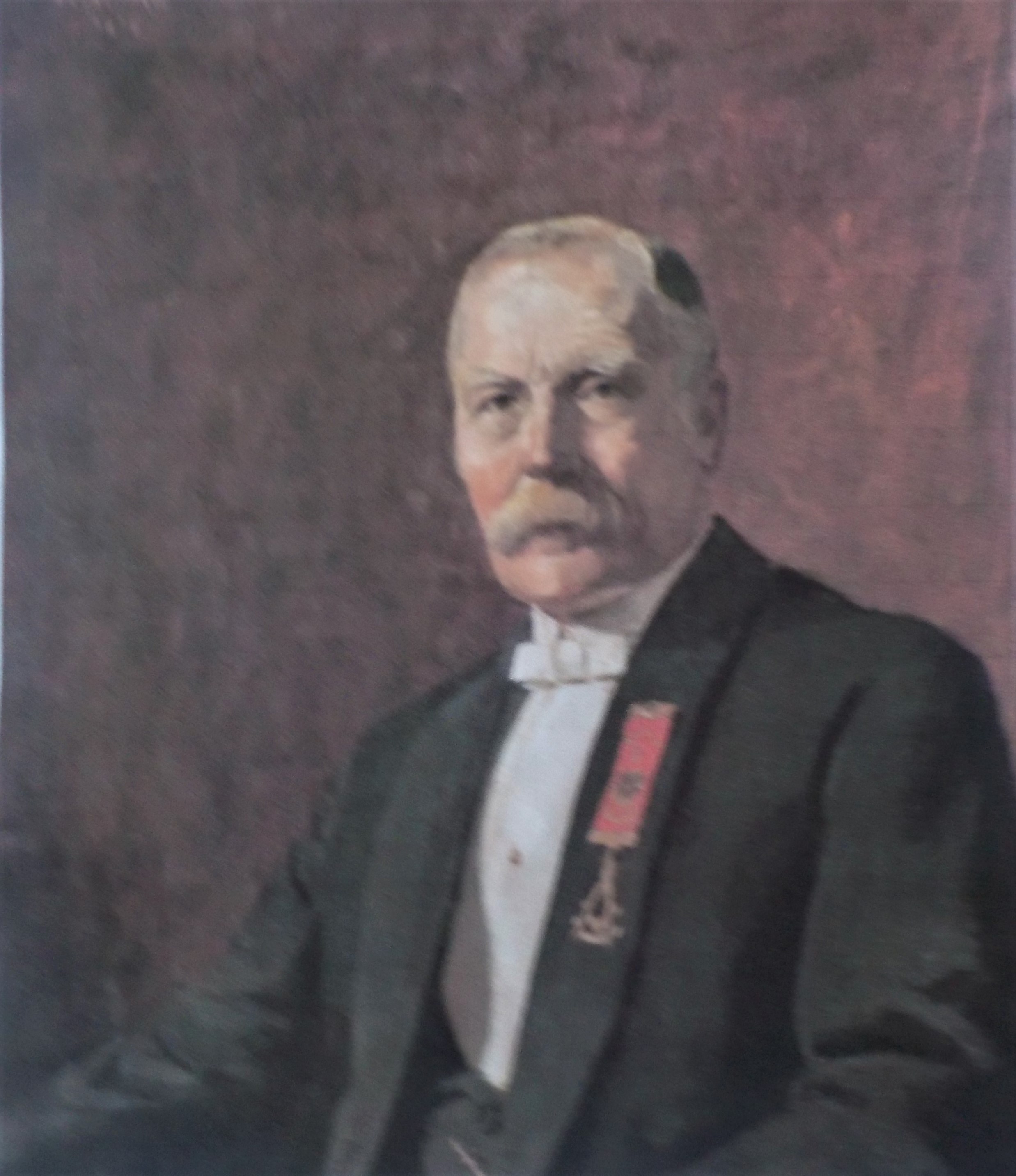
Robert Home – 1865-1938, the son of an artist, was an Edinburgh-born portrait and landscape painter, illuminator and stained-glass designer who learnt his trade at Edinburgh Art School. He exhibited at the Glasgow Institute of the Fine Arts, Royal Academy of Arts and Royal Scottish Academy.

Home was an authority on heraldic designs, skilled as an illuminator of manuscripts. In 1895 he married Helen Bonallo with whom he had 4 children, 3 sons and a daughter. However by 1918 he was separated from his wife and moved to Ceres.
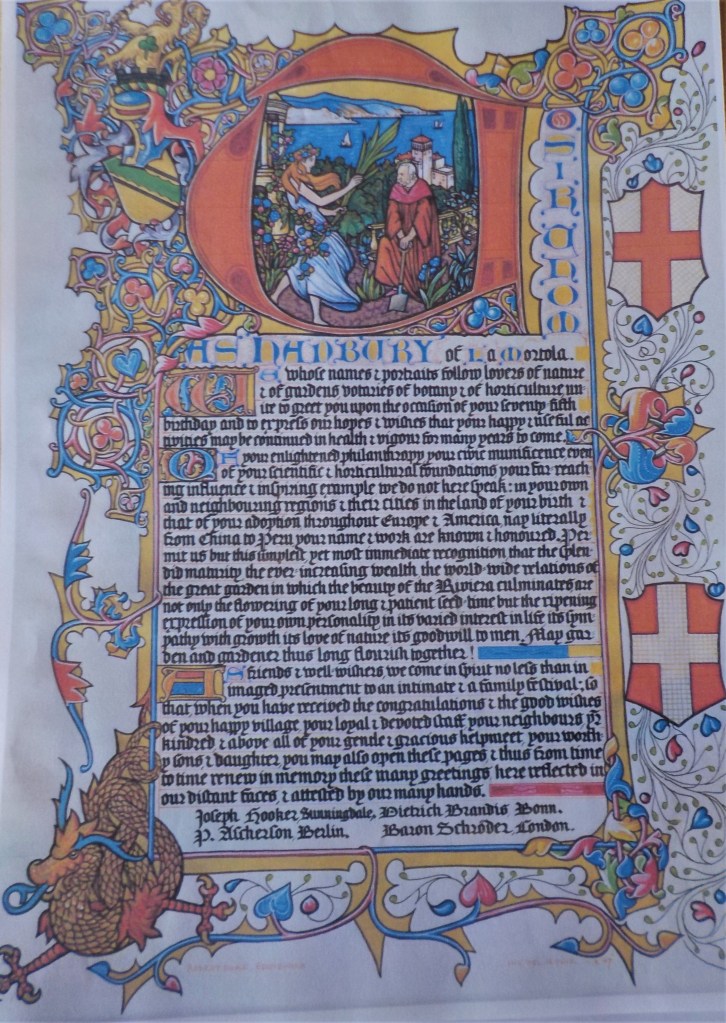
The frontispiece to a photo album illuminated by Robert Home, his signature can be seen in the bottom left-hand corner.

Home lived in Ceres from 1918 until his death in 1938. President of the Scottish Society of Artists, he was a skilled portraitist and also produced many paintings of local scenes. Home lived in Burnside Cottage with fellow artist, Eveline Jolly.

Burnside Cottage, Ceres.

Home came to Ceres at the end of the 1st World War but after seven years his eyesight began to fail. For four years he worked as a librarian at Crieff Library and his eyesight improved, gradually returning to his art activities.
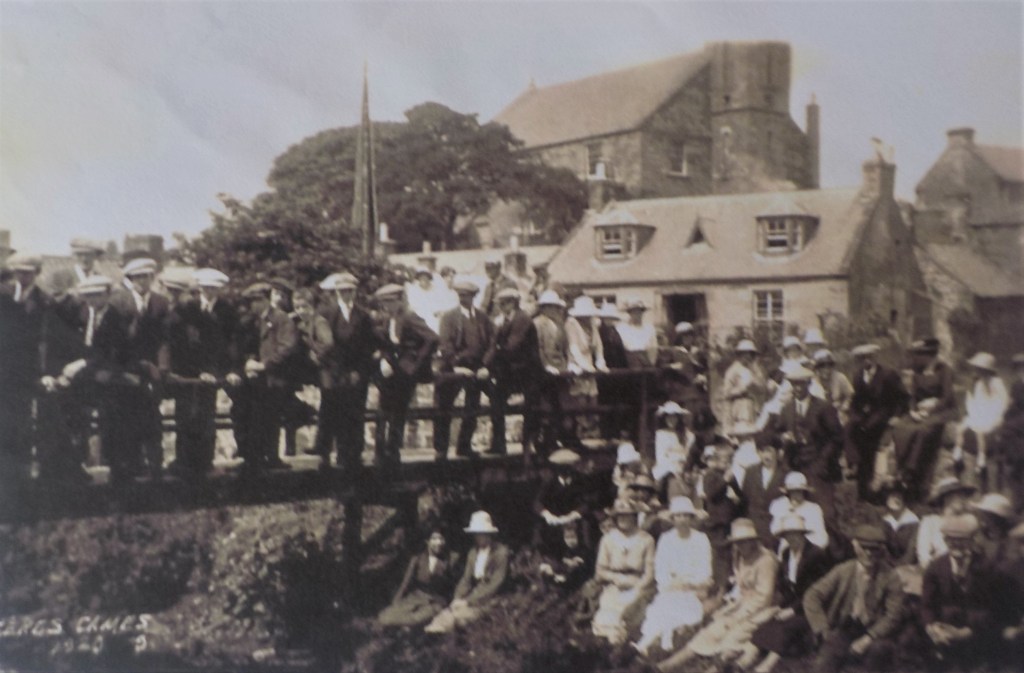
Watching Ceres Games 1920. Home and house guests would watch the Games from the roof of the shed at the foot of the Burnside Cottage garden.
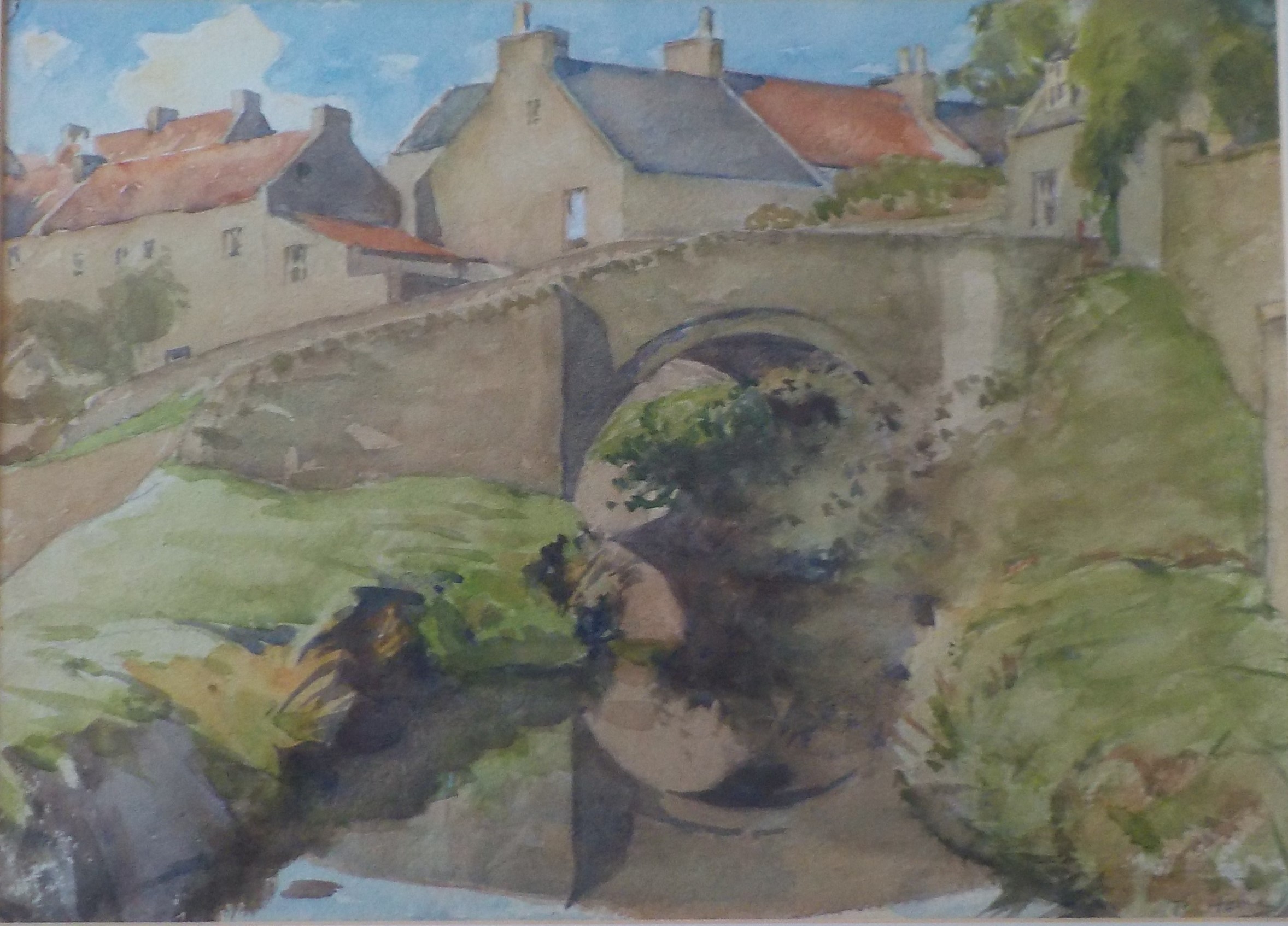
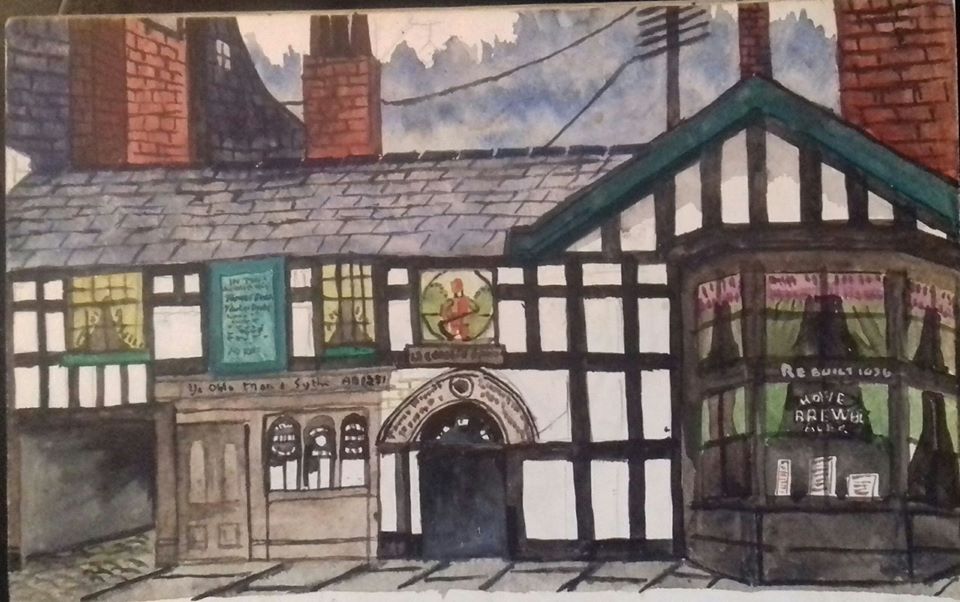
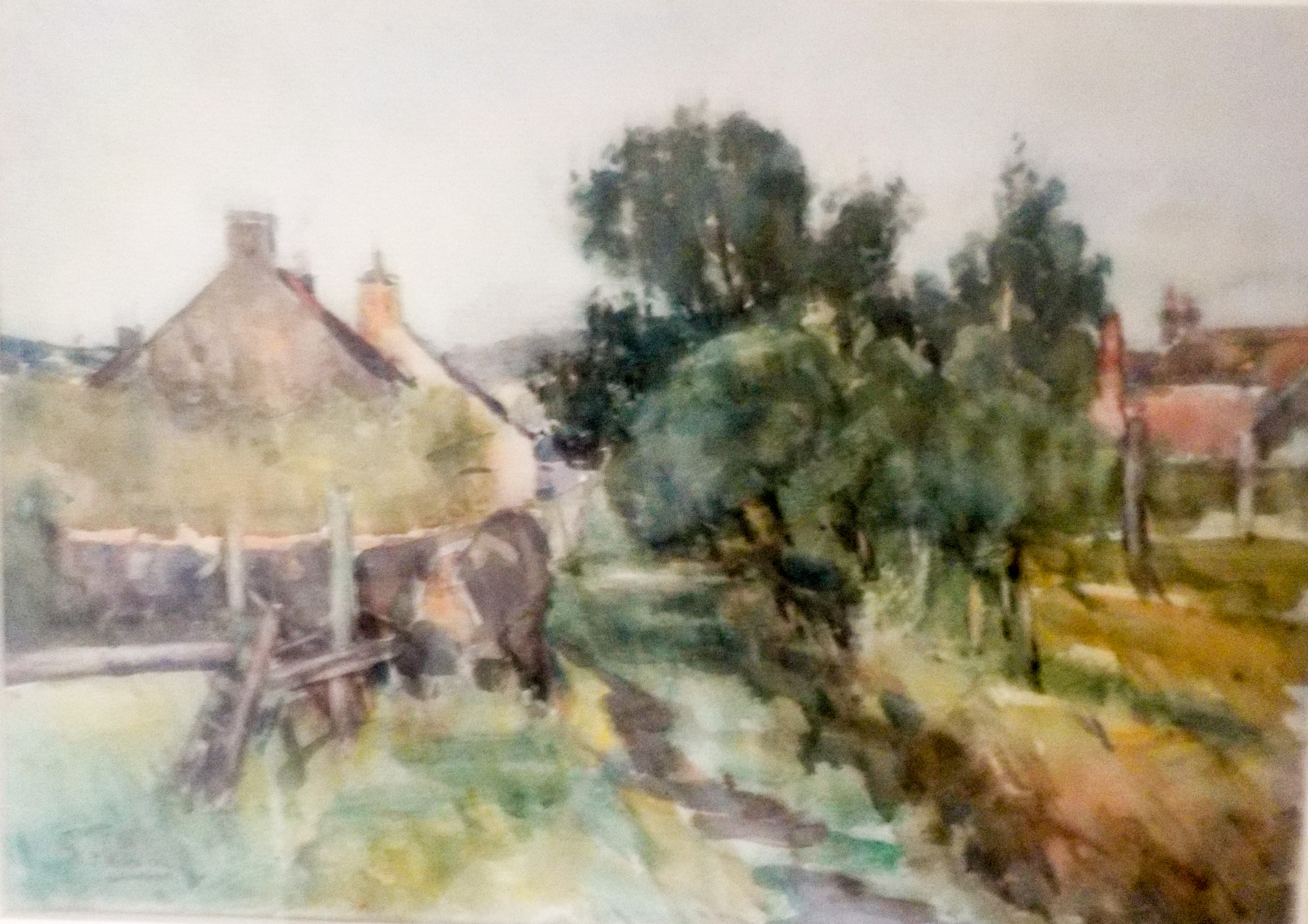
1 ‘Ceres’ watercolour. Private collection. 2 Right. Ceres Green. Fife Folk Museum. 3 Bottom right. Newtown, Burnside, Ceres.

Home was a prominent Freemason and was Depute Master of the Canongate, Edinburgh Lodge. Home was installed as master of the Lodge St Regulus, Cupar becoming its first ‘Right Worshipful Master’. From 1920-1922. He was President of the SSA (Scottish Society of Artists) 1915-1918.

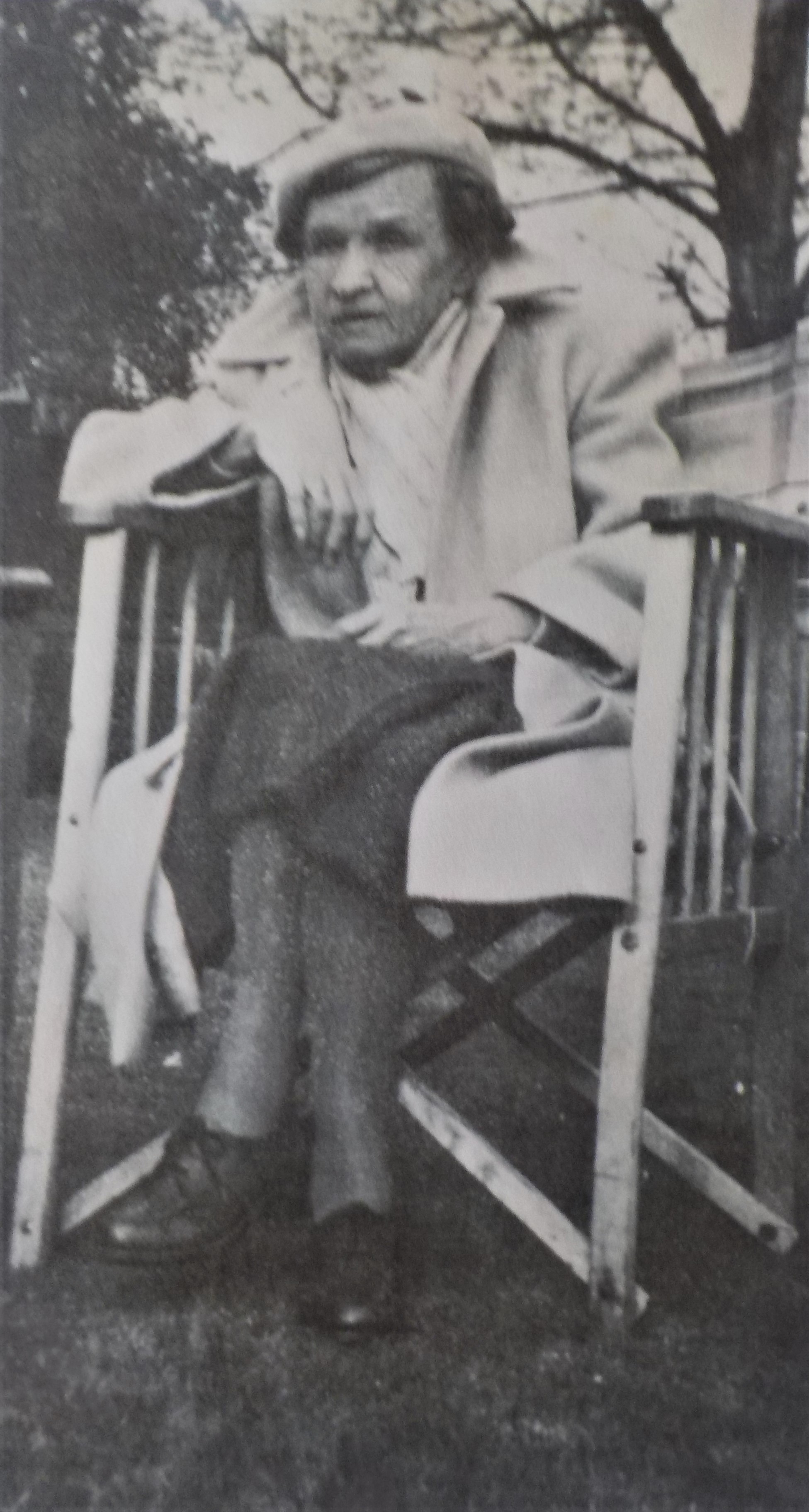
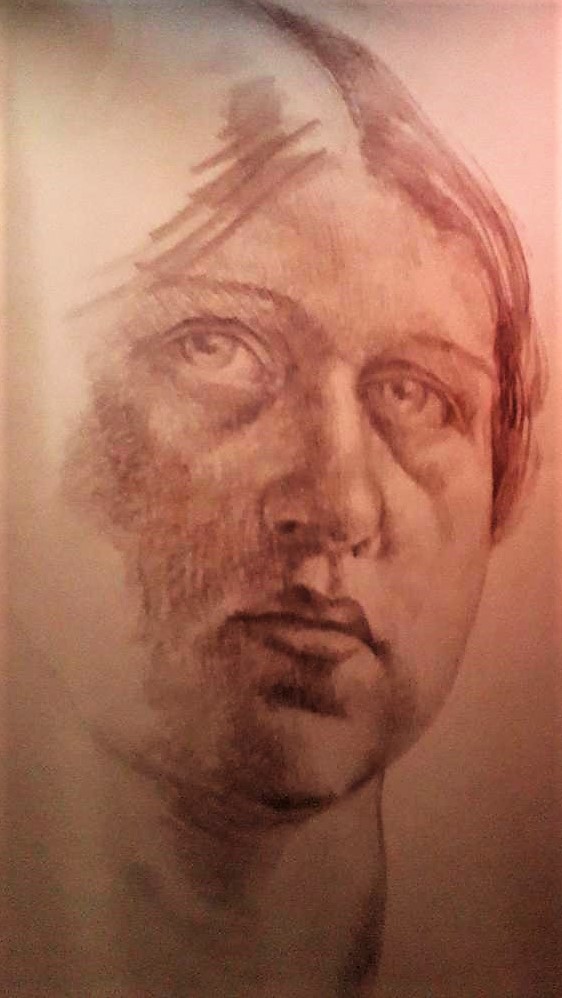
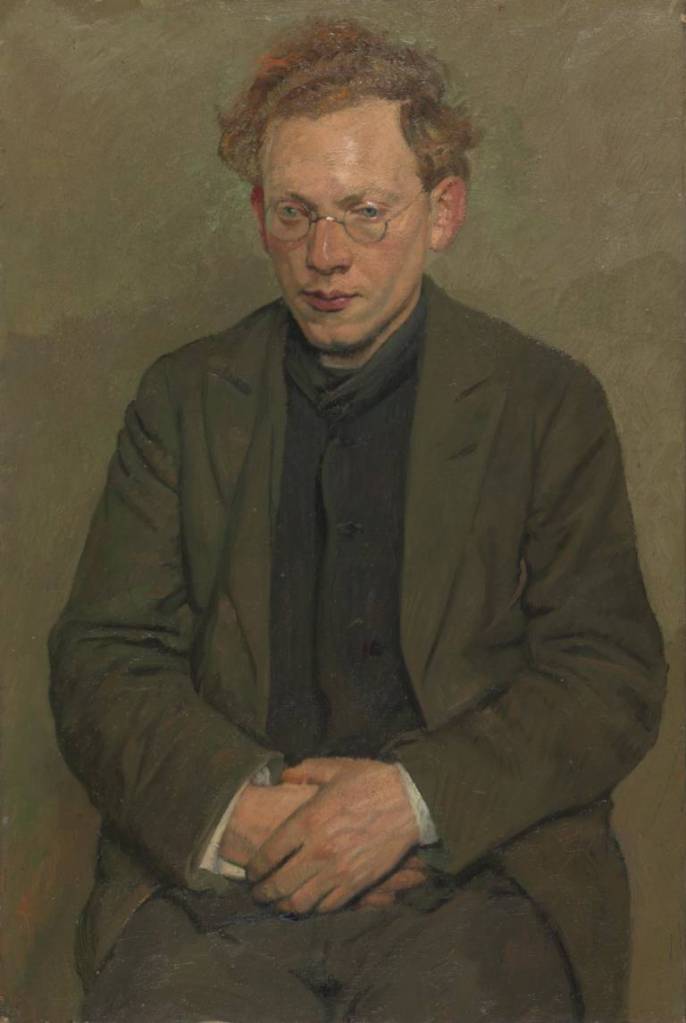
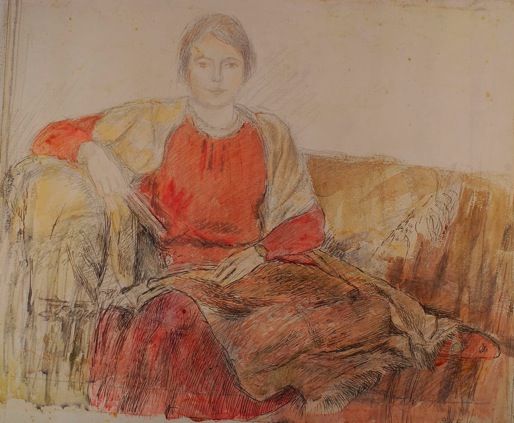
Eveline Jolly and Robert Home. Eveline Jolly 1954. ‘Portrait of a Gentleman’ 1920. Probably a self portrait.

Eveline Jolly 1884-1961 was born in Edinburgh December 1884 the daughter of the Rev. James Jolly and his wife Georgina (nee Adam). She was the second youngest of eight children, 5 boys and 3 girls.

Fellow artist Eveline Isobelle Jolly joined Home at Burnside Cottage she was a watercolour artist and illustrator also residing at St George’s Lodge, Earlsferry. Jolly exhibited at the Royal Society of Artists annual exhibitions after 1940. Apparently when buildings were pulled down in Main Street, Ceres she was the only one to object ! Jolly lived at Burnside Cottage until her death at Cupar’s Adamson Hospital in 1961. She is buried in the family grave in Grange Cemetery, Edinburgh.

Like many artists of his day Home made a living by portrait painting. 1 Alexander Taylor Innes (1833-1912), Tain Council Chamber. 2 David Berry Hart, Royal College of Physicians of Edinburgh. 3 Professor David Morisson (1868-1936), Wardlaw Museum. 4 Sir Thomas Richard Fraser (1841-1920), University of Edinburgh. 5 Margaret Lessels Robertson (detail). 1918,

The portrait of Margaret Lessels Robertson, Ardhu, Cupar created great interest when it was displayed at the Royal Scottish Academy. Margaret knew both artists well (known affectionately as Peggy), one of her granddaughters Mary Ellen remembers spending time with Eveline (Aunt Eva).

Home died in Dundee on the 10th August 1938 aged 73 survived by a wife and three sons he had been ill for only a few days but, it was said, died of a shock!  He is buried in Ceres Church graveyard.

A St Andrews ‘Citizen’ obituary states: ’Deeply interested in people, he was full of a generous humanity and kindliness and his gifts of conversation and humour brought him many friends in the circles in which he moved. He was interested too, in public questions and concerned for the welfare and progress of the beautiful village where in the summer he lived for twenty years and which he loved with all the artist’s love of beauty.’

Peggy’s granddaughter Mary Ellen knew both artists, one of her strongest memories is of watching Ceres Highland Games sitting on the roof of the shed at the foot of Burnside Cottage garden.

‘There would be several adults and children all sitting on the roof watching the Games. It was quite an adventure climbing up the ladder onto the roof, which must have been stronger than it looks now ! The highlight of the Games was the Horse Race at the end. It was so exciting – all these fast horses thundering round the course on the edge of the Games Park The corners were very tight. Everyone had someone they were rooting for. From our vantage point we had a great view of the straight along the side of the burn. Very dangerous, but so exciting for a child.’

‘I remember dad talking about what a practical joker ‘Uncle Bob’ was. His strongest memory was of ‘Uncle Bob’ getting into a bath fully clothed ad pretending there was nothing wrong.’

‘Aunt Eva seemed somehow French, she was very underweight , wore a black beret and smoked a lot.’

Mary Ellen Herdman (Robertson) 20.08.17.

The full size photo of Home’s superb portrait of Margaret Lessels Robertson, sadly some of the colour lost in this photo.

Many thanks to the Fife Folk Museum, Ceres for help updating (July 2022) this blog.

Graham Bennison, September 2020. https://www.facebook.com/BennisonArtist

Some of my own Ceres art can be found at http://www.etsy.com/uk/shop/bennisonartist

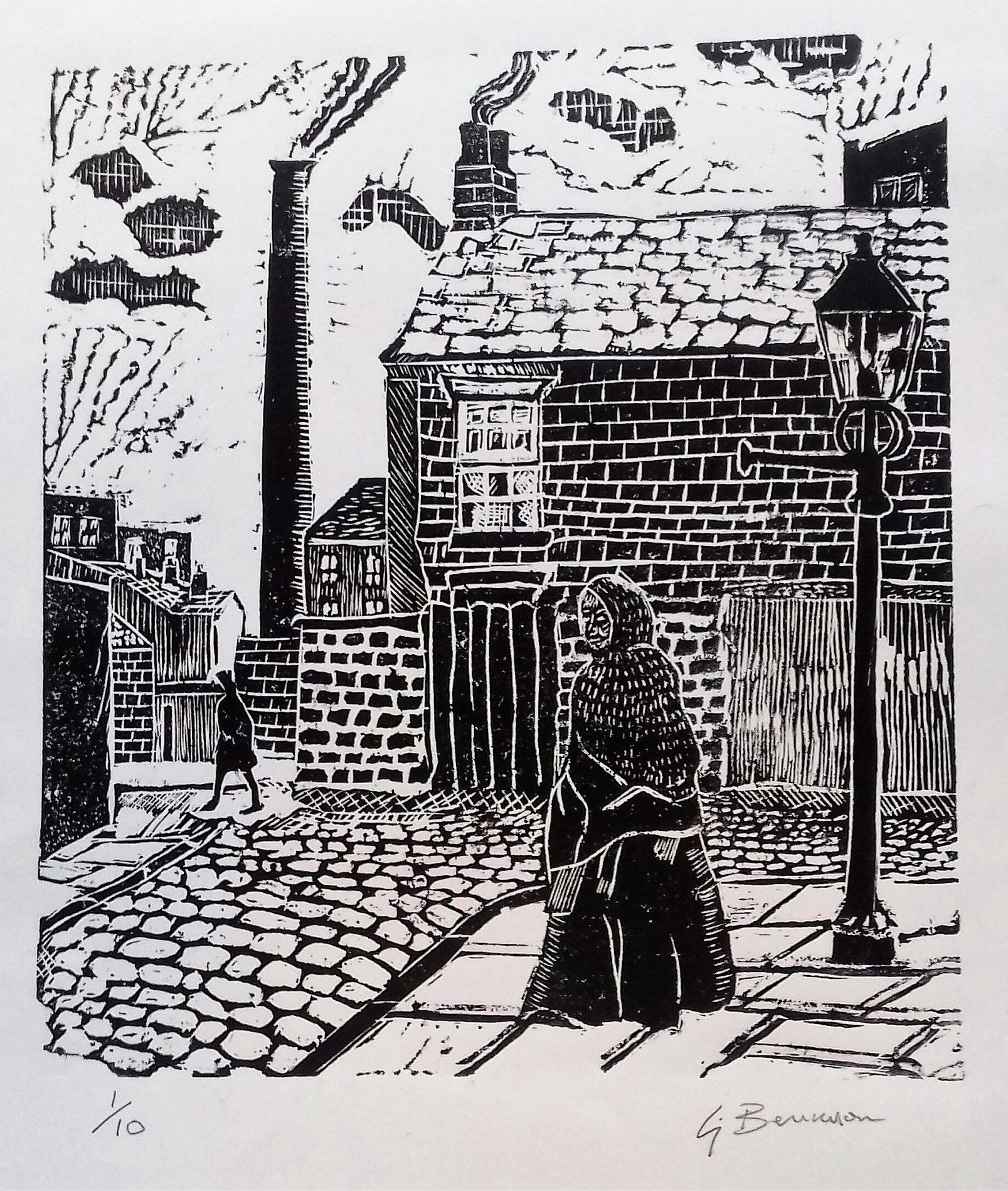
From the original wood cut (Bishop’s Brig) by Graham Bennison

Bolton ‘Work Town’ survey 1937/38.

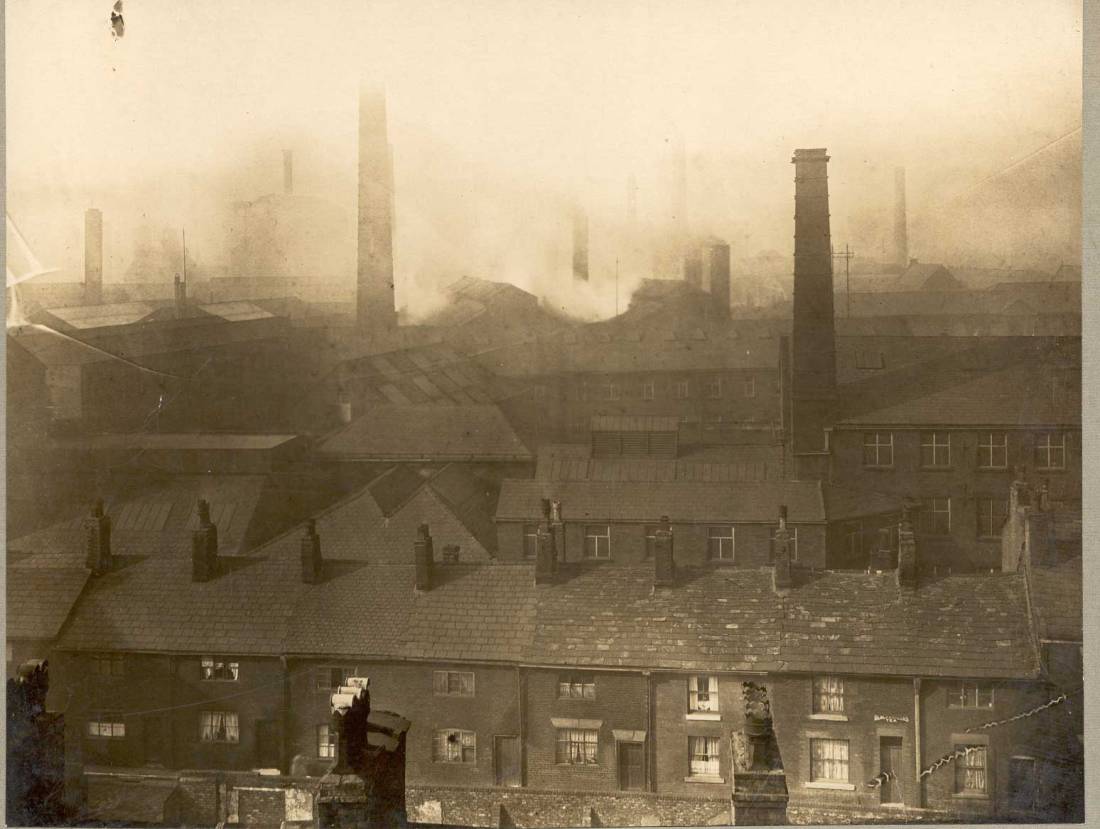
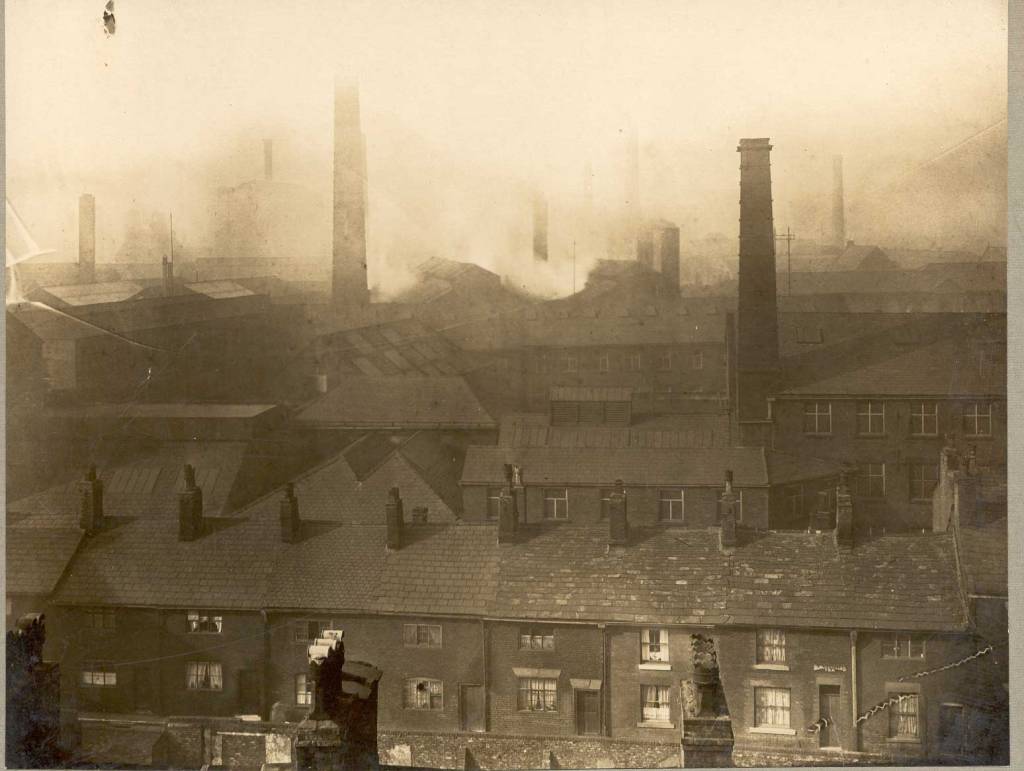
Bark Street, Bolton. This picture is undated and is simply labelled “the tannery”.

In 1937 a team of thirty-two researchers descended on the town of Bolton to carry out a unique Mass Observation survey of the everyday work and play of Bolton people.

The team were predominantly upper middle-class students (some Marxists), writers, artists and photographers led by Tom Harrisson, a budding social anthropologist, who regarded working-class Northerners as ‘a race apart’. One of the nine local helpers was Bill Naughton, a Co-op coalman, later writer of ‘All In Good Time’ (film the Family Way), ‘Spring and Port Wine’ and ‘Alfie’.  The survey was later titled ‘Work Town’.

Bolton was a town built on ‘King Cotton’, in the 1930’s no less than 112 spinning firms operated from 120 mills making, sheets, quilts, towels, brocades, twills and dress materials. Swan Lane Mill was the largest in the world. The workers stood on wooden floors and operated in temperatures between 73F and 98F, the tropical heat was maintained to prevent the cotton thread from snapping. In the cold of winter the workers left home in the dark and returned home in the dark, from the age of fourteen this was the lot of most Boltonians.

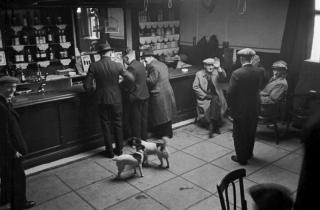
Humphrey Spender. ‘Man with hand up in pub’ (below, 1937/8).
© Bolton Council.  From the Collection of Bolton Library and Museum Services

The survey is mostly remembered through the photographs of Humphrey Spender, the collection now in the archive of Bolton Museum/Art Gallery. Spender and fellow photographer Michael Wickham recorded the life of the working classes following their subjects on holiday to Blackpool to record them at leisure.  Observers, meanwhile, gathered statistics on every aspect of behaviour. Listening in to conversations in pubs was often the best means of gauging the working man’s mindset.  Accompanying Spender’s photograph of a ‘Man with hand up in pub’ is perhaps the best recorded quote: “Why I drink Beer, because it is food, drink, and medicine to me, my bowels work regular as clockwork and I think that is the key to health…”

Being brought up in Halliwell, Bolton in the late 1940’s and 1950’s, still a smoky, soot covered mill town, it was only in the past twenty years that I learnt of the Work Town Survey and found the photographs of Spender. The latest revelation, however, was that artists were amongst the survey team.

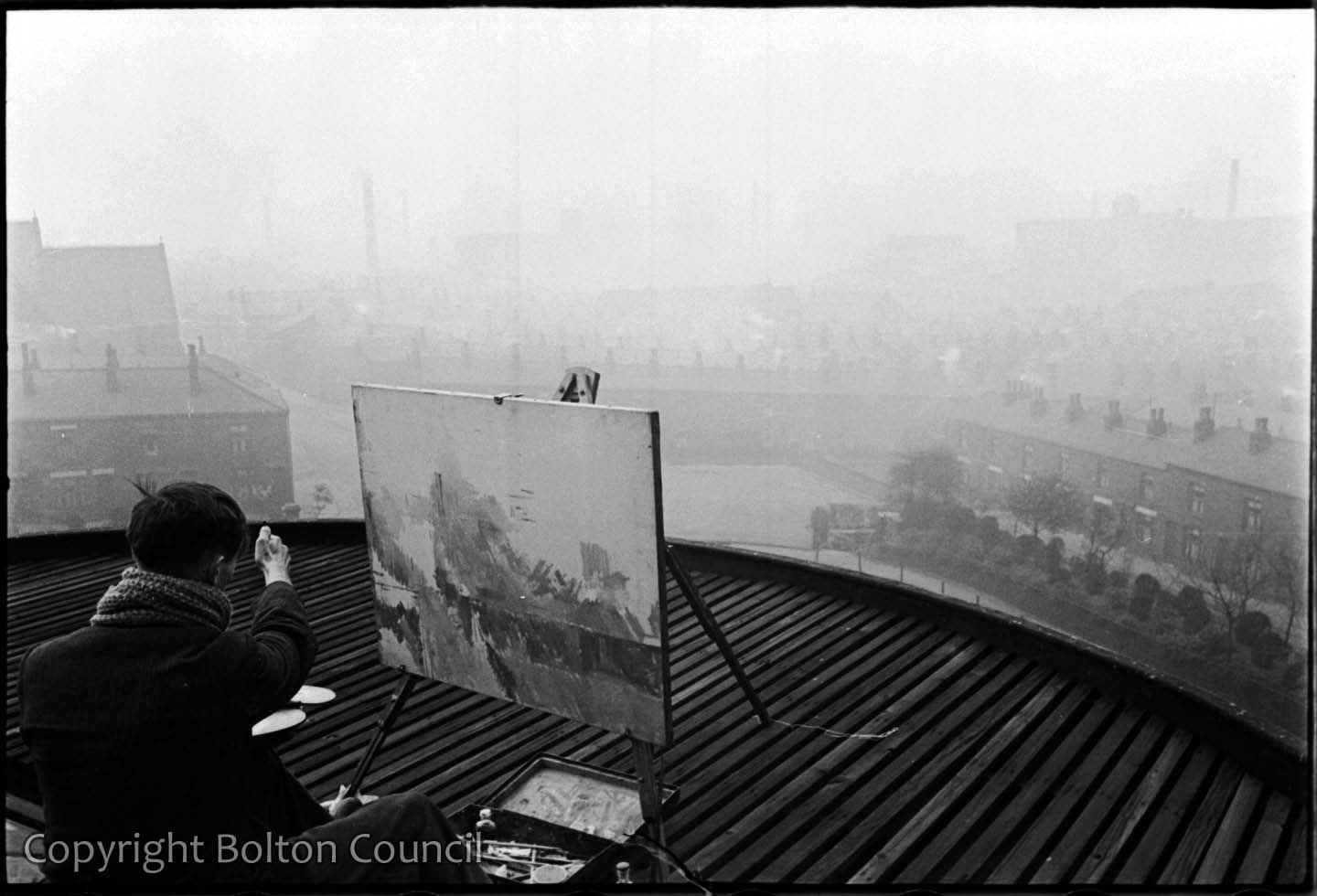
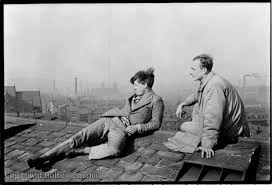
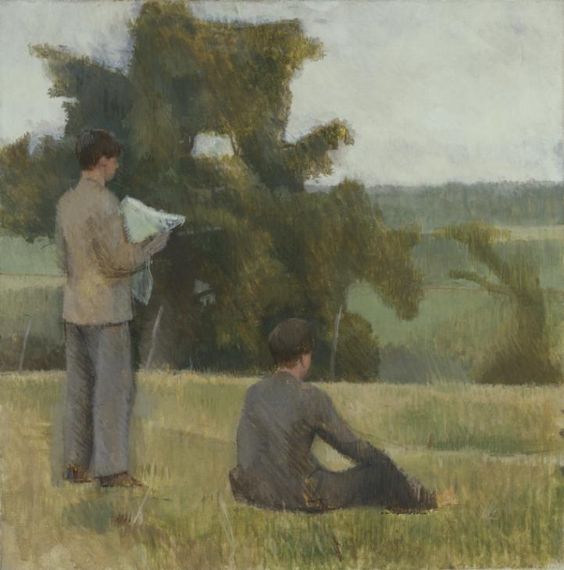
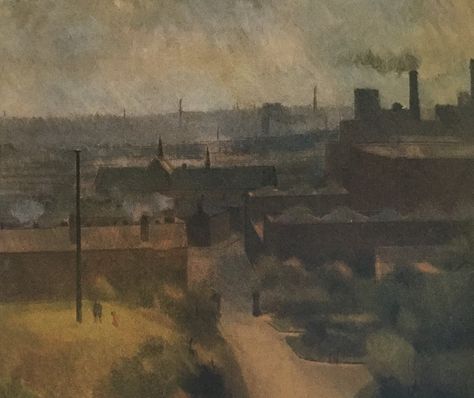
1 ‘Bolton’ by Sir William Coldstream, 1938. National Gallery of Canada. 2 Coldstream at easel photo by Humphrey Spender 1938. © Bolton Council.  From the Collection of Bolton Library and Museum Services. 3 Graham Bell (left) and Humphrey Spender on the roof of the Mere Hall Art Gallery, 1937. By Humphrey Spender. © Bolton Council.  From the Collection of Bolton Library and Museum Services. 4 on right. ‘On the Map’, Sir William Coldstream, 1937. In this picture Coldstream shows fellow-artist Graham Bell standing holding a map, and his friend Igor Anrep sitting on the ground.  Tate Gallery. 5 lower. ‘Bolton, Thomasson Park’ by Graham Bell 1938. Yale Centre.

Sir William Coldstream 1908-1987 was a noted portrait painter, knighted in 1956.  In 1949 he led the Slade School of Art as Principal, and Professor of Fine Art. Notable among his paintings is the portrait of Inez Pearn (at that time married to Stephen Spender, Humphrey Spender’s brother.).

Frank Graham Bell 1910 –1943, known as Graham, was a painter of portraits, landscapes, and still-life, and along with Coldstream, a founder member of the realist Euston Road School. Having enlisted in the RAF in 1942 his Wellington bomber plane crash-landed near Newark killing all the crew – Bell was only 32.

Bell and Coldstream started painting on the roof of the Art Gallery. “The place is in the middle of a dreadful slum.” noted Bell. Both artists painted a panoramic view of the town, devoid of human life. The two left Bolton after a three week stay, expressing relief to get back to London following their stay ‘in the hideous north’.

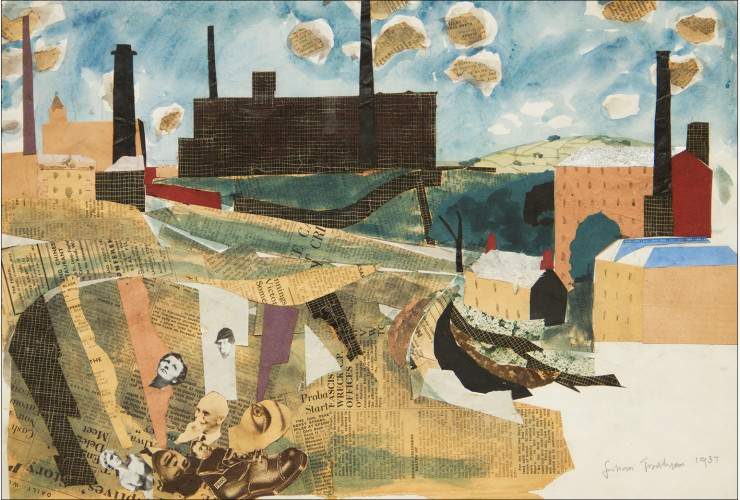
‘Bolton’, this collage artwork was created by Julian Trevelyan in 1937 and depicts a traditional industrial mill scene from the town. The collage shows the mills and chimneys of Bolton rising up into a bright blue sky. The fields and hills of the West Pennine Moors can be glimpsed in the background. Acquired in 2016 by Bolton Museum and Art Gallery. © Bolton Council.  From the Collection of Bolton Library and Museum Services.

Julian Otto Trevelyan 1910 –1988 was an artist and poet, he was the most successful artist in tuning in with the ideals of the project.  A young Trevelyan attended the Atelier Dix-Sept in Paris working alongside artists including Max Ernst, Oskar Kokoschka, Joan Miro and Pablo Picasso.
Trevelyan, the most active of the three artists in Bolton, spent a month in Bolton’s industrial streets, painting and creating collages from his suitcase full of materials.

Inviting Trevelyan to join the team Harrisson stated: “We have a Scotch Materialist, a Tramp Recorder, a Harpo Marxist and a coalminer in the house at the moment … You must paint some Bolton chimneys; they are like salt mines without the savour … Bolton Art awaits you! You will enjoy it, I swear!”
Arriving at the Davenport Street house, the base for the team, Trevelyan reflected: “Arriving at Davenport Street for breakfast. A house like any other in Bolton, it contained a few beds and office desks and an old crone who cooked us bacon and eggs and tea on a smoky grate.”

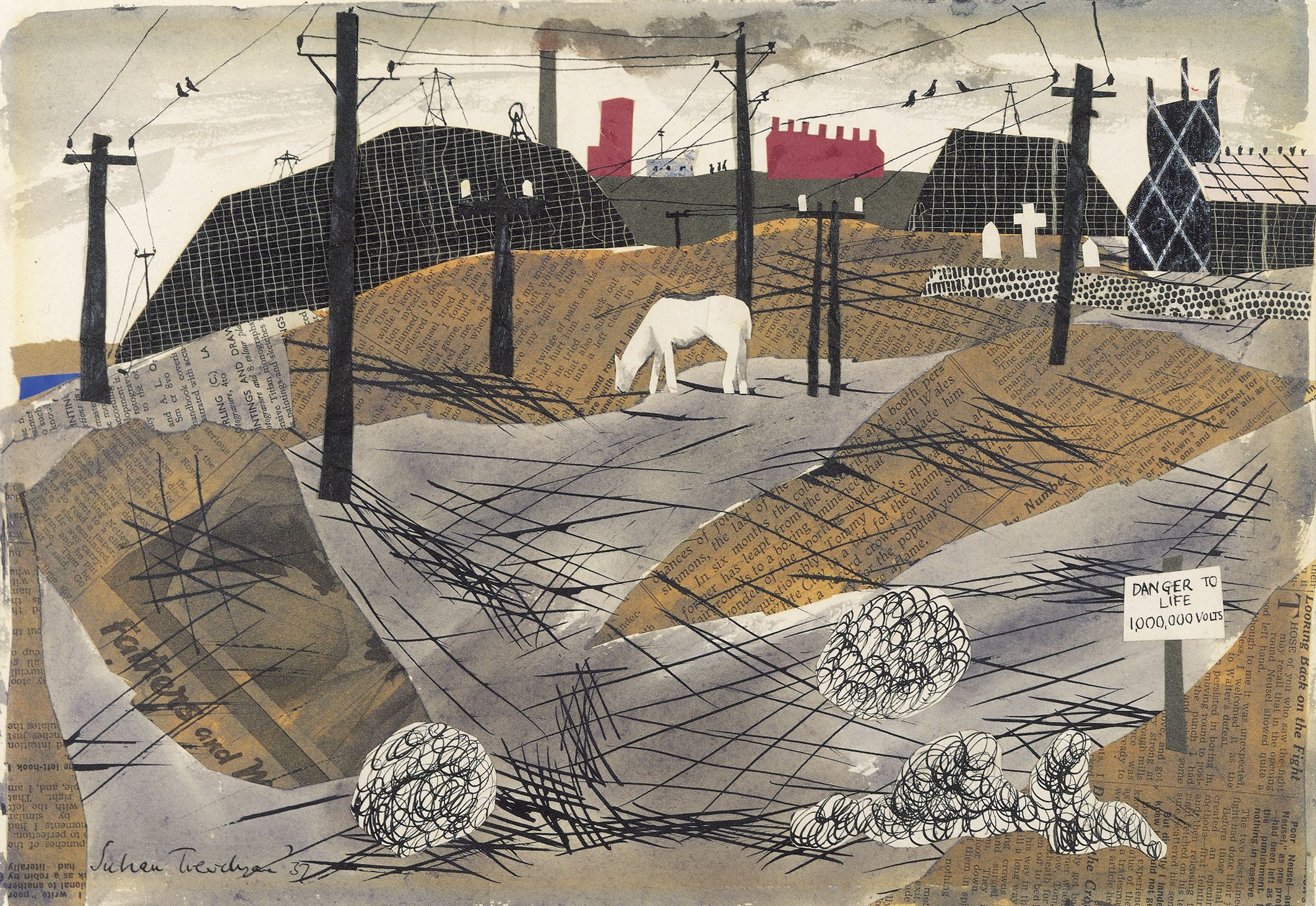
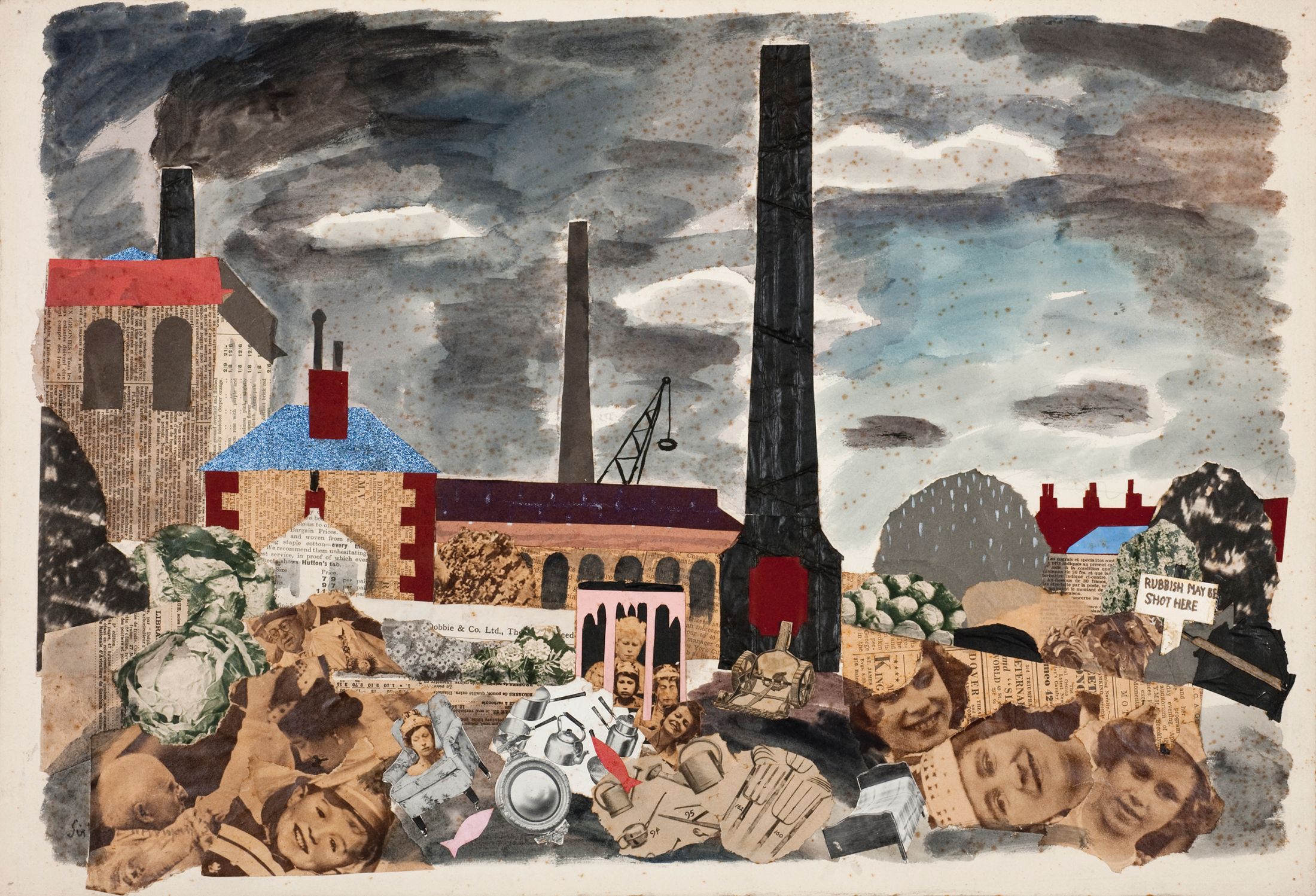
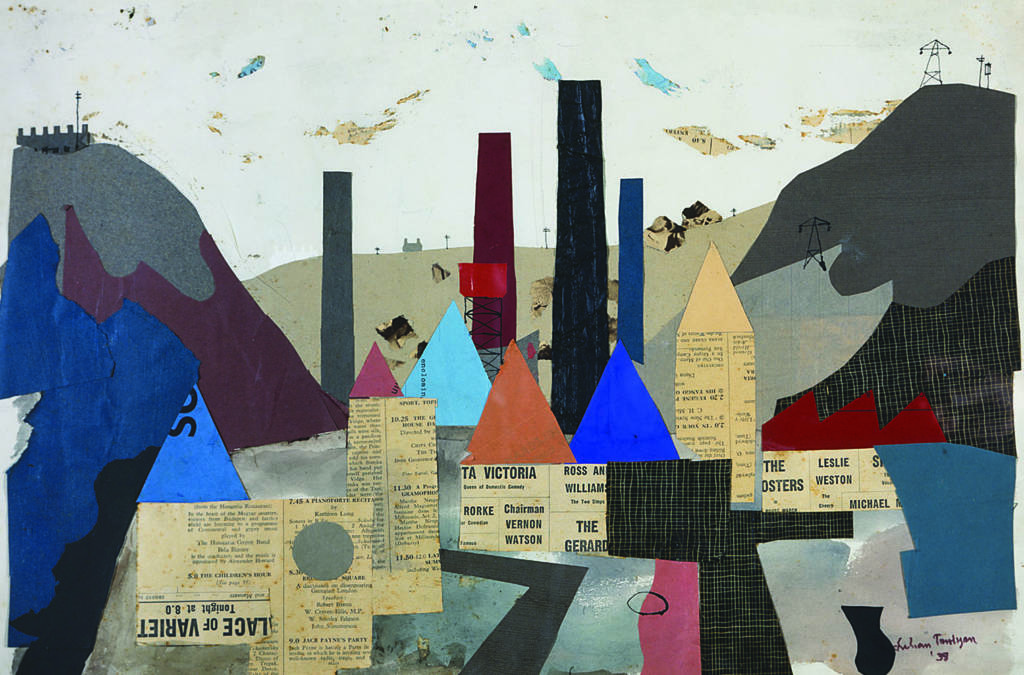
Trevelyan collages. 1 Bolton 1,000,000 volts, 1937, Private Collection 2 right. ‘Rubbish may be shot here.’ The Tate. 3 right. Trevelyan’s suitcase containing his assortment of materials for collage. 4 bottom left. ‘Bolton Mills’ 1938, Bolton Library and Museum Services. © Bolton Council.  From the Collection of Bolton Library and Museum Services. 5 right. Photo: Julian Trevelyan.

Trevelyan made a number of collages whilst in Bolton, in addition to painting watercolours of the townscape and taking photographs. Harrisson took a reproduction of his collage around the pubs and streets of Bolton to find out what local people thought of it, alongside copies of works by William Coldstream and Graham Bell. The collage produced a strong response, and Harrisson concluded that this showed that everybody was capable of responding to art, regardless of their class.

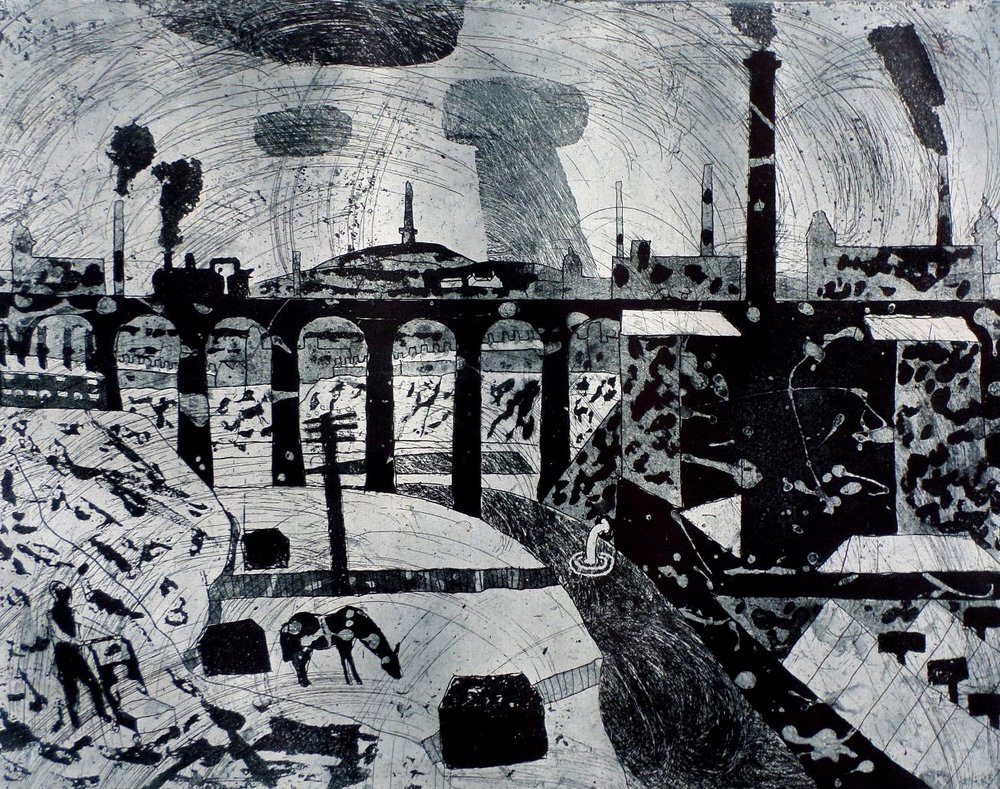
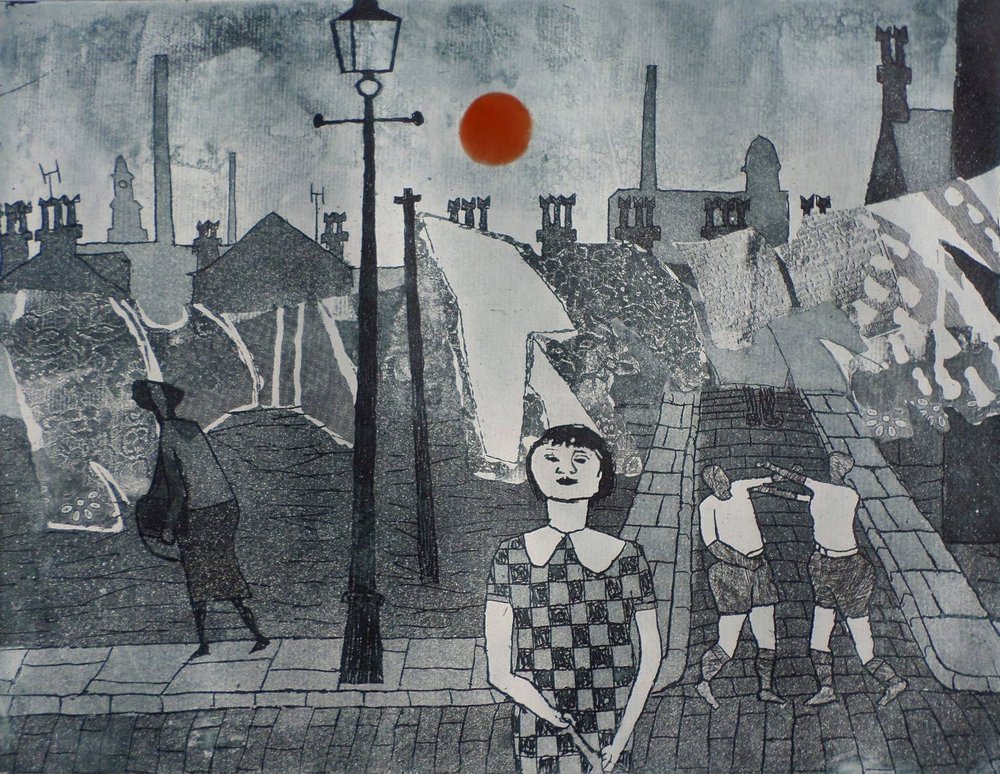
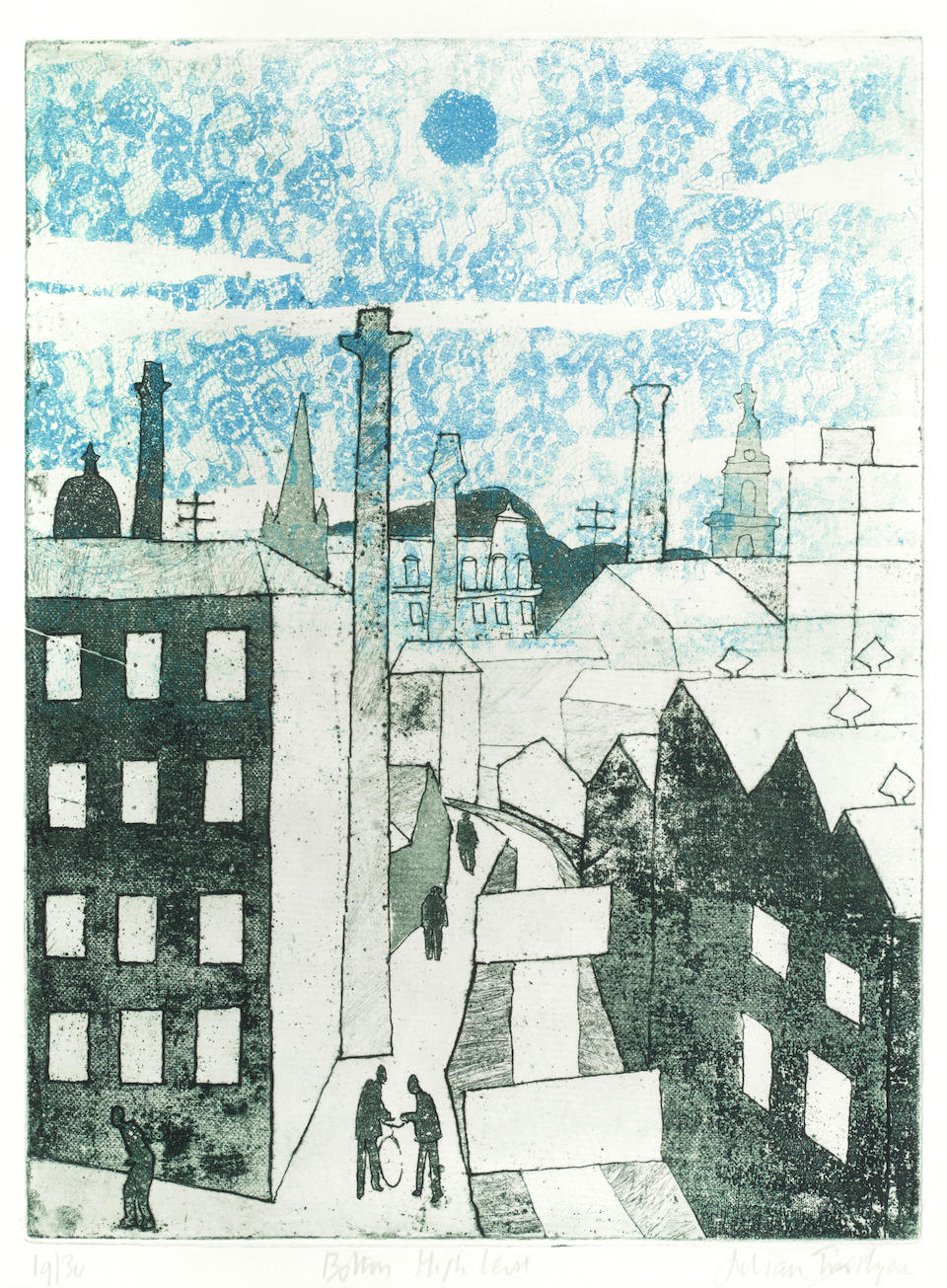
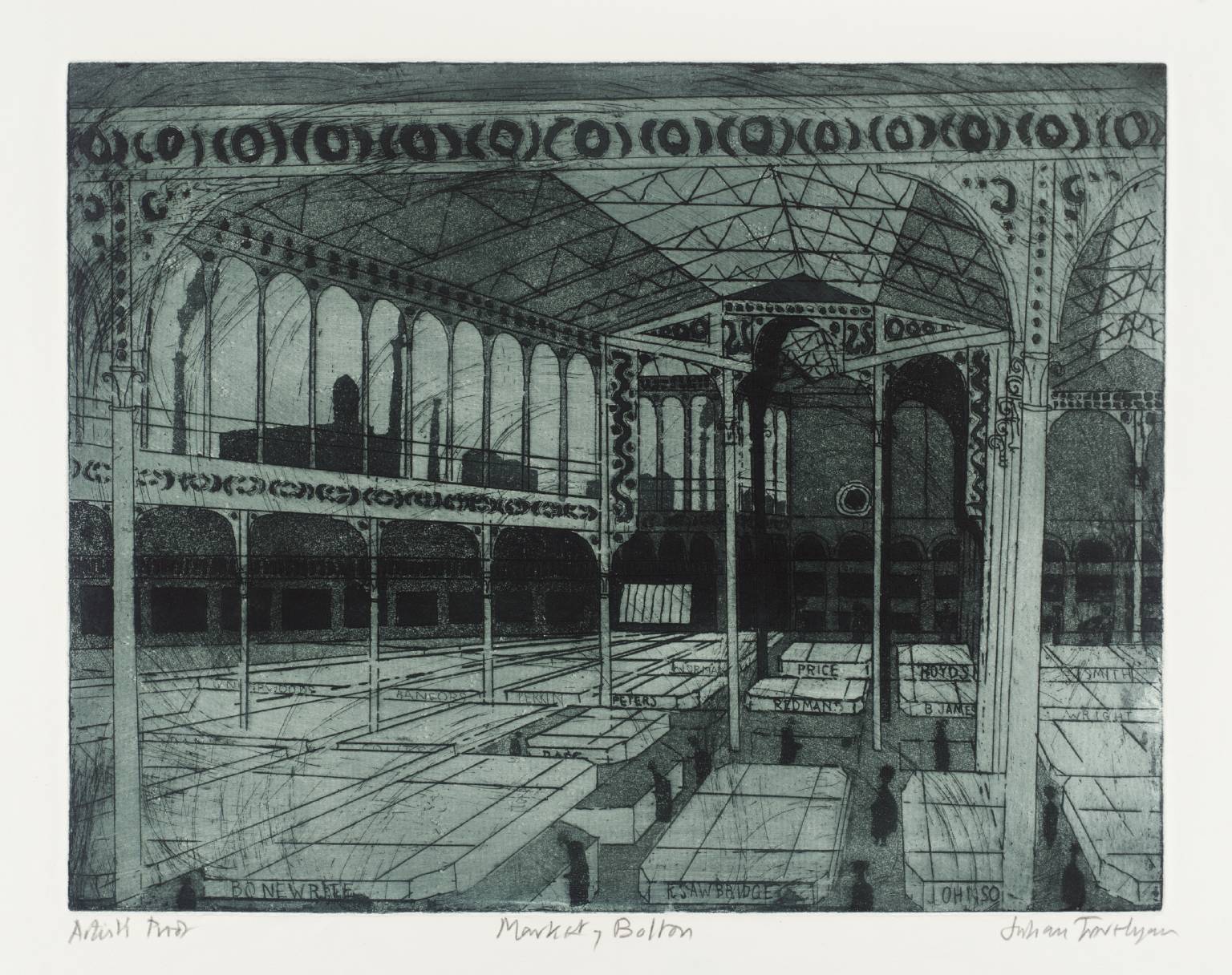
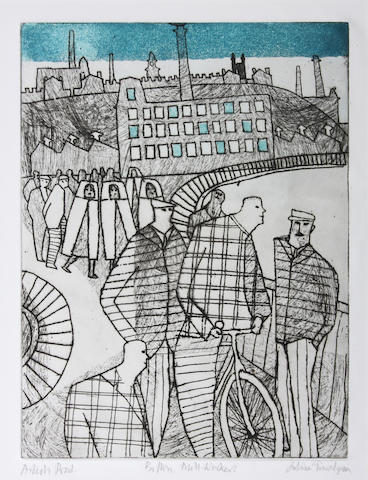
In 1960 a few of the original team returned to Bolton in a follow-up exercise to compare their observations from the 1930’s. Trevelyan produced a series of superb etchings. He was hugely influential in the revival of etching in the 1960s.  The Bolton prints can be viewed with other works produced by Julian Trevelyan, held in the Work Town Archive by arrangement at Bolton Museum.

Trevelyan’s superb series of Bolton Etchings, 1964. 1 Bolton. 2 Washday. 3 Bolton Wanderers. 4 right. Mills. 5 left below. Bolton market Hall. 6 right below. Mill Workers. © Bolton Council.  From the Collection of Bolton Library and Museum Services.

I departed Bolton in 1987 moving to North East Fife.  I visit my hometown regularly and often turn to the old industrial landscape of Bolton for inspiration in my own artwork.

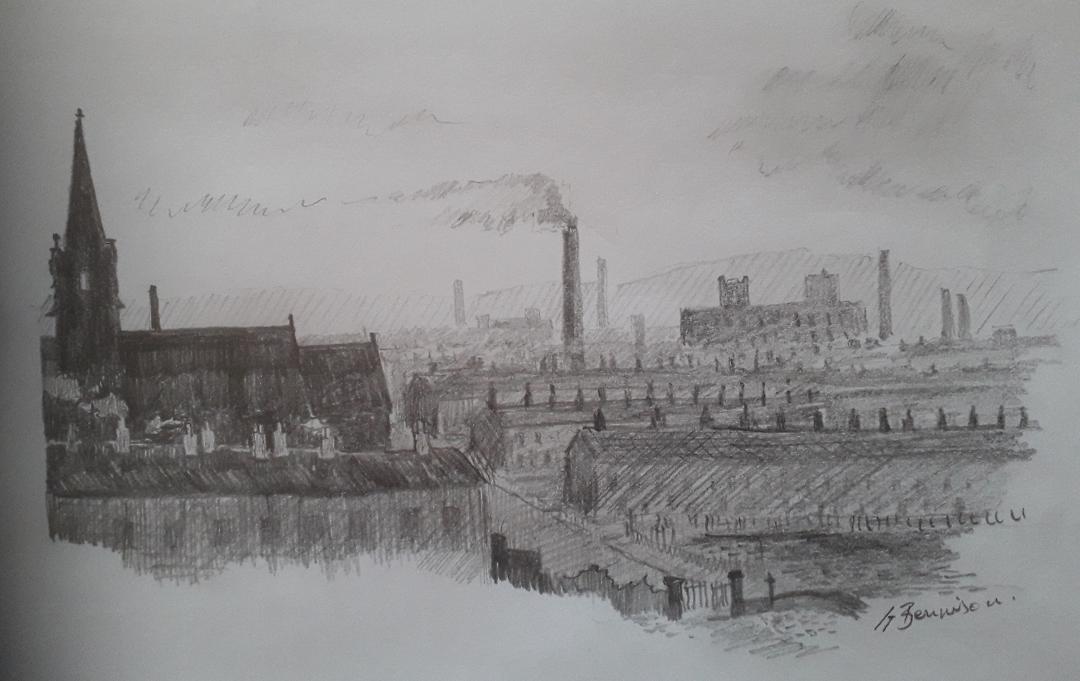
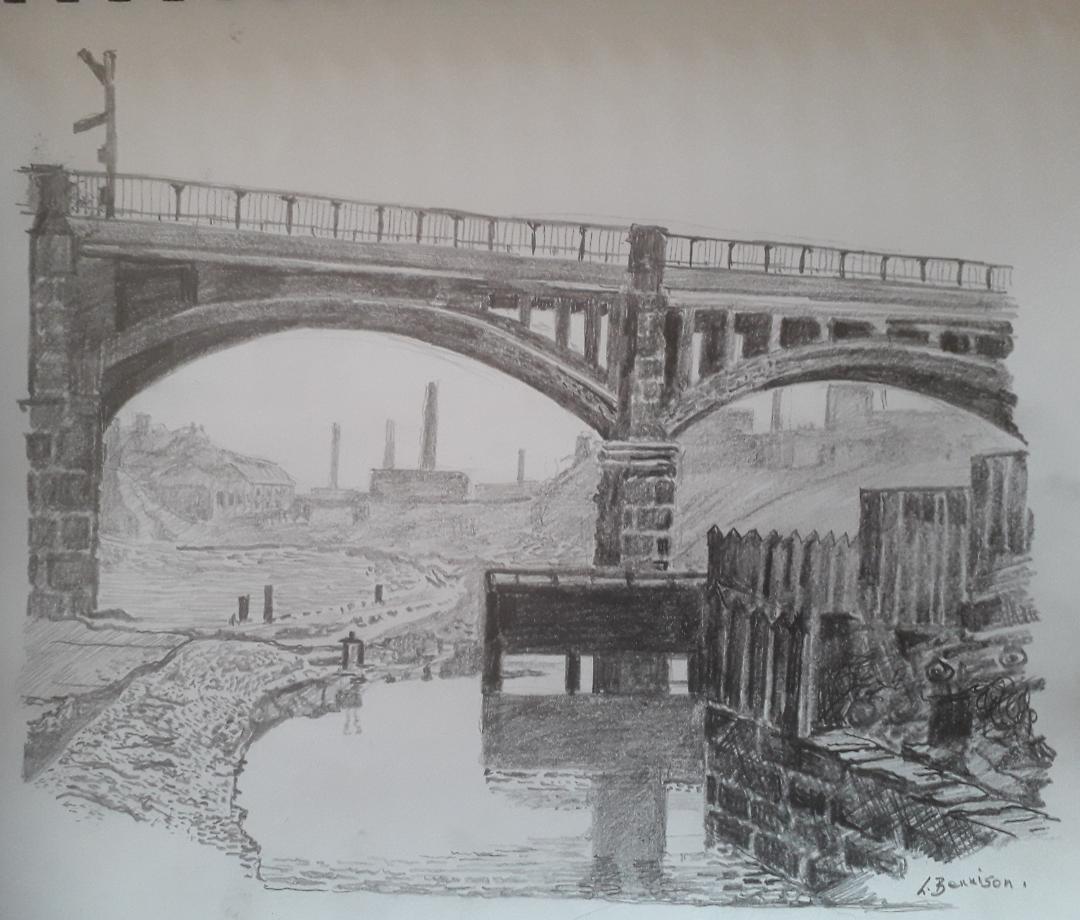
A sprinkling of my Bolton art work: ‘Bolton circa 1930’. Lino-cut 2018. A few available (bennyelmwood@yahoo.co.uk). 2 right. Pencil sketch ‘Church Wharf’. Right. 3 Pencil sketch based on a Spender photograph. 4 right. ‘Croal Valley’ . Lino-cut 1962 aged 16. 5 below left. ‘Man and Sycthe’ 1959 aged 13. 6 right: I’m on left at Bolton Art College with tutor Trevor Lofthouse on the right.

The Work Town project was ground-breaking in its scope and detail amassing an astonishing array of material, a fascinating insight into the work and play of the people of Bolton. The archive website can be viewed at boltonworktown.co.uk

Thanks go to Bolton Museum and Art gallery Archive for permission to re-produce photos and art work work here.

Note: Mere Hall was donated to the town as an Art Gallery by J.P. Thomasson in 1890, the collections of Mere Hall were transferred to a purpose-built gallery at Le Mans Crescent, most of its collection was subsequently disposed of before 1948 to make way for new acquisitions. Mere Hall became local authority offices used for weddings until 2016

Bibliography…some help from ‘Work Town’ by David Hall, Weidenfeld & Nicolson ISBN 978 1 780 22780 1

Graham Bennison, September 2020. More of my art at https://www.facebook.com/BennisonArtist also of interest https://www.facebook.com/boltoncollegeofart

Dora Carrington

Self Portrait 1910

Dora de Houghton Carrington (29 March 1893 – 11 March 1932), known generally as Carrington, is described by art critic and former director of the Tate Sir John Rothenstein, as “the most neglected serious painter of her time.”

Born in Hereford she attended the all-girls’ Bedford High School before entering the Slade School of Art in 1910. Now calling herself just ‘Carrington’ her fellow students included  Dorothy Brett, Christopher R W. Nevinson, Mark Gertler and Paul Nash, all at one time or another in love with her, as was Nash’s younger brother, John Nash who hoped to marry her. After graduating from the Slade, although short of money, Carrington stayed in London, living in Soho with a studio in Chelsea.

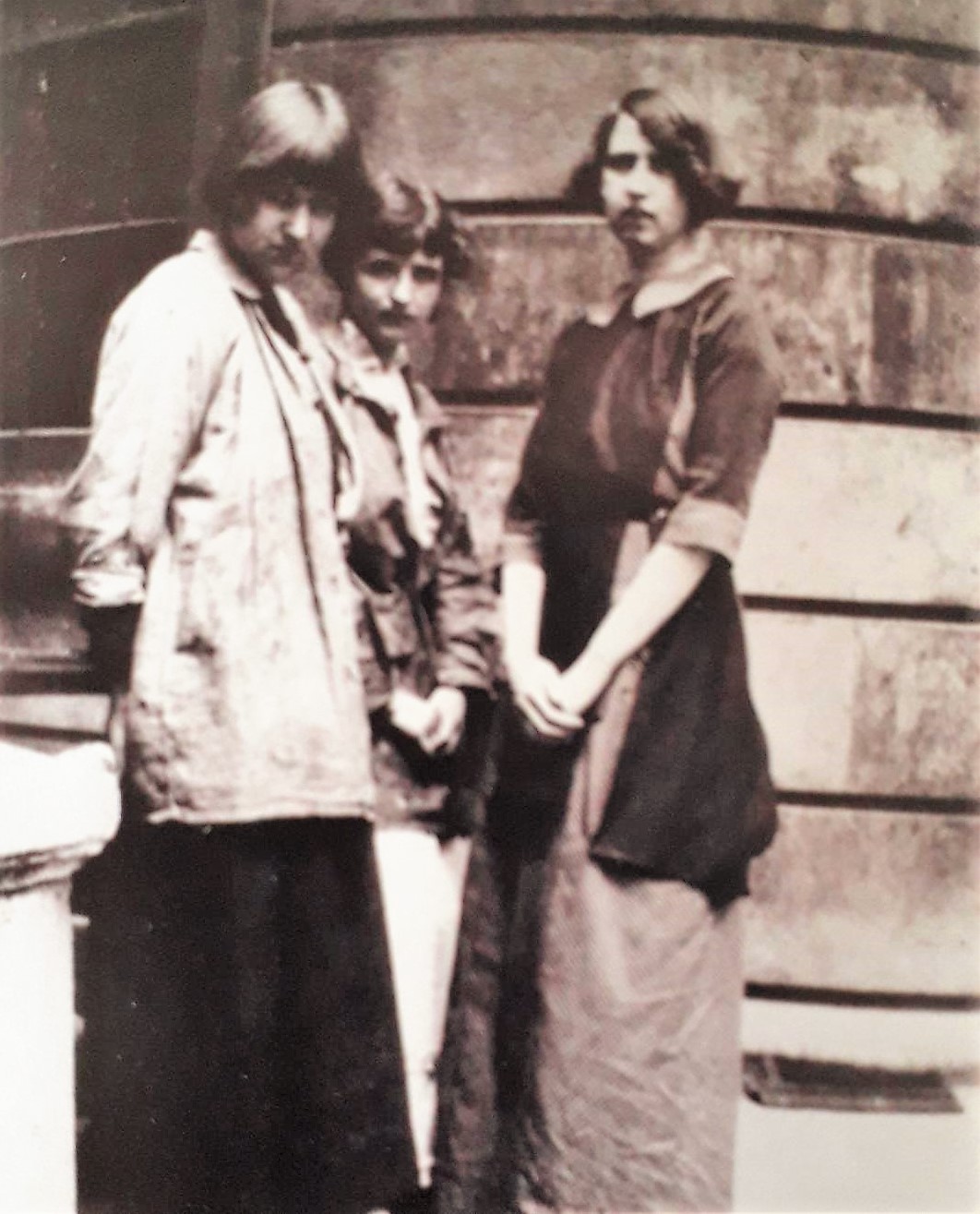
Pastel portrait of Dora Carrington at the Slade by Elsie McNaught, c1911. The ‘Cropheads’….Carringron, Barbara Hiles and Dorothy Brett 1912.

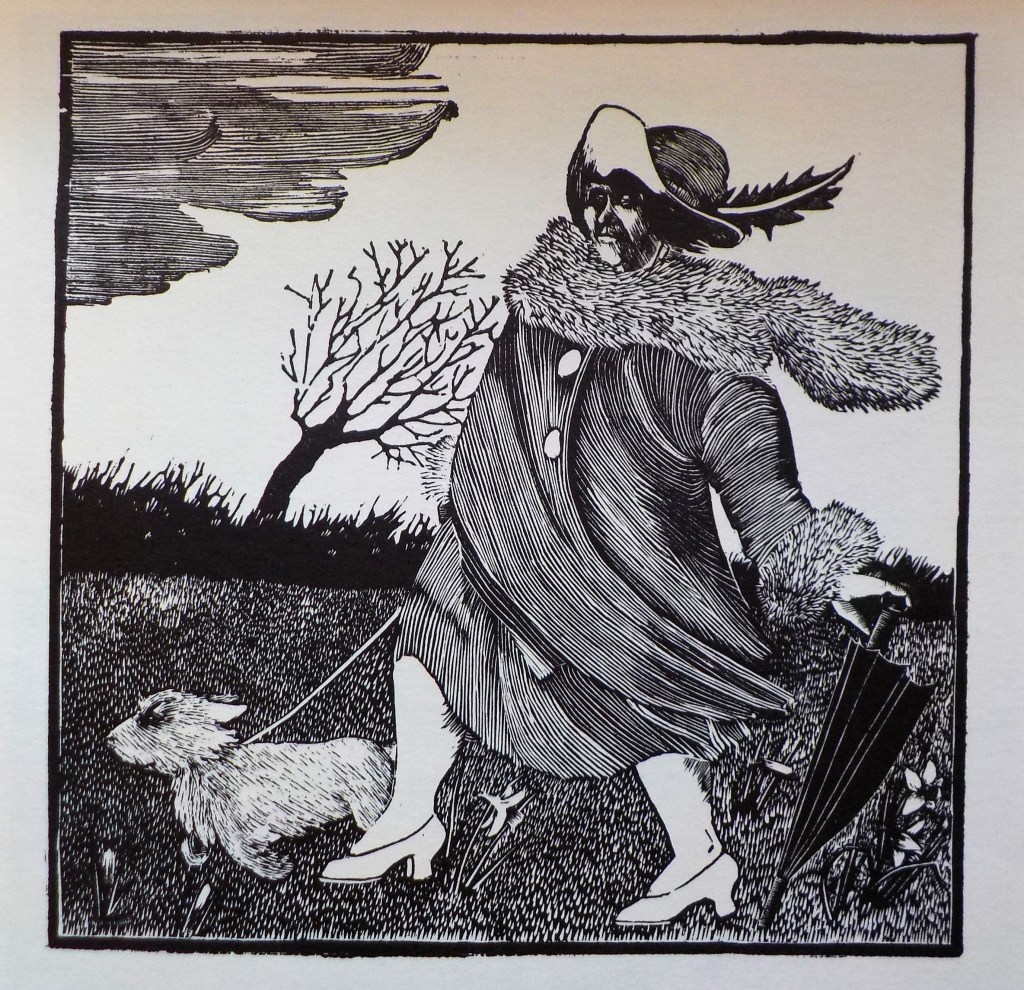
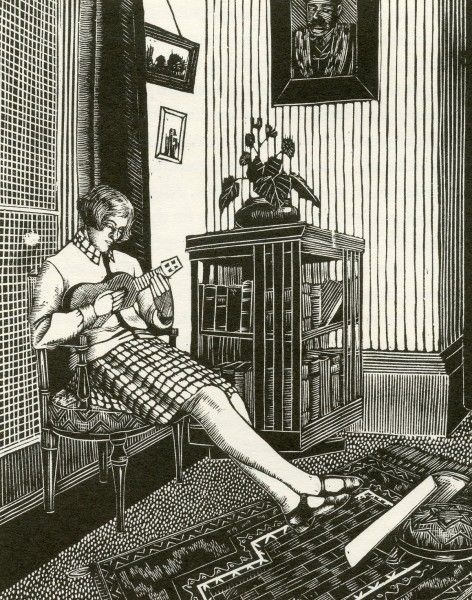
Carrington produced a number of wood-cuts working as a book illustrator for the Hogarth Press run by Leonard and Virginia Woolf. She also designed tiles, cut book plates, painted inn signs and designed furniture and decorations for houses where she spent her later years.

Defying the conventions of the time Carrington cut off her hair becoming one of the first ‘cropheads’ – a term coined by Virginia Woolf.  She was indeed troubled by her sexuality and is known to have had an affair with Henrietta Bingham and the writer Gerald Brenan.

Her association with biographer Lytton Strachey, a member of the Bloomsbury Group, started soon after she left the Slade in 1915. Strachey was the great love of Carrington’s life and her portrait of him reveals especial depth and intimacy. At the time Carrington painted this portrait, Strachey was working on Eminent Victorians (1918), a four-part biography of leading figures from the era, a work that would establish his enduring reputation as an important historical biographer.

Oil painting. Lytton Strachey 1916.

Early in their relationship they did share a bed but Strachey was a practising homosexual. They set up home at Tidmarsh Mill in Pangbourne and later at Ham Spray in Wiltshire.

The Mill at Tidmarsh. The quaint home shared by Carrington and Strachey from 1917 to 1924.

The couple were visited at Tidmarsh by Rex Partridge, a soldier who was promoted to the rank of major at twenty-three. Strachey relied on Partridge as a close friend and it was in 1922 that Carrington married Partridge to prevent him going abroad. Partridge found work at the Hogarth press for the Woolfs. The marriage was not a success but the ‘menage-trois’ continued. The move to Ham Spray was made in 1924, Carrington’s passionate but imperfect relationship with Strachey told on her. By 1928 Strachey was drawn more and more away by his homosexual nature while Partridge had formed a more lasting attachment in London. Carrington fell more and more into depression and a major blow came in 1931 when Strachey fell ill of an un-diagnosed cancer and died. Carrington tried to take her own life, but survived.

‘I see my paints and think it is no use to me, for Lytton will not see it now.’

Friends came to stay at Ham Spray to comfort her. Leonard and Virginia Woolf were some of the last to visit her. Virginia Woolf wrote ‘she seemed helpless, deserted like some small animal.’ The following day 11th March she took a gun, used for shooting rabbits, and shot herself in the chest, she was only thirty-eight.

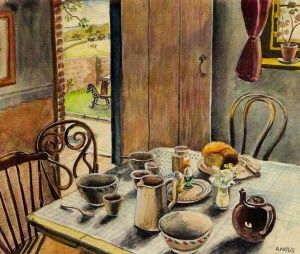
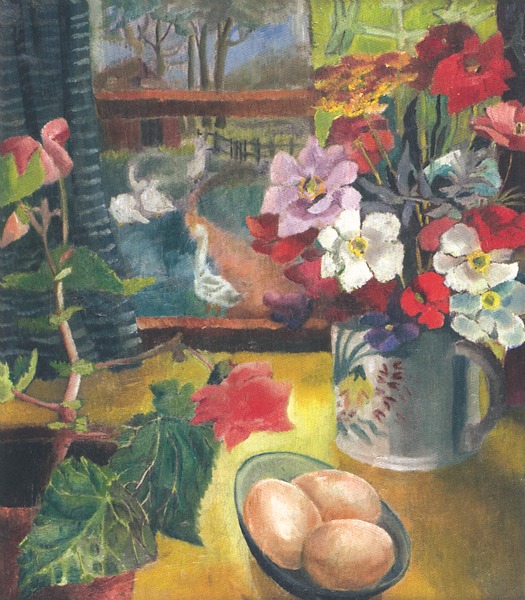
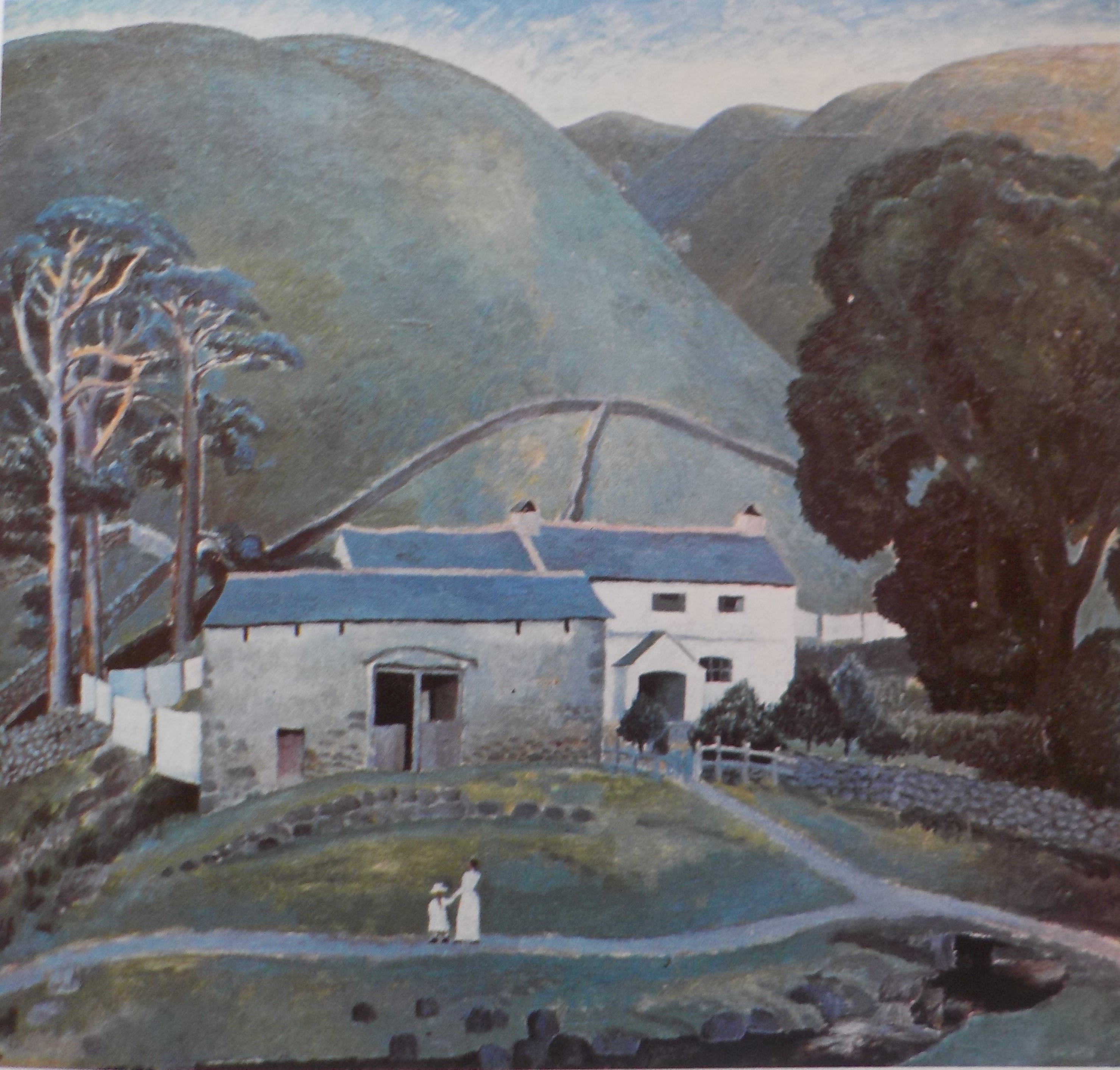
Eggs on a Table, Tidmarsh Mill, circa 1924. Carrington’s friend, the writer E. M. Forster. Watendlath Farm, near Keswick in the Lake District, where she spent a summer holiday with her husband and their friends in 1921.

Carrington was not well known as a painter during her lifetime, as she rarely exhibited and did not sign her work. No exhibition of her work was held until 1970, thirty-eight years after her death.

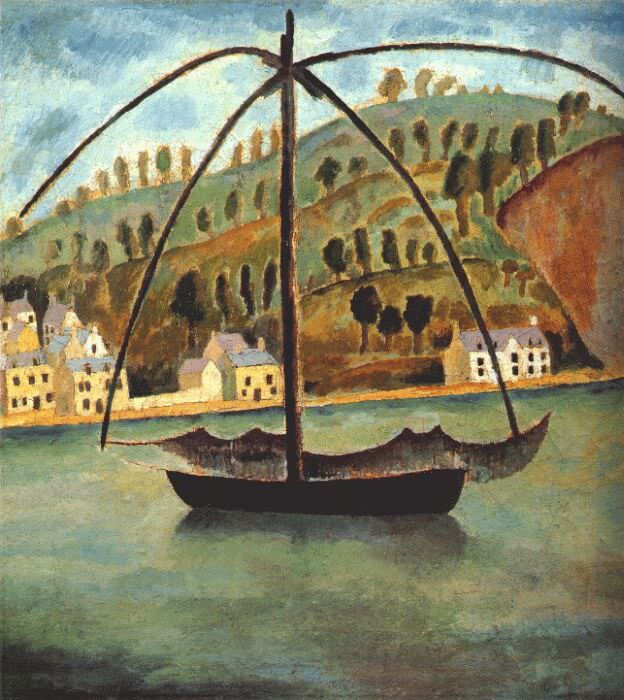
Larreau Snowscape 1922. Fishing Boat in the Mediterranean 1929.

An excellent book which has helped with some aspects of this blog is Voyaging Out: British Women Artists from Suffrage to the Sixties Hardcover by Carolyn Trant. ISBN-10 : 0500021821

Added 23rd Jan 2022. A letter from Carrington to Christine Kühlenthal (later wife of John Nash).

87 Carlisle Road, Hove

Monday December 1915

My Dear Christine

Well last week the Clive Bells’ asked me to stay with them near Lewes, just about 8 miles from Brighton where we are, so I went.   It was indeed a romantic house buried deep down in the highest & most wild downs I have ever seen. Duncan Grant was there, who is much the nicest of them & Strachey with his yellow face & beard, ug !  I used to walk along the ridge of the downs every morning early when the sun was just rising, and the wind on the top was more fierce & powerful than anything you could imagine.  It roared in my ears, and I had to lie flat down on the wet grass in order to look at the land below & and the sea beyond Newhaven which shone all silver.  We lived in the kitchen & cooked & ate there.  All the time I felt one of them would turn into mother & say ‘what breakfast at 10.30! Do use the proper butter knife!’  But no. Everything was behind time.  Everyone devoid of table manners, & and the vaguest cooking ensued.  Duncan earnestly putting remnants of milk pudding into the stock pot! They were astounded because I knew which part of the leek to cook! What poseurs they are really.

I may come up next weekend, if I hear of a job before then. But I will tell Brett & then we can have a party. But these escapes are matters of a moment. Nothing can ever be really described beforehand.

Noel goes to London today to have his arm treated, I shall miss him. You would love the country here.  I found a good cottage in the downs where they take people for £  – a week.  Shall we go one day next summer ? This I mean in all earnestness.  My love to you.

Carrington.

Brett….Dorothy Brett, fellow student at the Slade and close friend. Noel…….Dora Carrington’s brother.

Graham Bennison 23rd August 2020. https://www.facebook.com/BennisonArtist

Tirzah Garwood (11th April 1908 – 27th March 1951)

Tirzah Garwood was an exceptional artist but had the disadvantage of plying her trade at a time when female artists struggled for recognition. Having married Eric Ravilious in 1930 she followed the conventions of the time, giving up her wood engraving to be a wife, later a mother, and to support the career of her husband.  Often overlooked in the history of English art and design this essay seeks to showcase her undoubted talent as a wood engraver, painter and designer to a wider audience.

Tirzah was born as Eileen Lucy Garwood in Gillingham, the third child of Lt. Colonel Frederick Scott Garwood and Ella Corry. As the third child, simply called Tertia, the name was misheard by her granny and stuck as Tirzah !  Her family moved around and spent time living in Glasgow, Lyndhurst, Croydon and Littlehampton. Her mother, tired of moving around, decided to move the family to Eastbourne and the family settled at Arundel Road in April 1918, Tirzah’s tenth birthday.

Initially schooled at West Hill Eastbourne, at the age of seventeen Tirzah persuaded her parents to let her attend the Eastbourne School of Art to learn drawing and painting – 1920. For the last two years of her Eastbourne course she concentrated on wood-engraving taught by a young man called Eric Ravilious. Ravilious was employed part-time at Eastbourne as he was still in his final year of the Diploma Course at the Royal College of Art.

Tirzah’s first two wood-engravings, in 1926 were ‘Spring’ and ‘March’ part of the ‘Four Seasons Series’.  These were exhibited at the 8th Annual Exhibition of the Society of Wood-Engravers at the Redfern Gallery, Mayfair in 1927. More wood-engravings followed and received praise in The Times in 1927.

Wood-engravings: March, Spring, Summer, Autumn, Winter.

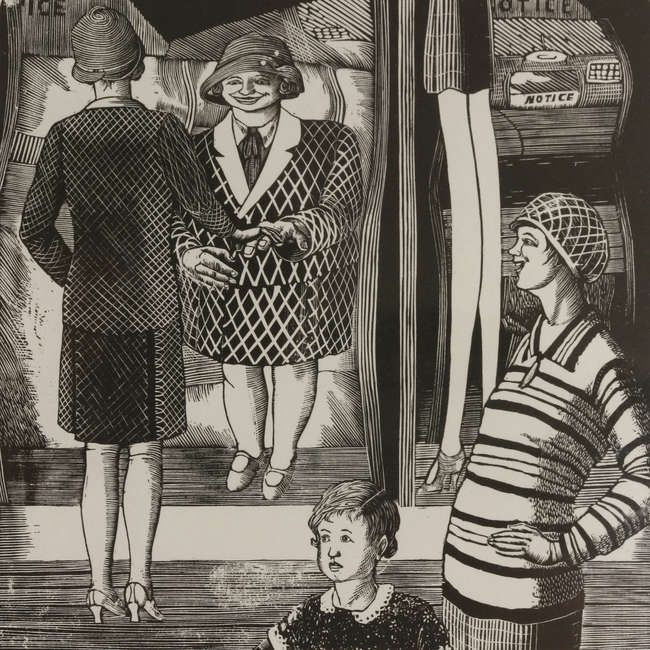
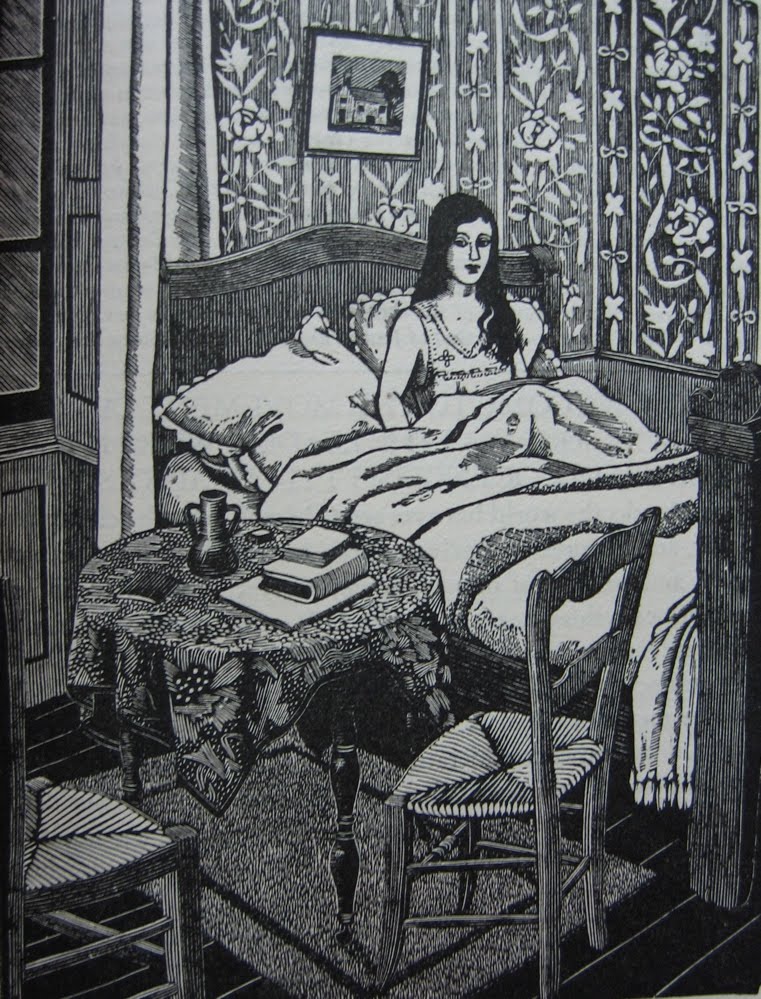
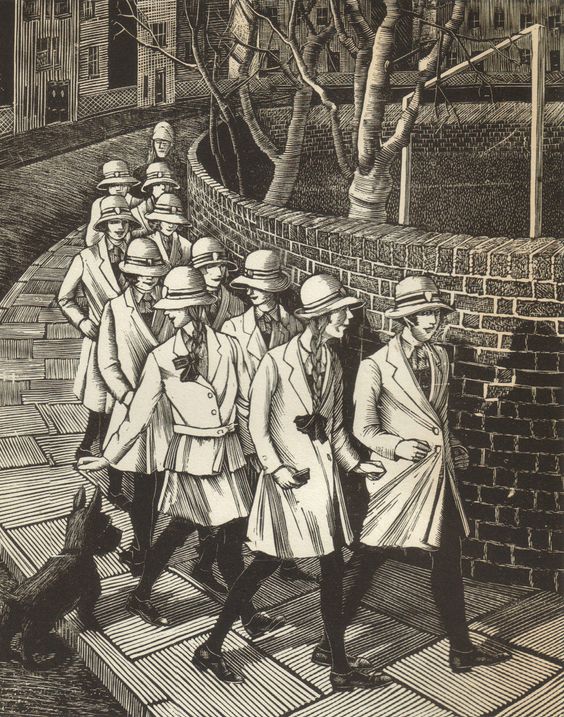
Quirky and sometimes surreal, Tirzah’s wood engravings are a complete contrast to the more rural subject matter of Eric Ravilious. Tirzah had few superiors, displaying great technical skill, her wood-engravings equal to anything produced by Ravilious.

A range of other wood-engravings 1927 to 1930.

Tirzah’s parents thought her subject matter hideous. She stated in her autobiography; ‘They thought Mr Ravilious was perverting a nice girl who used to draw fairies and flowers into a stranger who rounded on them and did drawings that were only too clearly caricatures of themselves’.  Mr and Mrs Garwood also regretted the decision to let Tirzah study at the Central School of Art moving to Kensington in 1928 the year of her first commissioned work for the BBC to produce three engravings for ‘The Pilgrim’s Progress’. As a well-heeled family they were also less pleased in 1930 when Tirzah announced she was marrying Eric Ravilious – a match they thought well beneath her.

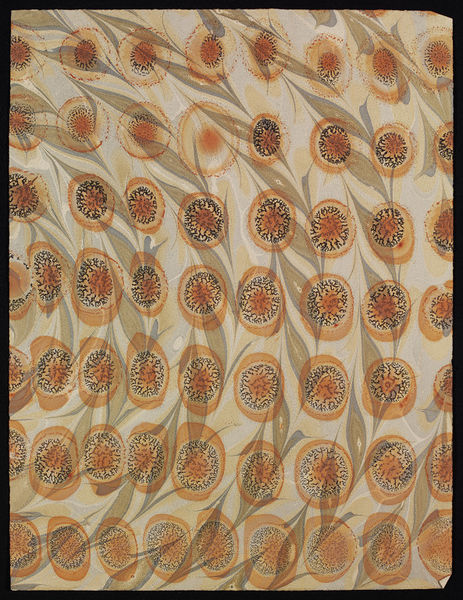
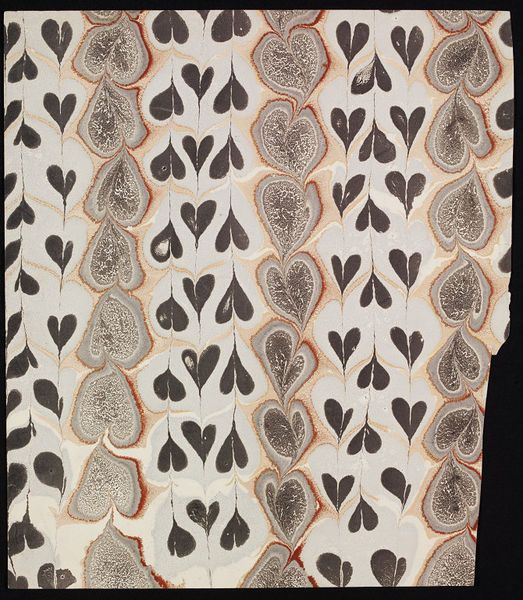
A wood-engraving entitled ‘Cat Into Wife’ 1928 could well picture Ravilious. The married couple worked together on projects but these dwindled when they moved to Great Bardfield, Essex, initially sharing a house with Edward and Charlotte Bawden. This move marked the end of her wood-engraving but helped by Charlotte Bawden, Tirzah started designing and making marbled papers.

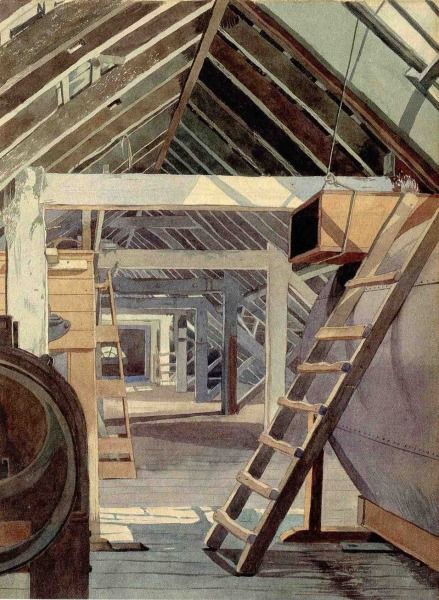
Wood-engraving ‘Cat into Wife’ 1928. Water-colour: ‘Barcombe Mill Interior’

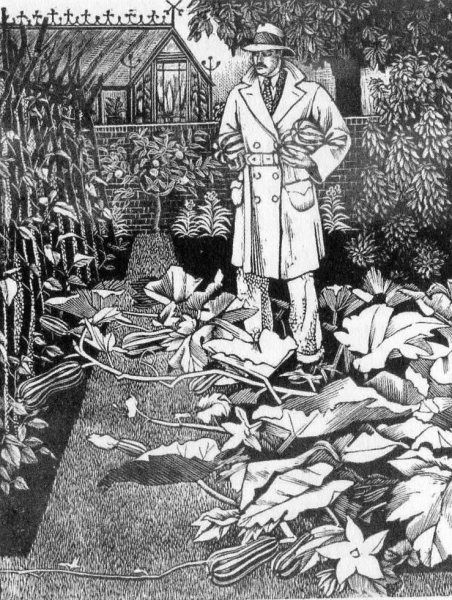
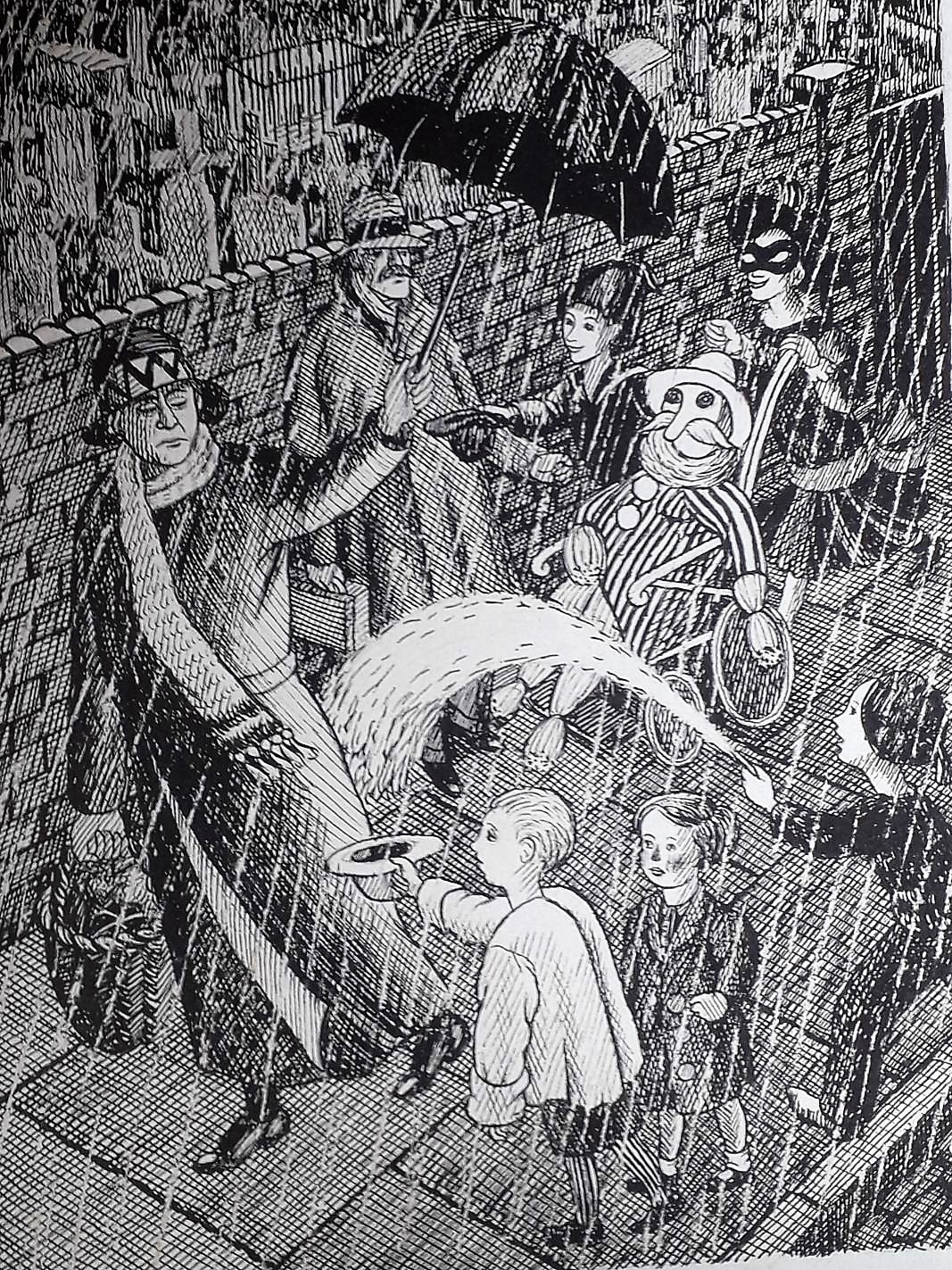
1927. Engagement photo. Ink drawing for ‘Penny For The Guy’. Pencil Drawing – ‘Street Games’.

The most famous ‘joint project’ in the spring of 1933 was a commission from the architect, Oliver Hill, to paint a mural on the tearoom walls of the Midland Hotel, Morecambe. The couple found lodgings in nearby Heysham. Tirzah wrote in her autobiography of how the ‘…new hotel resembled a big white concrete ship facing out across the shining sands, mudflats and treacherous waters of Morecambe Bay’.

Hill and his financiers were eager to hurry completion of the mural prior to the opening of the new art deco hotel but as Eric and Tirzah worked they became increasingly aware that their mural had no hope of lasting.

Tirzah wrote: ‘Decorating the tea room was disheartening work because the plaster was too recently put onto the wall and as well as not being dry, it exuded little heaps of yellowish sand or lime or whatever it is that plaster is made with. When we were drawing out the design, if we used an India rubber or disturbed it in any way the white paint peeled off…’

What is not widely known is that it was Tirzah that put most effort into the work – Eric departing on seven occasions (two days at a time) to return to work teaching at the RCA. The grand opening of the hotel took place in July 1933. The following year in March the couple returned to carry out extensive repairs but the mural soon deteriorated again.

In the 1980s theatrical decor artists from Thames Television had the notion of reproducing the mural, in its original location, for an episode of Hercule Poirot entitled ‘Double Sin’ that was to be filmed in the hotel. With only the black and white photographs as a visual source, the set designers were obliged to make their own judgements concerning the colours they used. A further restoration of the hotel in 2013 saw the mural re-painted by artist Jonquil Cook.
The modern mural……..well worth a visit !

The summer of 1934 was spent at Peggy Angus’ cottage Furlongs nestled in the South Downs. By this time Eric had already had an affair with Diana Low while that summer another partner Helen Binyon made her first visit to Furlongs. Tirzah herself fell in love with artist John Aldridge a newcomer to Great Bardfield.
Later that year Tirzah and Eric decided that they wanted a house of their own and moved to Bank House, Castle Hedingham near Great Bardfield. Their first child John Ravilious was born in 1935 followed by James in 1939 and Anne in 1941. After Anne was born in the April of 1941, they moved out of the often cold, and sometimes flooded Bank House to Ironbridge Farm near Shalford, Essex. It was from this last home that in 1942 Eric, now a war artist, departed to his post in Iceland vanishing without trace in an air rescue mission, aged only thirty-nine. Shortly after this tragedy Tirzah had a mastectomy for primary cancer.

Tirzah with John, Anne and James.

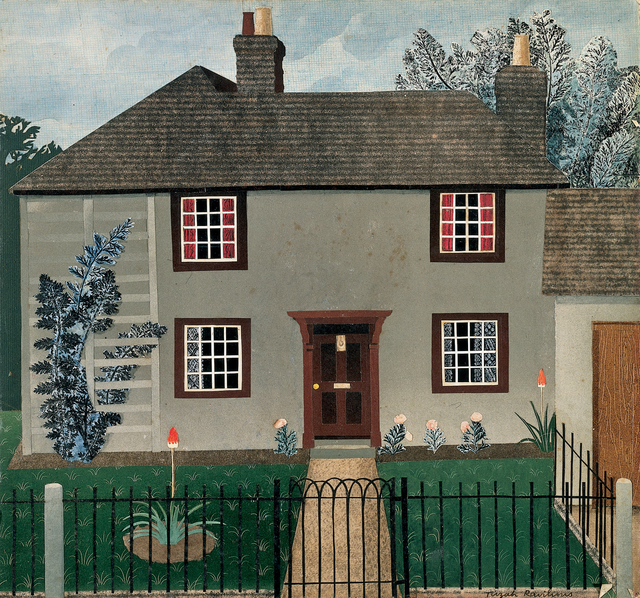
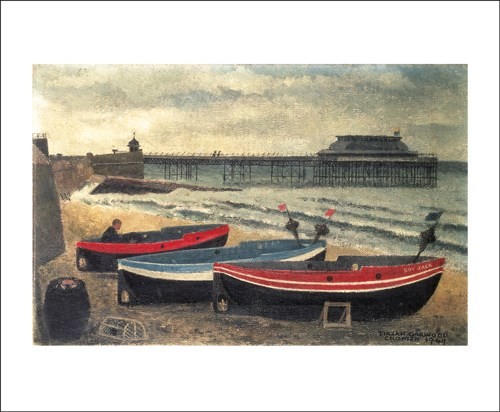
Tirzah started writing her autobiography in March 1942 from her hospital bed. By February 1943 most of her manuscript had been typed up. The remaining eight years of Tirzah’s life were in some ways the most productive of them all. She returned to her art, her first oil paintings were produced in 1942-44.  A major interest became the making of collage models of the domestic architecture of her neighbourhood – models of cottages, schools, chapels, etc.

Marbling’s and collaged cottages, shops etc.

Close friend Olive Cook wrote of her collage models:’ These compositions recapture in all freshness the relationship of an imaginative child with its dolls, trains, toy soldiers and farm animals and conjure up a magical child’s world of closely seen plants. A doll steps forward with her little muff from a thicket of bright tulips; toy trains run round a toy stable and toy horses in a landscape of spear shaped leaves and scarlet tulips; a toy soldier lies in the path of a toy steam engine watched by a maid from an upper window in a doll’s house set against a sombre river scene’.

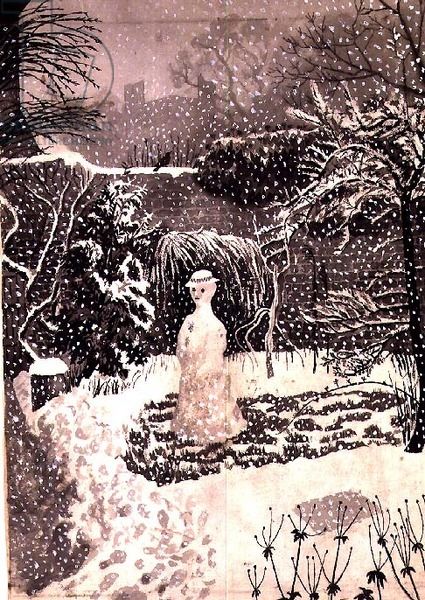
Later Oil Paintings: Boats on Cromer Beach 1949. The Cock. ‘This is Etna’ 1944. (Etna. Mount Caburn (from Furlongs) is a 480-foot prominent landmark in East Sussex). Snow-woman (water-colour). ‘Peggy Angus Sat on a Bed’.

Kiran Ravilious, wife of Tirzah’s grandson Ben wrote:There is a painting by my husband’s grandmother Tirzah Garwood that went missing. My mother-in-law didn’t know where it was, someone else said she had it etc, etc. My sister-in-law finally found it. It’s a painting of Peggy Angus sitting on a bed. The funny thing is, Peggy didn’t like how Tirzah painted her face so she touched it and her hair up! It seems that’s exactly the sort of strong-minded person Peggy was. I love a painting with a story behind it!

In 1946 Tirzah happily married radio producer Henry Swanzy, a widower also with three children, and the family moved to Hampstead, London. By summer 1950 secondary cancer of the spine had been diagnosed.

It was left to Tirzah’s daughter Anne to later finish Tirzah’s autobiography writing: ‘During the last year of Tirzah’s life, sometimes in bed and often in pain,, relived by deep ray therapy and testosterone, Tirzah completed no less than twenty small oil paintings.’ Friend Olive Cook recalled how she amazed her friends by her determination, courage and unquenchable gaiety in what she declared was ‘The happiest year of her life’.

Tirzah died suddenly and without pain on Easter Monday 27th March 1951 two weeks short of her forty-third birthday. She is buried in the Churchyard at Copford, Essex. The headstone is inscribed:

TIRZAH SWANZY 1908 – 1951, ERIC RAVILIOUS Lost in the Atlantic.

Blessed are the eyes which see the things that ye see.

In a generous gesture it was Henry Swanzy that included Eric’s name on the headstone.

I acknowledge the help of this publication and I would seriously recommend Tirzah’s autobiography Long Live Great Bardfield: The Autobiography of Tirzah Garwood Paperback – 20 Oct. 2016 by Tirzah Garwood (Author), Anne Ullmann (Editor, Preface). ISBN-10: 1910263095 (Abe Books), ISBN-13: 978-1910263099 (Amazon) and possibly the cheapest….https://persephonebooks.co.uk/products/long-live-great-bardfield?_pos=2&_sid=01bd6898a&_ss=r

https://fleecepress.com/hornet-wild-rose

Please support our Facebook group Eric Ravilious and Friends: https://www.facebook.com/groups/488249232182567

Graham Bennison. https://www.facebook.com/BennisonArtist
Barnett Freedman 1901 – 1958)

Barnett Freedman by William Rothenstein.

Barnett Freedman was, in the words of Paul Nash, one of “an outbreak of talent” that came to study at the Royal College of Art in 1922. But, unlike his contemporaries, Eric Ravilious, Edward Bawden, Enid Marx, Douglas Percy-Bliss, etc. Freedman’s path through early life and to the RCA was not an easy one.

Born to Jewish immigrants from Russia his childhood was marked by ill health spending four years in a hospital bed between the ages of nine and thirteen with respiratory and heart problems. With little formal schooling behind him, Freedman used these years, to learn to read, write, play music, draw and paint. By the age of fifteen his health had improved, and he secured a job as a draughtsman to a monumental mason. In the evenings he attended St Martin’s School of Art until 1922. For three years in succession Freedman had unsuccessfully tried to win a London County Council senior scholarship which would have enabled him to enter the RCA. Finally, a frustrated Freedman approached RCA Principal Sir William Rothenstein, himself no stranger to prejudice. The LCC judgement was reversed and with a grant of £120 a year, Freedman was able to study under the guidance of Rothenstein. Freedman was primarily a painting student but in a few years time he became an expert practitioner in lithography.

In 1926 Freedman married a fellow student Claudia Guercio, a ceremony kept a secret from her disapproving parents. Another period of ill health followed but during the late 1920’s Freedman, after hard times, enjoyed a series of successful book illustrations with Faber and Gwyer. Faber gave Freedman his first major commission illustrating Sigfried Sassoon’s Memoirs of an Infantry Officer published in 1931.
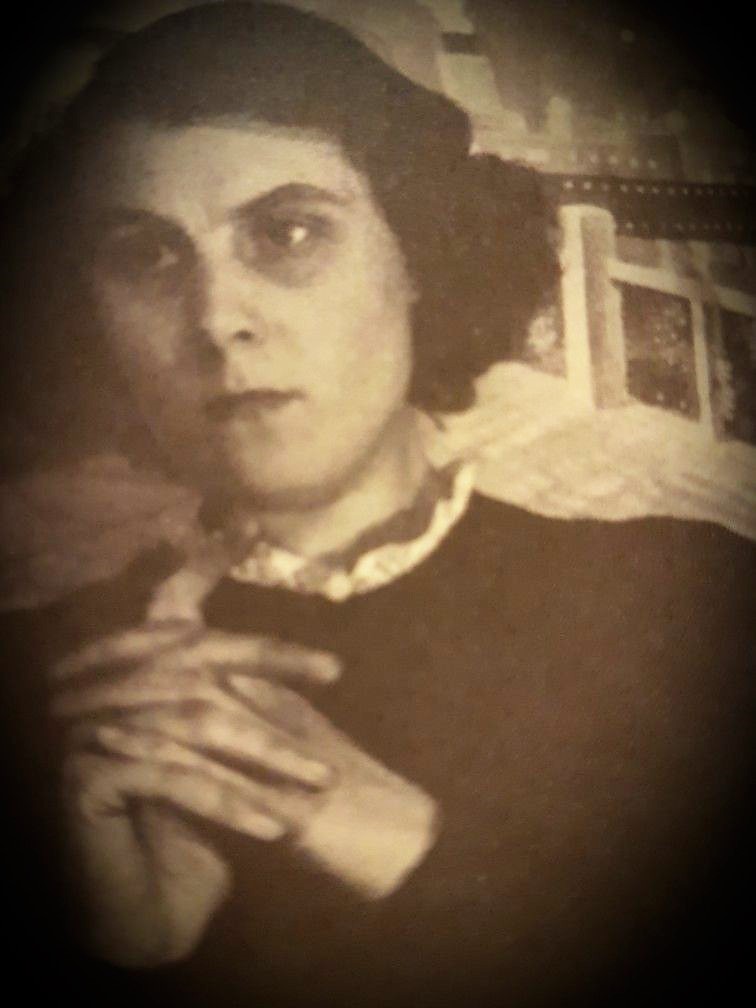
Claudia Guercio

Freedman was an early exponent of auto-lithography working with Harold Curwen from the early 1930’s. Freedman was key in persuading friend Eric Ravilious to try his hand at lithography. Freedman was a key part of the brave pre-WW2 experiment Lithographs for Schools, a series issued by Contemporary Lithographs Ltd.
In 1935, Freedman was commissioned to design a special issue of stamps to celebrate the Silver Jubilee of George V. King George’s Jubilee stamp which would become one of a long 20th century line of everyday collectables.

George V Silver Jubilee Stamps.

Also, in 1936 Freedman was given the task of illustrating George Borrow’s novel Lavengro, commissioned by the Limited Editions Club of New York. The full-page lithographs used in this novel were later repeated on a larger scale for Tolstoy’s War and Peace. Lavengro was an edition of 2,000 and War and Peace 1500 copies making some of Freedman’s finest work highly collectable today at soaring prices !

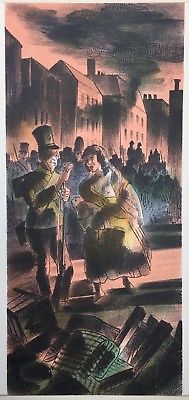
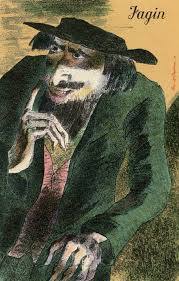
Prior to the war two books occupied Freedman – Henry IV and Oilver Twist. Unfortunately, both were published by American book clubs and therefore not available to the general public.

Illustrations for :- Lavengro, War and Peace, Oliver Twist and Henry IV.

Freedman believed that “the art of book illustration is native to this country … for the British are a literary nation.” He argued that “however good a descriptive text might be, illustrations which go with the writings add reality and significance to our understanding of the scene, for all becomes more vivid to us, and we can, with ease, conjure up the exact environment – it all stands clearly before us.”

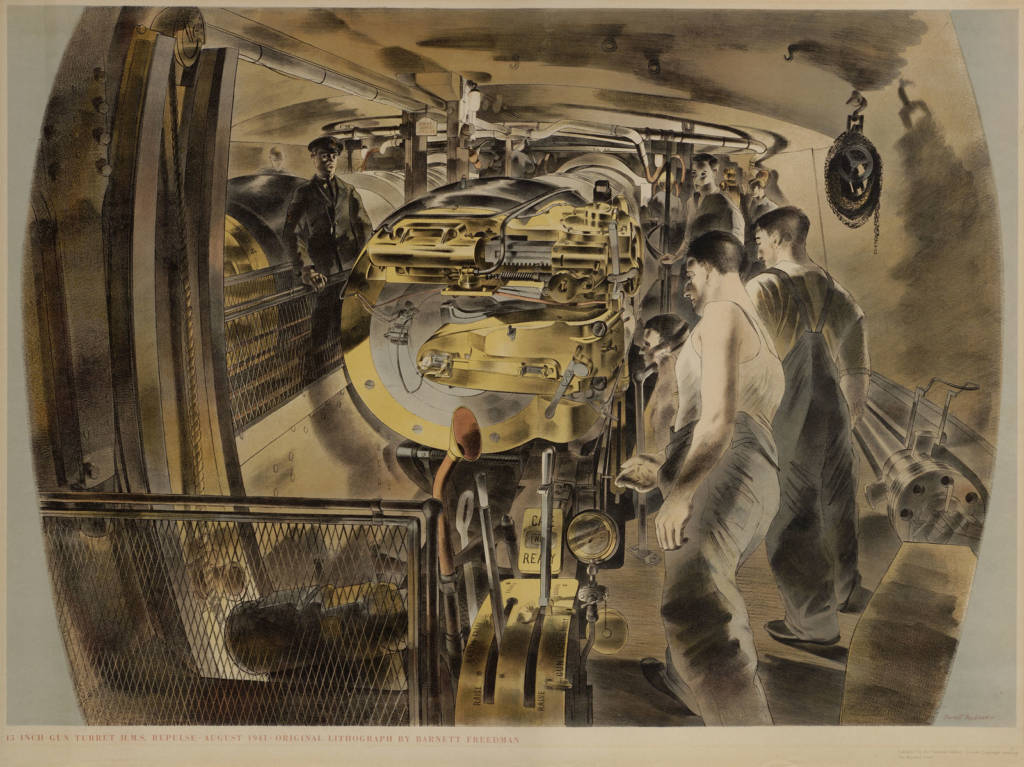
Like Ravilious and Bawden, Barnett Freedman was commissioned as a war artist accompanying the expeditionary force in the spring of 1940, before the retreat at Dunkirk. Returning from France Freedman continued to work for the War Office and the Admiralty, gaining a CBE in 1946.

15-Inch Gun Turret, HMS Repulse, August 1941, Lithograph on paper
Painting on the roof top as a war artist

In post-war Britain lithography became an important tool in bringing art to the people. Prints could be made relatively affordable and available to a wider audience. Freedman was involved with a number of projects including the much-loved Lyons Tea Rooms Lithograph and Guinness Lithograph projects.

Lyons Tea Room: People, 1947, Lithograph on Paper

Sadly, Freedman with his reoccurring health problems died of a heart attack in January 1958 at the age of just fifty-six while working in his studio.

Not as well known as Ravilious and Bawden, Freedman, however, ranks as a major British artist whose work deserves to be more widely known, like his RCA colleagues Freedman bridged the gap between fine art and design. I hope this blog will, in some small way, help to bring his work to a wider audience.

Graham Bennison https://www.facebook.com/BennisonArtist

Helen Binyon 1904-1979

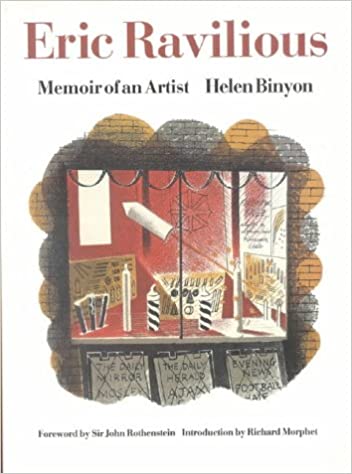
Published in 1983 posthumously, Helen Binyon penned the first extensive biography of Eric Ravilious entitled ’Eric Ravilious Memoir of an Artist. The account of the life and work of Ravilious is detailed, yet nowhere in the 139 pages is there a mention of the fact that they were lovers!

Binyon was born 9th December 1904 at Chelsea in London, she was the daughter of the notable poet and scholar Laurence Binyon. Binyon studied at the Royal College of Art between 1922 and 1926 where she was taught by Paul Nash and her fellow pupils included Edward Bawden, Peggy Angus, Douglas Percy-Bliss, Barnett Freedman, Enid Marx and Eric Ravilious.

Ravilious once remarked that he and Binyon were only really on hat-raising terms at the RCA, Binyon living at home. Sometime around 1930 Binyon had a joint exhibition, with Bawden and Ravilious, at the Redfern Gallery in London.

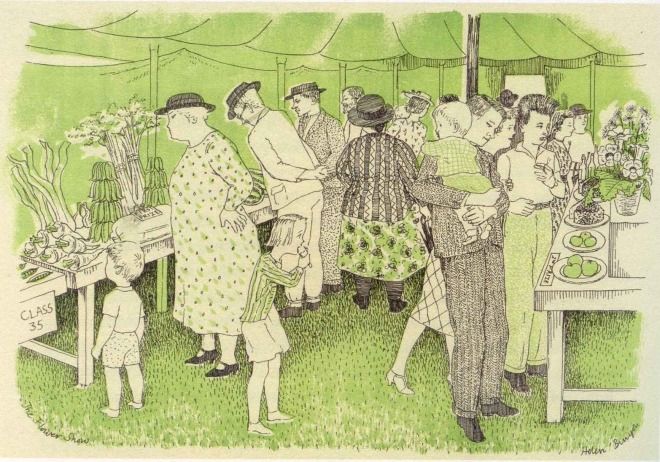
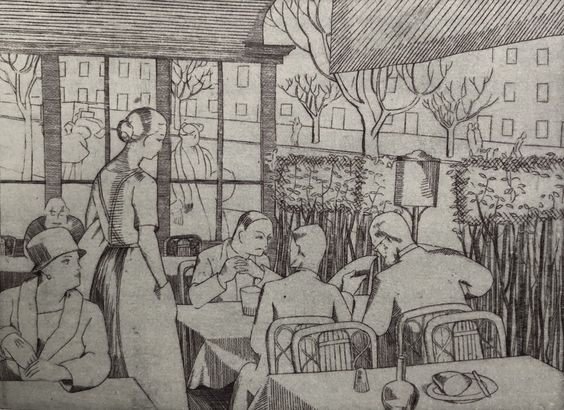
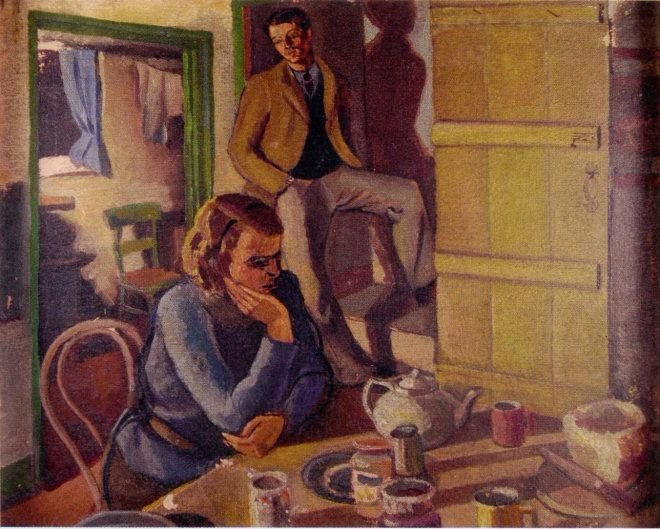
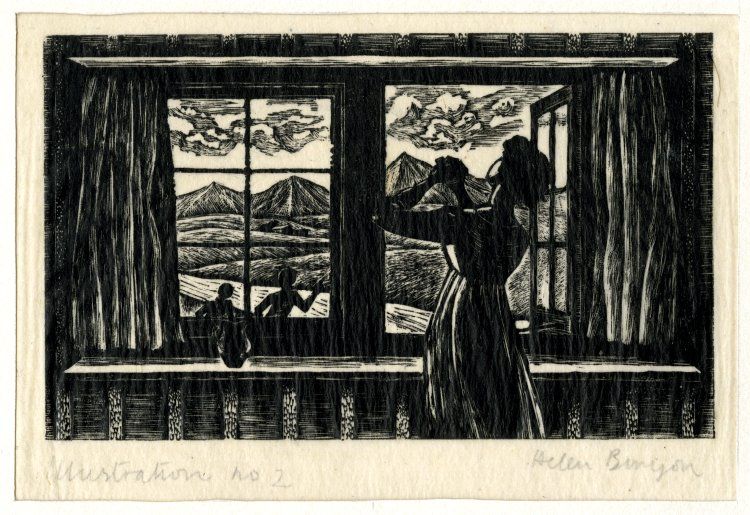
Helen Binyon: Woman Standing at a Window.   The Flower Show.    The Ste Cecile Cafe.

Between 1931 and 1938, Binyon taught part-time at the Eastbourne College of Art and at the North London Collegiate School. With her twin sister, Margaret, Binyon established a travelling puppet theatre, Jiminy. Binyon’s interest in puppetry continued throughout her life and she wrote two books on the subject.

In 1930 Ravilious was married to Tirzah Garwood but had long-lasting affairs with Helen Binyon and with Diana Low, neither of which had any enduring effect on the marriage, and the two women remained close friends with Tirzah.

In 1935 Binyon was a visitor to Peggy Angus’ cottage Furlongs, nestled amongst the hills near Firle in the South Downs. Peggy (known as “Red Angus”) was active in the Artists International Association, and shared these politics with Binyon, with whom she also shared a London flat.

Binyon and REvilious by Peggy Angus

Helen Binyon and Eric Ravilious at Furlongs by Peggy Angus.

Back in her student days, and from a privileged background, Helen had been presented at court. Peggy’s favourite put-down of her was to say: ‘Now Helen, don’t be a lady.’

Extra-marital affairs ‘a la’ the near-by Bloomsbury group were far from unusual amongst the friends and in 1935 Helen and Eric became lovers, a relationship that lasted more than two years during which time Tirzah became pregnant, gave birth to John, and also discovered the affair.

In her fabulous autobiography ‘Long Live Great Bardfield’ Tirzah writes:  ‘He came back to Hedingham late one evening after having been away for about a fortnight and he didn’t appear to want to talk about what he had been doing. I didn’t ask thinking it was because he was tired.  When we woke up in the morning I asked him again and he suddenly turned with such dislike in his voice and said ‘You know very well I’ve been making love to Helen’……….I jumped out of bed and went into the next room to weep and feeling indignant, because the shock had made my baby give such a jump in my inside. Eric was very repentant but still determined to continue making love to Helen’.

‘I knew that under the same circumstances I should in all probability have behaved in the same way and I couldn’t blame Helen for taking him away from me, because Diana [Low] had already done so.’

Diana Mabel Low, born 3rd February 1911. Died 20th May 1975.

Binyon was a talented artist and book illustrator and in 1937 Ravilious recommended Helen as an illustrator for Pride and Prejudice, a series of Penguin Illustrated Classics. On New Year’s Eve 1938 Helen wrote: ‘My Darling I am so excited; I got a letter from Robert Gibbings this morning asking me to do ‘Pride & Prejudice’ – isn’t that lovely. It’s got to be done by the end of March which will be a sweat, sweetie thank you so much for suggesting me’.

One of many illustrations for children’s books by Binyon.  I was fortunate to find a copy of the 1938 Pride and Prejudice on Ebay !

However, late in 1937, the affair was ending as Helen found a new partner in John Nash. Binyon met Nash in 1936 when she and Ravilious were staying with Percy and Lidia Horton at Assington in Suffolk.

Percy-Frederick-Horton-Coates-Corner-Assington-Suffolk

A Corner of Assingham by Percy Horton.

Ronald Blythe a friend of John Nash recalled the easy-going John and Christine Nash morality: ‘They both had affairs – it was a big thing in those days. People didn’t divorce in that generation, they had affairs. There was a tottering stack of letters by John’s chair including letters from Helen Binyon, for anyone to read.  John and Eric Ravilious shared Helen. She was known as Fair Helen’.

During World War II, Binyon worked for the Admiralty drawing hydrographic charts. Later in the conflict she worked on the preparation of photographic exhibitions for the Ministry of Information and served in the ambulance service.

A final meeting between Helen and Eric took place at the beginning of July 1942 seven weeks before Eric’s tragic posting to Iceland in 1942.

Helen recalled: ‘He had been sent to draw at an RNA training station at Westonzoyland, on the Somerset coast……. we walked over the hills outside Bath and had a picnic in a valley near Charlcombe’.

After the War, Binyon taught at the Willesden School of Art and then at the Bath Academy of Art from 1949 to 1965. Binyon is fondly remembered by Bath pupils as a caring, inspirational teacher. In her later years she lived with her sister Margaret in Chichester, where she wrote her memoir.

‘An Outbreak of Talent’ was the expression used by Paul Nash to describe the remarkable collection of artists who studied at the Royal College of Art in 1923/4, when he was employed there as a part-time tutor in the Design School. It is now good to see the lesser known artists in that group and indeed the wider Ravilious/Bawden circle now receiving the recognition they deserve for their talents.

Bibliography: Ravilious & Co: The Pattern of Friendship by Andy Friend. Thames & Hudson, 2017 ISBN      050023955X, 9780500239551

Eric Ravilious: Memoir of an Artist by Helen Binyon. Published by Lutterworth Press (1983) ISBN 10: 0913720429

Long Live Great Bardfield by Tirzah Garwood, Persephone Books. ISBN 9781910263099

Graham Bennison     https://www.facebook.com/BennisonArtist

Please support the Eric Ravilious and Friends Facebook group…….. https://www.facebook.com/groups/488249232182567

Eric Ravilious and Furlongs.

Furlongs cottage is situated in the South Downs near to West Firle. I visited the cottage in May 2018.

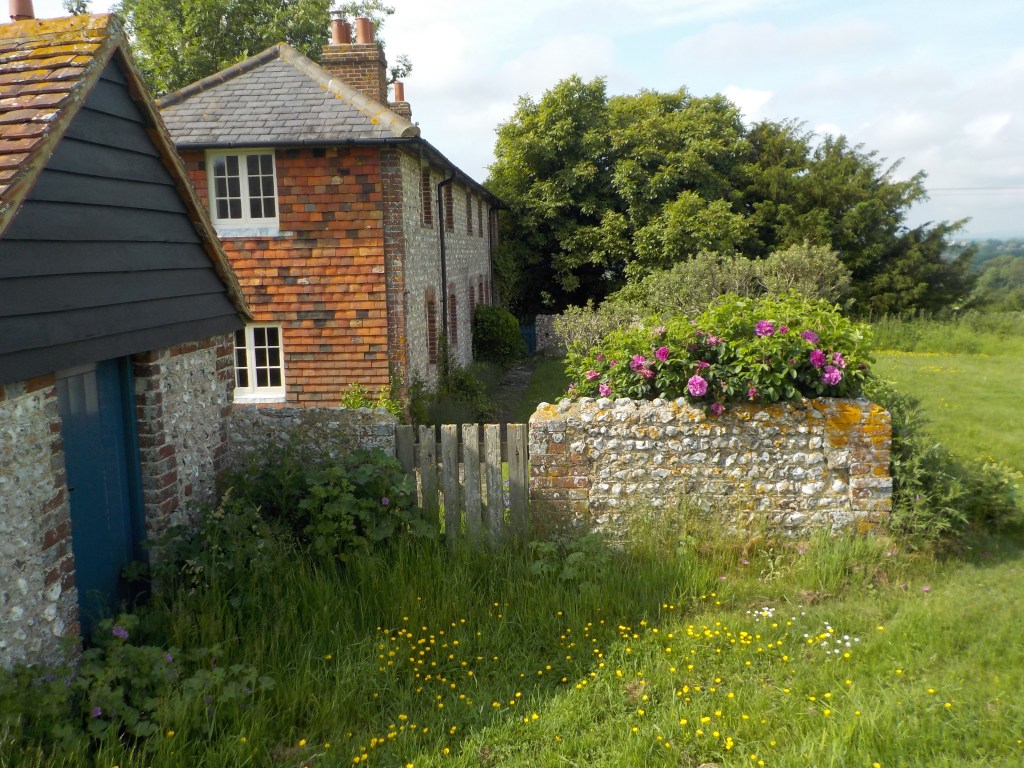
Artist Peggy Angus found the cottage in 1933 and rented one end of the building. Eric Ravilious first visited Furlong’s at Peggy’s invitation in February 1934 spending four days there before returning home to Brick House, Great Bardfield, Essex, He was full of ideas for watercolours he wanted to paint amongst the Downs.  Furlongs was somewhat ‘Spartan’ – downstairs a dining room, a sitting room and a scullery and two bedrooms upstairs.

Downs in Winter

Eric returned with wife Tirzah in the spring of 1934. Tirzah remarked: “To fetch water we had to wind  a well handle in the well house across the farmyard 95 times because the well was 90-odd feet deep. When the bucket eventually came up, it was leaking very fast so you had to pour it quickly into the  pails before it had all run away again….” Despite the discomforts Eric and Tirzah fell in love with the place.

Peggy and Eric shared many painting trips around the locality and that winter one day, with Peggy painting a view back down the road to Furlongs cottage, Eric painted ‘The Downs in Winter.’

The two also painted a number of paintings of the nearby Asham Cement Works.

‘Dolly Engine’. Eric Ravilious.          ‘Asham cement Works’. Peggy Angus.

Eric and Peggy would regularly disappear together up the hill towards the Works as noted by Tirzah’s father Colonel Garwood who referred to Peggy as a ‘Bolshie woman’ and ‘the Red Angus’ in his diary.

It was also in 1934 that another visitor to Furlongs, Helen Binyon started a close friendship with Eric. She and Eric fell very much in love. and Eric would visit Furlongs to stay with Helen and Peggy.

Helen Binyon described the route to Furlongs:“They continued, along a narrowing tree-lined lane, until they reached an open field, with the swelling slopes of the chalk Downs beyond P, their rounded tops bare against the sky. They turned to the right, along a deeply rutted track, past a little copse, over which towered the wheel of a creaking wind pump; on its vane the mysterious word ‘DANDO’. Ahead and still some way off, they saw the cottage.”

Binyon and REvilious by Peggy Angus

Helen Binyon and Eric Ravilious by Peggy Angus.    1934 at Furlongs.

Artist Percy Horton was yet another regular visitor to Furlongs. He and Eric were both musical as was Peggy and the evenings would be full of songs singing around the sitting room fire made with sticks and branches gathered from the local wood. With no electricity an oil lamp would light the proceedings.

Eric and Tirzah moved from Great Bardfield in 1934 to Castle Hedingham in Essex and the following June 1934 Tirzah’s baby John was born. Eric’s trips to Furlong continued however, and his love affair with Helen continued until 1937 when the affair cooled as Helen commenced an affair with artist John Nash.  Meanwhile Tirzah had fallen in love with artist John Aldridge!  A final meeting between Helen and Eric was seven weeks before Eric’s tragic posting to Iceland in 1942.

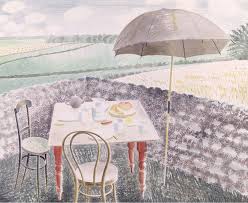
Four of Ravilious’ best known paintings were produced during this period.  A pre-war visit to Furlongs in 1939 resulted in the water-colour ‘Tea at Furlongs’.

Peggy had married Jim Richards in 1936 and in 1939 found herself at Furlongs with  one baby and pregnant with another.  Eric was there to help while Tirzah was in Eastbourne herself pregnant with James. In the dead of a summer’s night Peggy felt the baby coming and dispatched Eric to bring Mrs Spikes, a mother of five camping in the nearby field. Eric then had to go to the phone box in Glynde to call the local doctor who knowing the cottage well  refused to come.  The doctor advised Eric to take Peggy to a nursing home in Lewes but Eric couldn’t drive and there was no  car.  Eric aroused Mr Lusted of the Trevor Arms and he agreed  under protest to transport them both to the hospital in Eastbourne where Angus was born.

Peggy Angus.    The Cart Track to Furlongs.  Angus and Victoria at breakfast.   The Three Bears.  Portrait of Jim Richards.

Following the war Peggy divorced then living in Camden during her teaching years. She returned to Furlongs dividing her time between the cottage and London. She died in 1993 aged 89 and the cottage returned to the Glynde Estate.

Graham Bennison.      https://www.facebook.com/BennisonArtist

Eric Ravilious in Fife and Dundee

In October 1941 Ravilious’ work as a war artist took him to Fife where he lodged with John and Christine Nash at Crombie Point Cottage near Dunfermline.

On the  20th October he wrote to his wife Tirzah: I was so pleased to find your letters and the parcel (most welcome to Christine) when I came home today from my ship….I’m glad Ironbridge is warming up for the Essex winter………Christine has just gone off to London and possibly Wiston so may perhaps see you. She is a wonderful person in any house, and gets us all up with tea in the morning and a splendid breakfast then lights my fire if I work at home and she goes off to Dunfermline for beer and cigarettes. What more could you want?

John and Chrstine Nash John and Christine Nash.
On the 17th November 1941 Eric wrote to Tirzah from John and Christine Nash’s cottage at Crombie Point, near Rosyth.

My darling Tush,

John had a late night on one of his expeditions so here is a letter while he is dressing, or rather splashing in that cold bath. I must say there is a lot to be said for it and now I have them in the mornings too, and after it no Scotch cold affects you – of course Christine comes in early with tea and then makes a roaring bedroom fire. John is blowing like a whale. I’ve bought the thickest pants they had in Greenoch for 18/6 and find that it does help the seascape painter’s gout a bit, and the General’s leather coat helps too. It is a splendid thing to have. I shall be going off to Dundee for a week on Friday or Saturday but, write here and they will send the letters on, and I might ring you up from there……….      

 All my love Eric.

Presumably ‘Greenoch’ is Greenock ?

John Nash, no longer a war artist, was now on the Commander in Chiefs staff at Rosyth.  Nash told Eric that he would find good subjects to paint in the east ports of Scotland.  Eric had sailed past them and under the Forth Bridge  when on his way to Norway.

Ravilious Forth
Ravilious Fortth 2

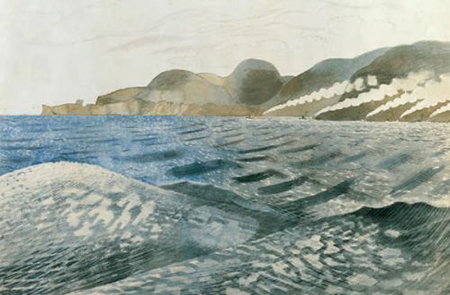
Channel Fisher, painted at the Firth of Forth 1941    Study.  ‘The Firth of Forth’, circa 1940–41.

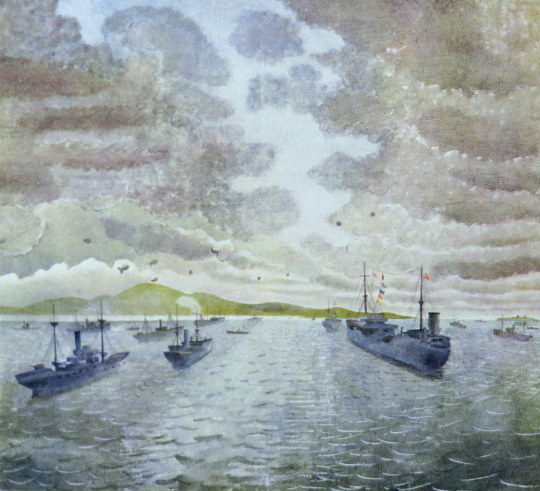
Convoy From a Merchant Ship at Anchor, c.1942.’ The convoy is anchored in Leven bay, near Methil.  Just 11 miles down from my tiny hamlet in North East Fife is the once thriving port of Methil. Methil Docks, was the largest coal port in Scotland, particularly significant during World War II for the movement of coal and other resources. The docks had a hydraulic power station serving the distinctive coal hoists, all of which were once local landmarks. The second work is ‘Convoy in Port, Methil.’ Manchester Art Gallery..

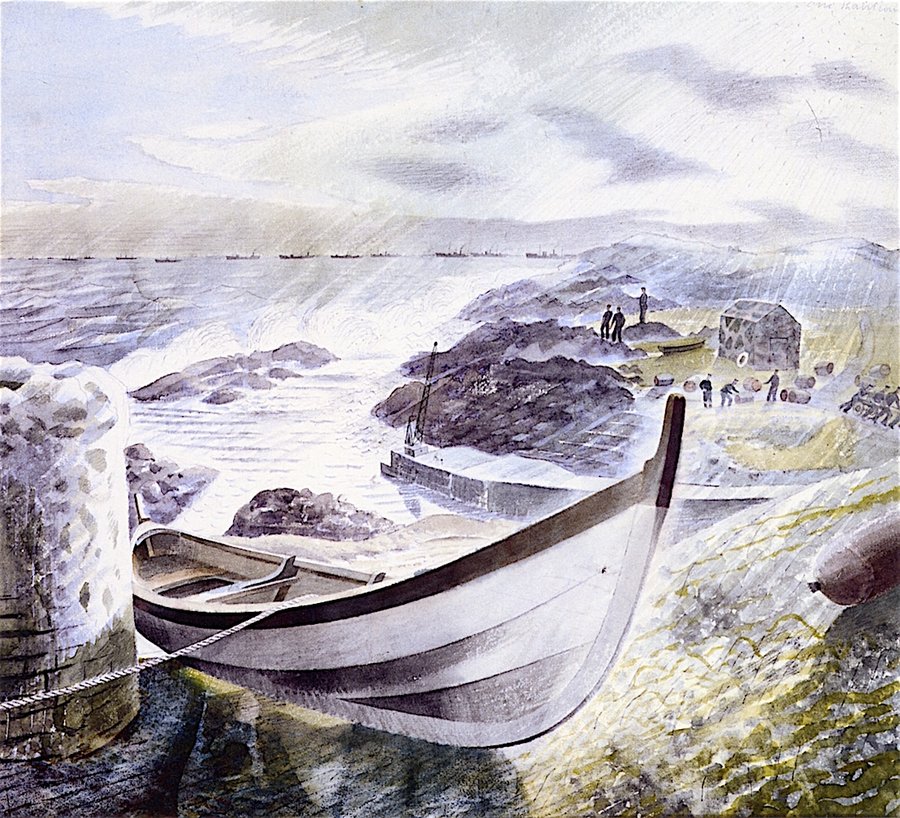
Ravilious enjoyed being taken around by John and staying with them. He had visits to draw the Rosyth docks and the Forth Bridge. He was also able to visit the Isle of May and other islands in the Forth Estuary.  From R.N. Signal Station on the Isle of May he wrote to Tirzah:

I’ve landed her by way of a destroyer – and an RAF launch – and am now living with this small naval mess, five officers and a few ratings. They are all very nice people.  The island is rocky and rolling and wild, in peacetime a bird sanctuary. Hooded crows and golden-crested wrens are about; I wish you could see the island. You would love it. There is the oldest beacon – 1636 – in the centre (you light a fire on the roof of a thing like a large dovecot) and the turf is just like a pile carpet. They took me to the lighthouse lantern this morning. I’ve just been entranced with the place all day and explored without working so must have an early bed (one game of darts) and work early tomorrow.

Ravilious Isle of May

Storm, Isle of May. 1941.

Ravilious convoy passing

“Convoy Passing an Island” 1941 (painted on the Firth of Forth).

Ravilious stayed longer at an R.N.A. station in Dundee. Ravilious wrote to Edward Dickey (Ministry of Information):

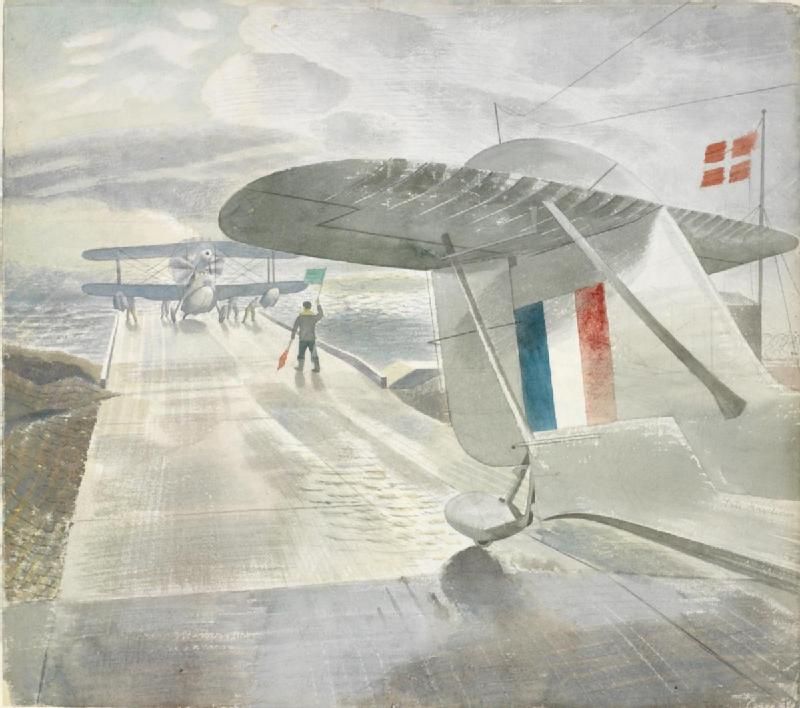
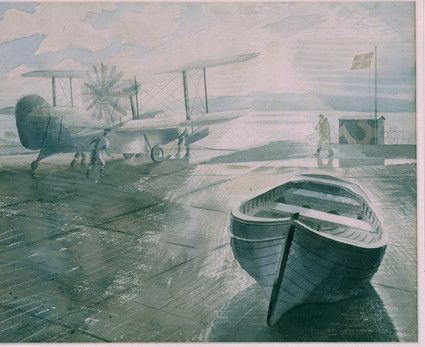
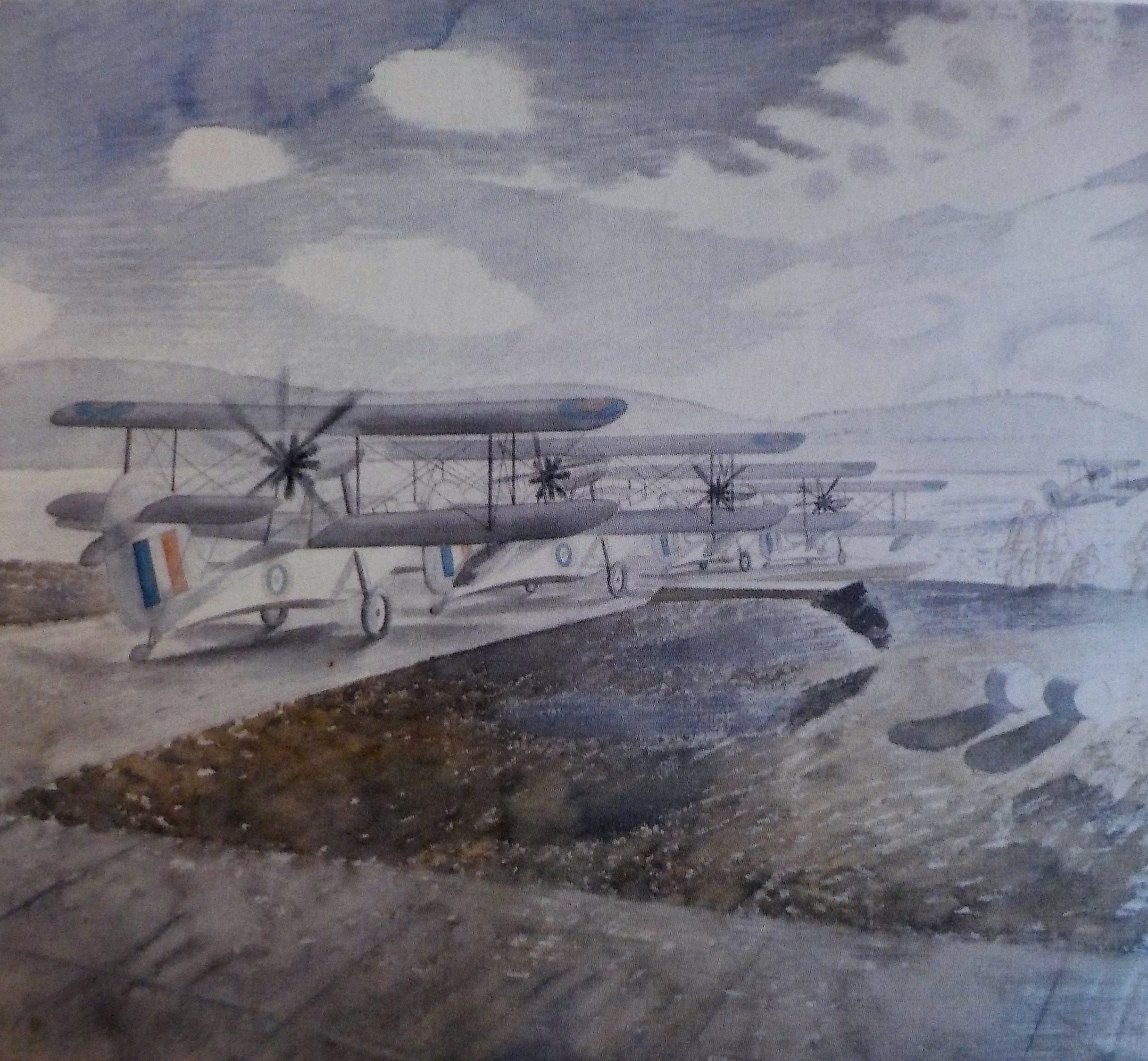
This is an excellent place for work, The address a Fleet Air Arm mess. I spend my time drawing seaplanes and now and again they take me up; this morning rather uncomfortably in the tail, but it was worth it for the view. I do very much enjoy drawing these queer flying machines and hope to produce a set of aircraft paintings.  I hope Paul N hasn’t already painted Walrus’s – what I like about them is that they are comic things with a strong personality like a dusk, and designed to go slow.  You put your head out of the window and it is no more windy than a train.

Ravilious Sick Bay, Dundee

 RNAS Sick Bay, Dundee, 1941.

RNAS Sick Bay, Dundee is probably the best known work from ER’s time in Dundee. On the 12th December 1941 he wrote to Margaret Pilkington (Secretary of the Society of Wood Engravers): I’m busy drawing sea planes at the moment after a few weeks work at convoys and merchant ships, and it is a pleasant change. Walruses are particularly nice aircraft and very pleasant to fly in, as a passenger only of course. The daylight hours get less and less in Dundee but the weather is very good……

These planes and pilots are the best things I come across since the job began. They are sweet and have no nonsense (naval traditional nonsense and animal pride): they help in all sorts of ways and take me up when they can. I must say it is most enjoyable….. it is a joke dressing up with flying suit, parachute, Mae West and all and climbing in over the nose. Sometime this week they promise a trip in the rear gunner’s cockpit which is uncomfortable but has the best view: the only drawback is that I have to do a number of simple (?) mechanical things with hatches when the sea-plane comes down on the water. How trusting they are !

Ravilious Walrus aircraft on the slipway 1941
Raviious Walrus and dinghy. 1941

Walrus and dinghy. 1941.

Ravilious stayed at Mayfield House off the Arbroath Road. Mayfield House was gifted to the Dundee Teacher Training College by Sir William and Lady Ogilvy Dalgleish and was opened in 1912 as a hall of residence for female students. The hall was extended in 1932 and 1963 allowing it to house students of both sexes. The building has since been demolished and the site developed as a housing scheme.

Letter to Helen Binyon from Mayfield Hostel, Ferry Road, Dundee.  3rd December 1941.

My Dear Helen……………This is a very good place.  I work hard every day in the Scotch mists drawing planes and live in this naval air station mess, once a girl’s school and now HMS something and of course afloat.  Wrens liven the scene and bring in cups of tea at 7.30 – mine even stirs the tea to save me having to bother with the spoon……..  John is away for a few days.  Christine said he gets leave in January.  I shall go home for Christmas if possible because Tirzah and the whole family have the whooping cough.,,,,,,,,,, All my love and many happy returns of the 9th.

Afternoon programme

‘Afternoon Programme’ was painted while staying at Mayfield House. December 1941.

On the 27th August 1942 Ravilious wrote a postcard to Tirzah from Prestwick.  It is calm and fine here with no wind and I hope very much we go tomorrow.  They did…to Iceland on the 28th.  On the 2nd September the air sea rescue mission failed to return Missing, presumed dead.

Graham Bennison, 15th May 2020.            https://www.facebook.com/BennisonArtist

Painted on the reverse of ‘The Firth of Forth’, circa 1940–41.  BUT further research has revealed this is in fact Scapa Flo, unfinished 1940, so not the Forth.

Back Latch Cottage, Ceres. George Leslie Hunter and William Meldrum.

DSCN0156_edited

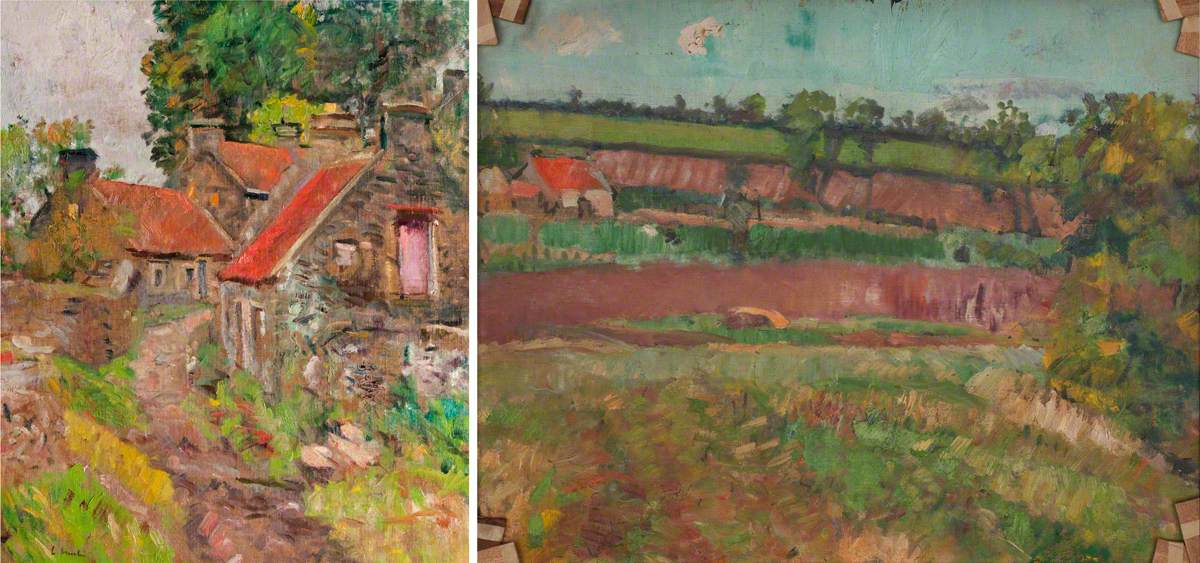
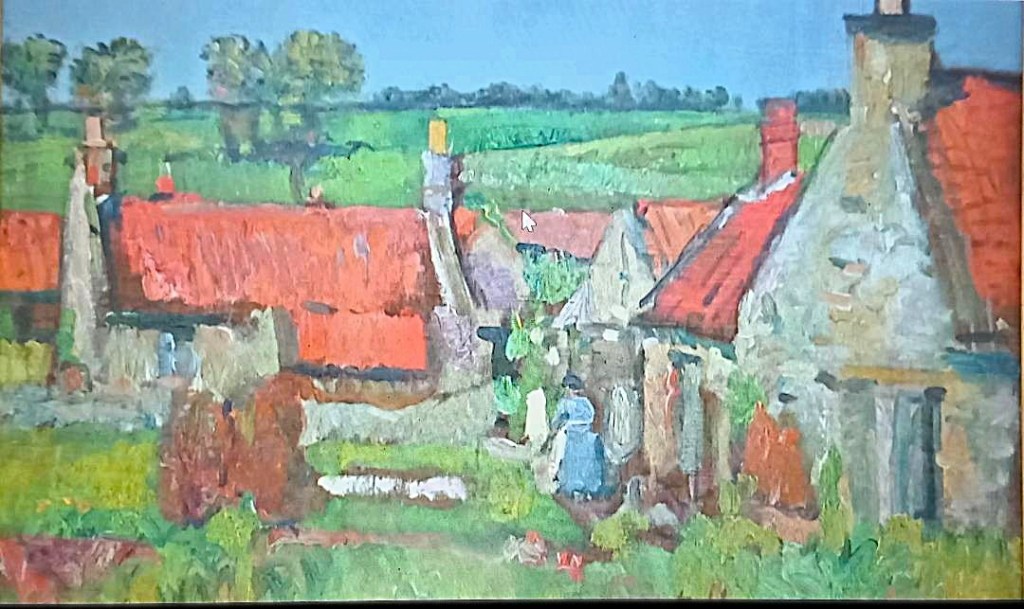
Red Roof Cottages. George Leslie Hunter.

DSCN0153_edited

Back Latch Cottage. William Meldrum.

George Leslie Hunter (7 August 1877 – 7 December 1931) was a Scottish painter, regarded as one of the four artists of the Scottish Colourists group of painters. After the Fist World War, Hunter painted regularly in Fife – Lower Largo and Ceres were favourite places to paint.

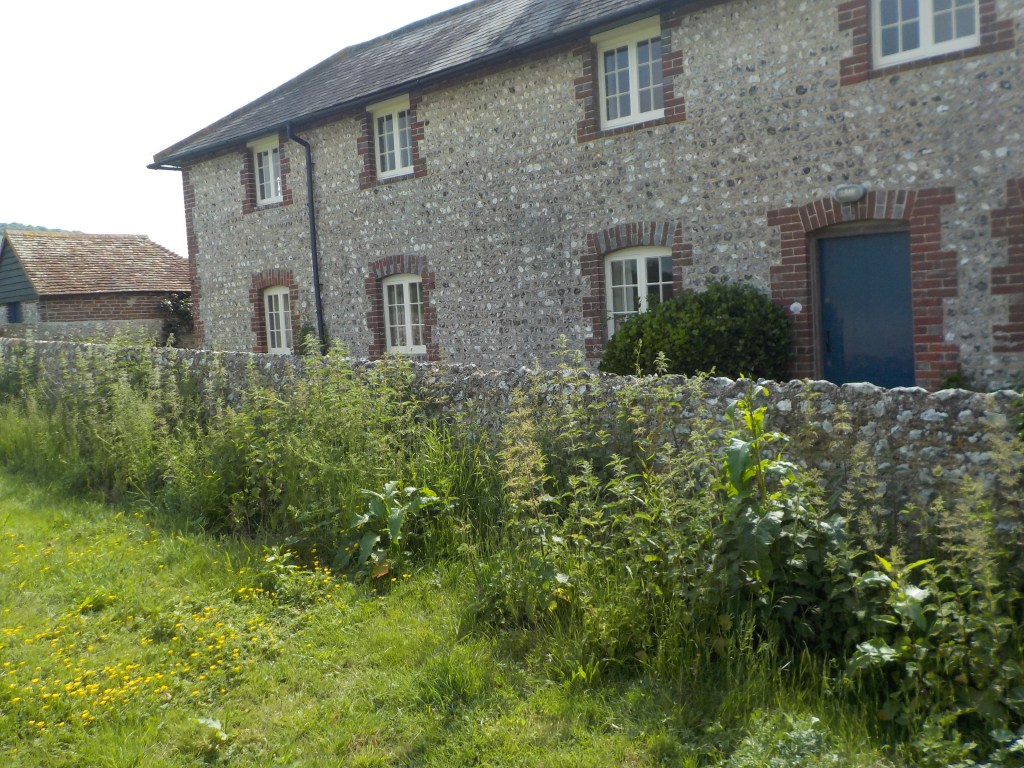
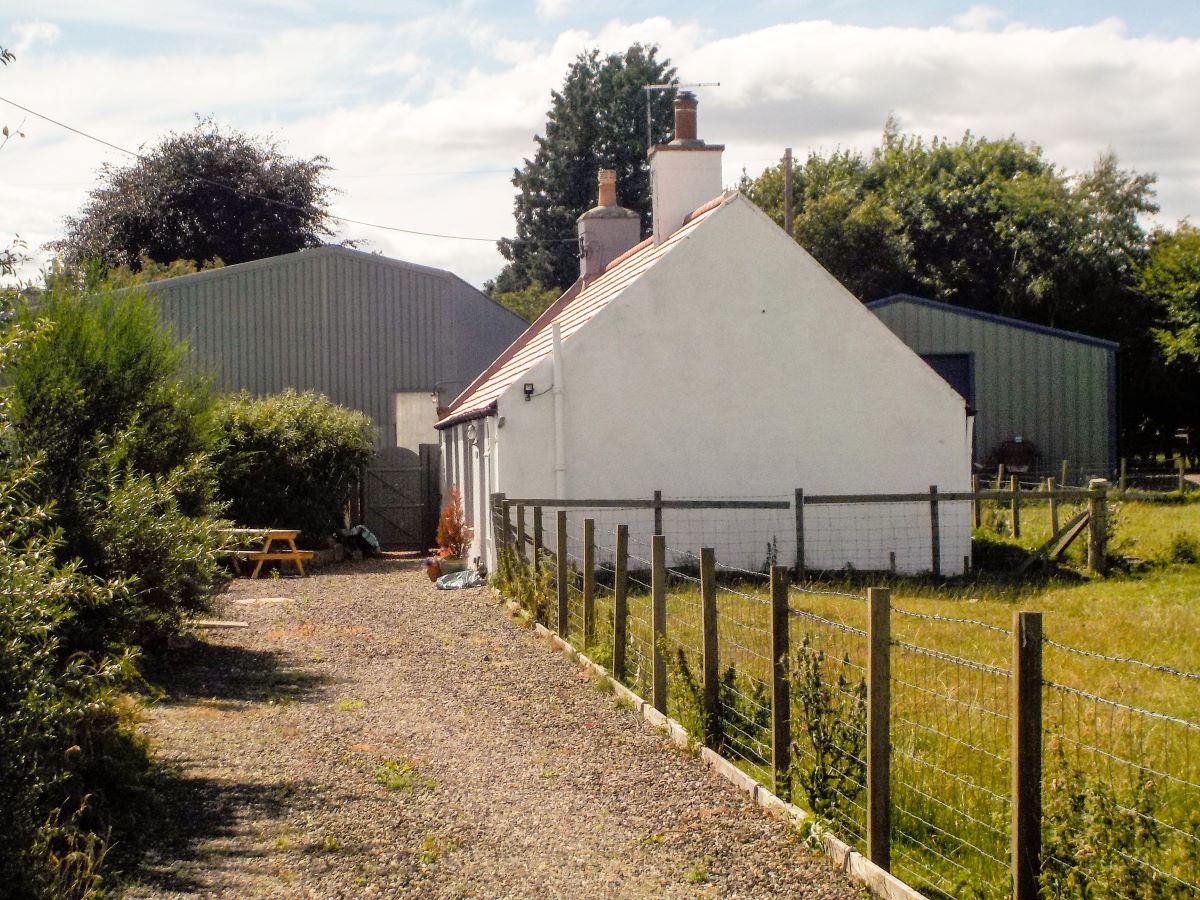
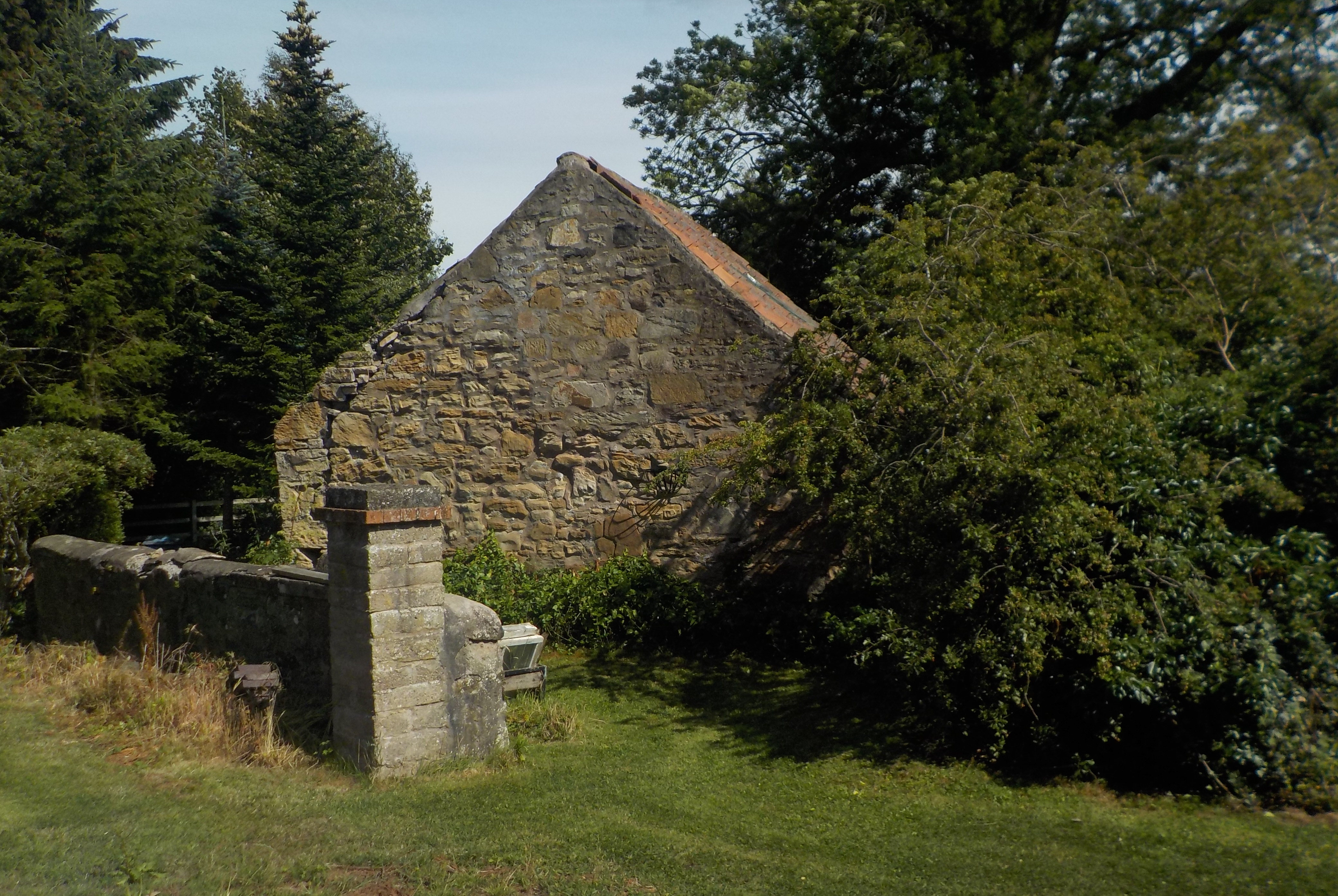
The Meldrum family owned land and property in Ceres and with Glasgow artist William Meldrum (1865–1942 ) the two artists rented Back Latch cottage in Ceres owned by Meldrum’s father. Hunter stayed in Ceres in May and November 1920 and also the summer of 1921. The paintings of Latch Cottage show the view from the main road, obscured by foliage now and also the small engineering works building. The cottage now viewed from the east end.

DSCN0155_edited

This painting by Graham Bennison from 1998 shows much less change. Close to Latch Cottage is the Old Mill which can be seen in the Hunterian Gallery, University of Glasgow.  The painting on the right is on the reverse of the panel.

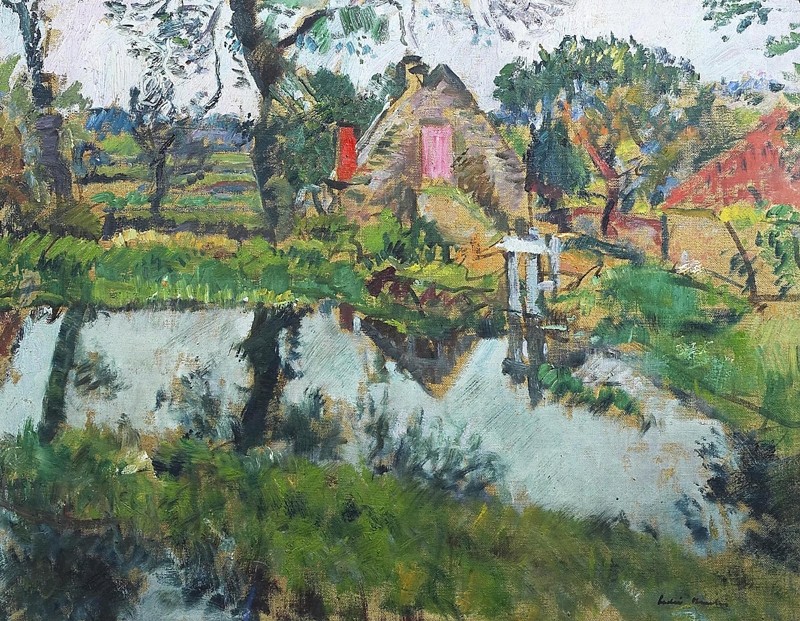
Hunter, George Leslie, 1879-1931; Ceres Mill, Fife (recto), Fife Landscape (verso)

DSCN0150_edited

The Old Mill today.

The Ceres Burn winds its way to Pitscottie behind Wellwood House on the main road.  A new residence further back is taking shape on the site of one of Hunter’s favourite sites to paint.  With the new building taking over and the pond long gone it would now be difficult to recognise ‘The Old Mill, Fife’.  Hunter produced a number of paintings of this view.

George Leslie HUnter. Old Mill

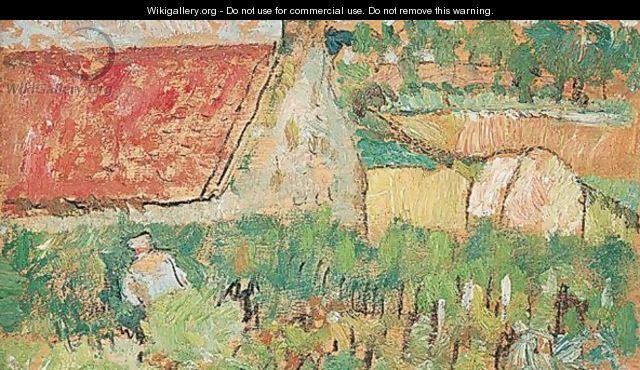
Below just a few of the many paintings of Ceres by Hunter.

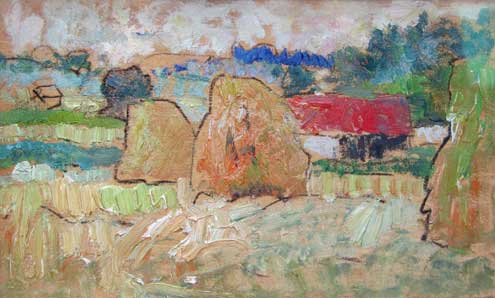
Ceres haystacks George Leslie Hunter

Ceres Haystacks.

George Leslie HUnter. Ceres.

As shown on BBC Antiques Roadshow from Hill of Tarvit 28th Dec. 2025.

Ceres.

George Leslie HUnter. Ceres..jpg pencil

Unfinished sketch.

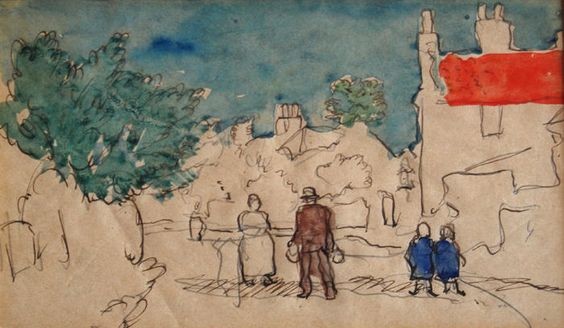
George Leslie Hunter. Cottages, Ceres.

Cottages, Ceres.

George Leslie Hunter. Old Man Clipping hedge.

Old Man Clipping Hedge, Ceres.

Old Mill Ceres by Hunter

Another painting of The Old Mill, Ceres.

Graham Bennison.  July 2018. https://www.facebook.com/BennisonArtist